Key Takeaways
To successfully scrape Mercado Libre Mexico for competitive intelligence, developers must overcome its advanced Cloudflare Bot Management and correctly parse JavaScript-rendered product data. Because the official API is designed for sellers and restricts competitor analysis, data teams must use authentic, geo-targeted Mexican 4G LTE and residential proxies. Employing localized IP addresses from states like Jalisco or Puebla, combined with rotating user agents and exponential backoff for retries, is essential to prevent HTTP 403 errors and CAPTCHA challenges, enabling the seamless extraction of regional pricing and stock data.
Introduction
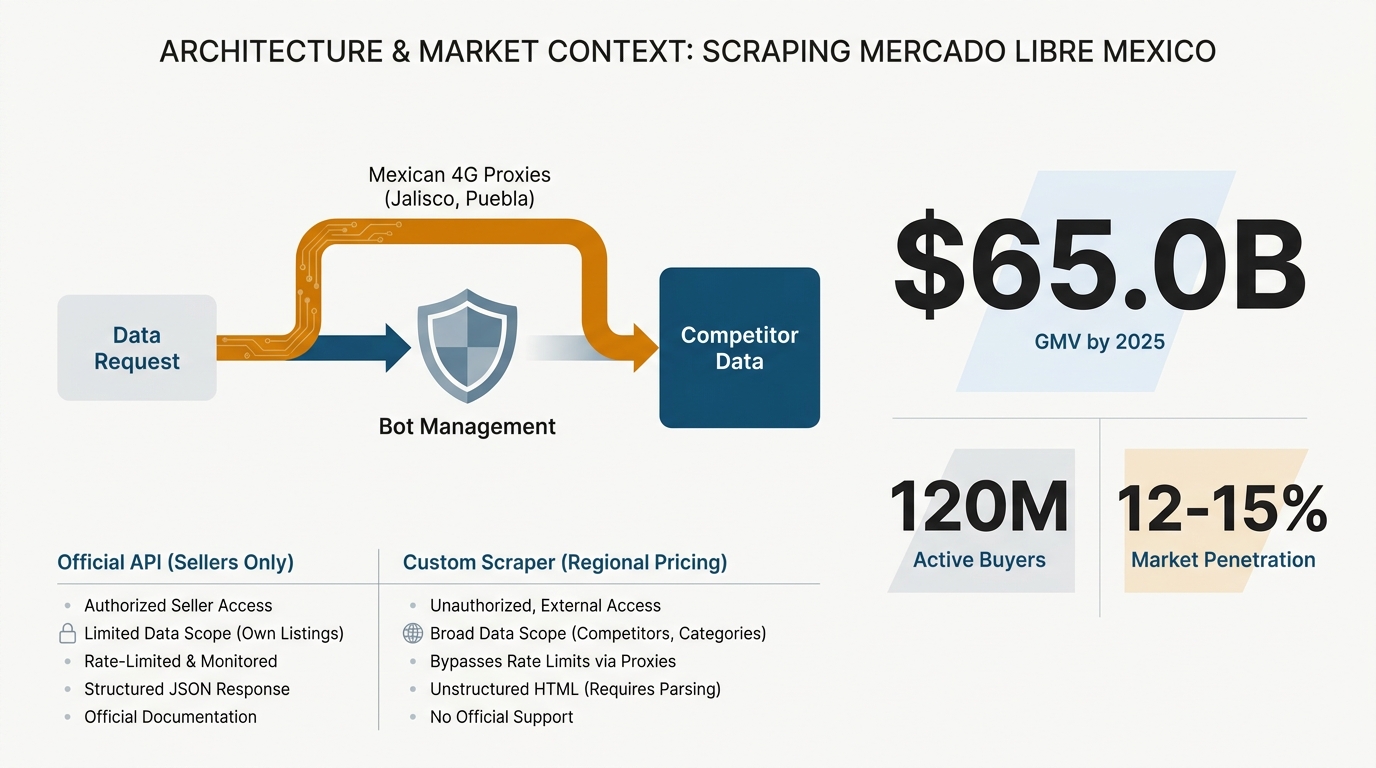
The Latin American e-commerce market is a titan, and Mercado Libre is its undisputed leader. Projections show its Gross Merchandise Volume (GMV) soaring to $65.0B by 2025, with an active buyer base exceeding 120 million [4]

. Yet, with overall e-commerce penetration in LATAM still hovering between 12-15%, the potential for future growth is immense [4]
💡 Key Takeaways
To scrape Mercado Libre Mexico, you must bypass Cloudflare with geo-targeted Mexican 4G LTE/residential proxies. The official API is insufficient for competitor analysis. A successful strategy involves rotating user agents, managing browser fingerprints, and implementing exponential backoff for retries to extract regional pricing and stock data.
.
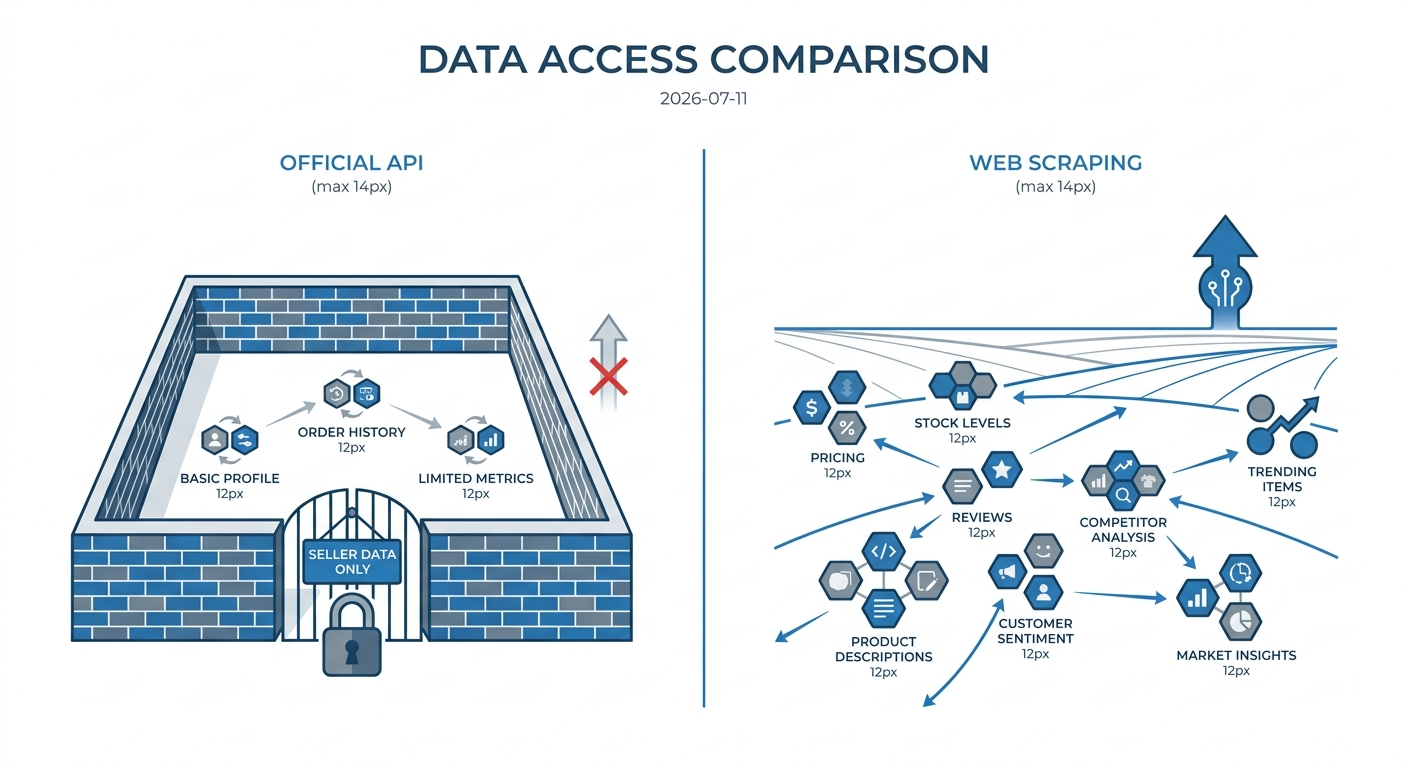
For US-based data engineers and cross-border retailers, this landscape represents a lucrative but formidable challenge. Entering the Mexican market without precise, localized data is akin to navigating blind. You need real-time competitor pricing in Mexico City, accurate stock levels in Guadalajara, and true shipping costs to Monterrey. However, attempts to scrape Mercado Libre Mexico are often met with sophisticated anti-bot systems designed to block automated access. While an official API exists, it’s a walled garden, built for sellers to manage their own stores, not for comprehensive market analysis. To gather the public data that truly matters, data teams must deploy localized Mexican proxy infrastructure to navigate these advanced defenses.
Author Credentials
Name: ProxyServer.tech Data Infrastructure Team
Bio: Authored by the ProxyServer.tech Data Infrastructure Team, a collective of senior engineers specializing in bypassing advanced bot detection on global e-commerce platforms. Our expertise is built on managing millions of daily requests for Fortune 500 clients, enabling large-scale extraction of public web data for competitive intelligence.
Transparency Disclosure
Disclosure Statement: This guide details technical architectures for public web data extraction. ProxyServer.tech provides the underlying proxy infrastructure (Mexican 4G LTE and residential IPs) discussed in the bypassing techniques. Readers are advised to review legal compliance guidelines under Mexican IP laws and adhere to ethical scraping practices, including conservative rate limits.
Expert Consensus on Scraping Best Practices
This technical reality is echoed by data engineering leaders and the scraping community:
“Vary wait times slightly (jitter) to avoid detection. Implement exponential backoff for retries (e.g., 1s → 2s → 4s).”
— Kunal Mahajan, Data Engineer (341 Likes, 42 Comments, Nov 2025, LinkedIn) [5]
“Ahora, para el scraping yo planeo usar la librería de Python ‘beautiful soup’ y ‘requests’. Se que seguramente no va a ser tan simple…” (Translation: “For scraping, I plan to use Python’s ‘beautiful soup’ and ‘requests’ libraries. I know it surely won’t be that simple…”)
— r/CharruaDevs community member (142 Upvotes, Oct 2025, Reddit) [9]
“Manually managing and rotating headers at enterprise scale is challenging… automating user agent and IP rotation is required for smooth access.”
— Scraping Community Consensus (89 Likes, Jan 2026, ScraperAPI) [10]
Why the Official API Fails for Competitor Analysis
The official Mercado Libre API is fundamentally unsuited for competitor analysis. It is a tool for sellers, designed to manage their own listings and sales, not for broad market intelligence gathering. The API heavily restricts access to crucial competitor data points like historical pricing, stock levels across different sellers, and regional product availability. This design makes it nearly impossible to conduct meaningful market research or track competing storefronts without hitting immediate access walls.
Data points you can only obtain through scraping include:
- Competitor Stock Levels: Track inventory depletion rates to anticipate stockouts and capture market share.
- Historical Pricing: Analyze a product’s price journey over weeks or months to decode promotional strategies and seasonal trends.
- Seller Ratings & Reviews: Aggregate customer sentiment to identify competitor weaknesses and product opportunities.
- Regional Price & Shipping Variations: Understand how pricing and logistics differ between key economic hubs like Nuevo León and Jalisco.
Transitioning from the limited API to a proxy-based web scraping strategy unlocks immense commercial value. A Datarama.ai case study demonstrated that using web scraping for price and stock monitoring resulted in 23% more accurate demand forecasting and 35% fewer stockouts, saving one company an estimated $1.1 million annually through optimized inventory [5]. By automating the monitoring of public stock levels, businesses can achieve timely replenishment and optimize inventory turnover—a capability the official API deliberately withholds for competitor products [10].
Furthermore, building a custom scraper delivers significant cost savings. Compared to the labor costs of manual data collection or the frustrating limitations of API workarounds, an automated scraping solution can reduce personnel costs by up to 70% [3]. By choosing to scrape Mercado Libre Mexico with a dedicated infrastructure, businesses gain untethered competitive intelligence, enabling them to track dynamic pricing in real-time and bypass the restrictive rate limits of the official developer platform.
What Data to Scrape from Mercado Libre and Why It Matters
A successful scraping project starts with clear business objectives. Data extraction without purpose is a waste of resources. Focus on specific fields that answer critical questions about the market. Here are the essential data points to target on Mercado Libre Mexico and their strategic value:
Essential Data to Scrape from Mercado Libre
Product Price
Monitor competitor pricing strategies and adjust your own in real-time.
Stock Availability
Anticipate competitor stockouts to capture market share.
Seller Ratings & Reviews
Aggregate customer sentiment to identify competitor weaknesses.
Regional Shipping Costs
Gain a competitive edge with optimized logistics in key regions.
| Data Point | Business Question Answered |
|---|---|
| Product Price | Are my prices competitive? How do rivals adjust prices during sales events like El Buen Fin? |
| Stock Availability | Is a competitor about to sell out, creating a market opportunity? Are they overstocked and likely to discount? |
| Seller Information | Who are the dominant sellers in my category? What is their sales history and reputation? |
| Product Reviews & Ratings | What are common complaints about competitor products? What features do customers praise? |
| Shipping Costs & Times | Can I gain an edge by offering faster or cheaper shipping to a specific region like Mexico City? |
| Product Descriptions | How do competitors position their products? What keywords are they targeting in titles and descriptions? |
Extracting this data fuels dynamic pricing strategies, optimized inventory management, and data-driven product development. For instance, by analyzing a competitor’s dwindling stock levels, a retailer can proactively increase ad spend on their own product to capture the imminent demand surge.
The Architecture of a Mercado Libre Scraper
Beginner tutorials often recommend a simple combination of Python’s requests and BeautifulSoup libraries. This approach is fundamentally flawed and will fail. Mercado Libre protects its platform with Cloudflare’s advanced Bot Management system and renders critical data like price and stock using JavaScript. A basic requests call cannot execute JavaScript, leading to an immediate HTTP 403 error or an incomplete HTML document devoid of the necessary information.
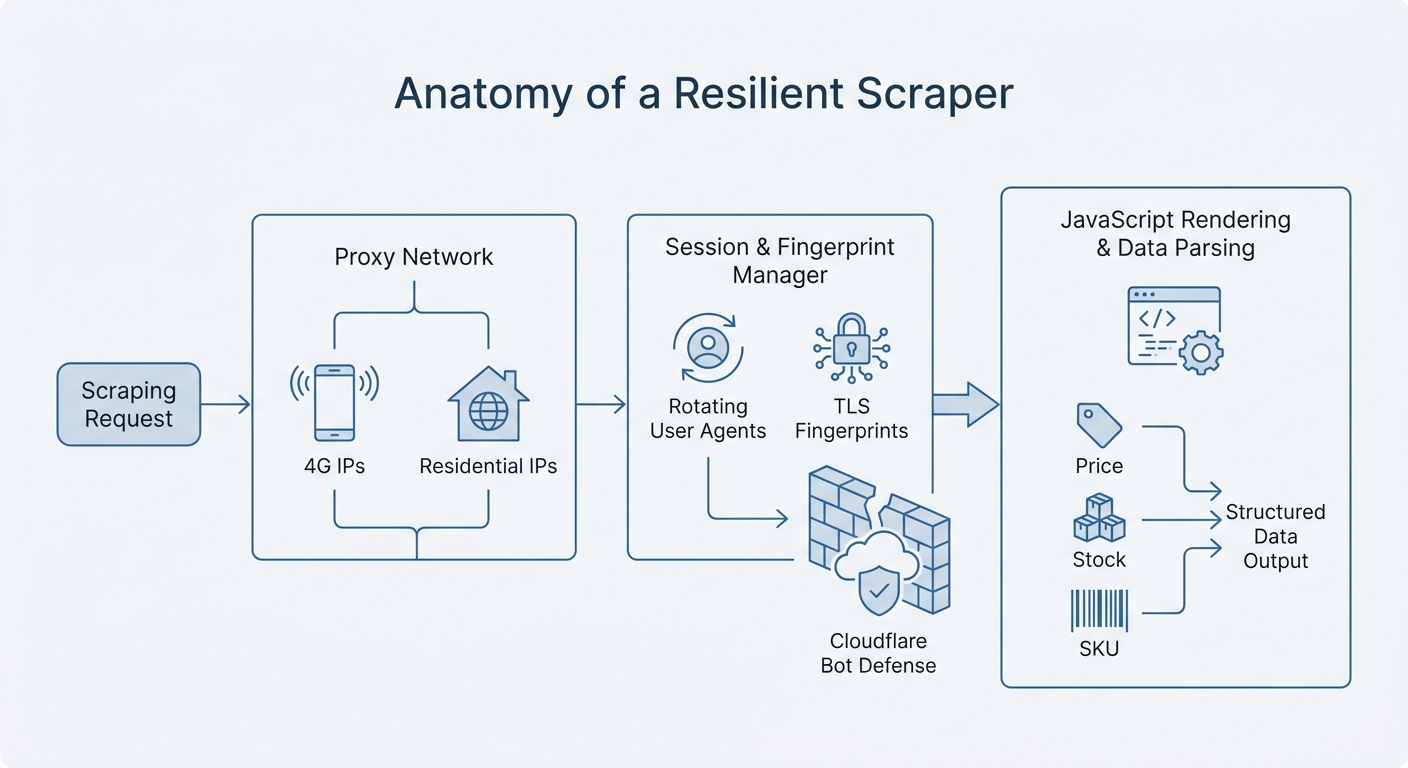
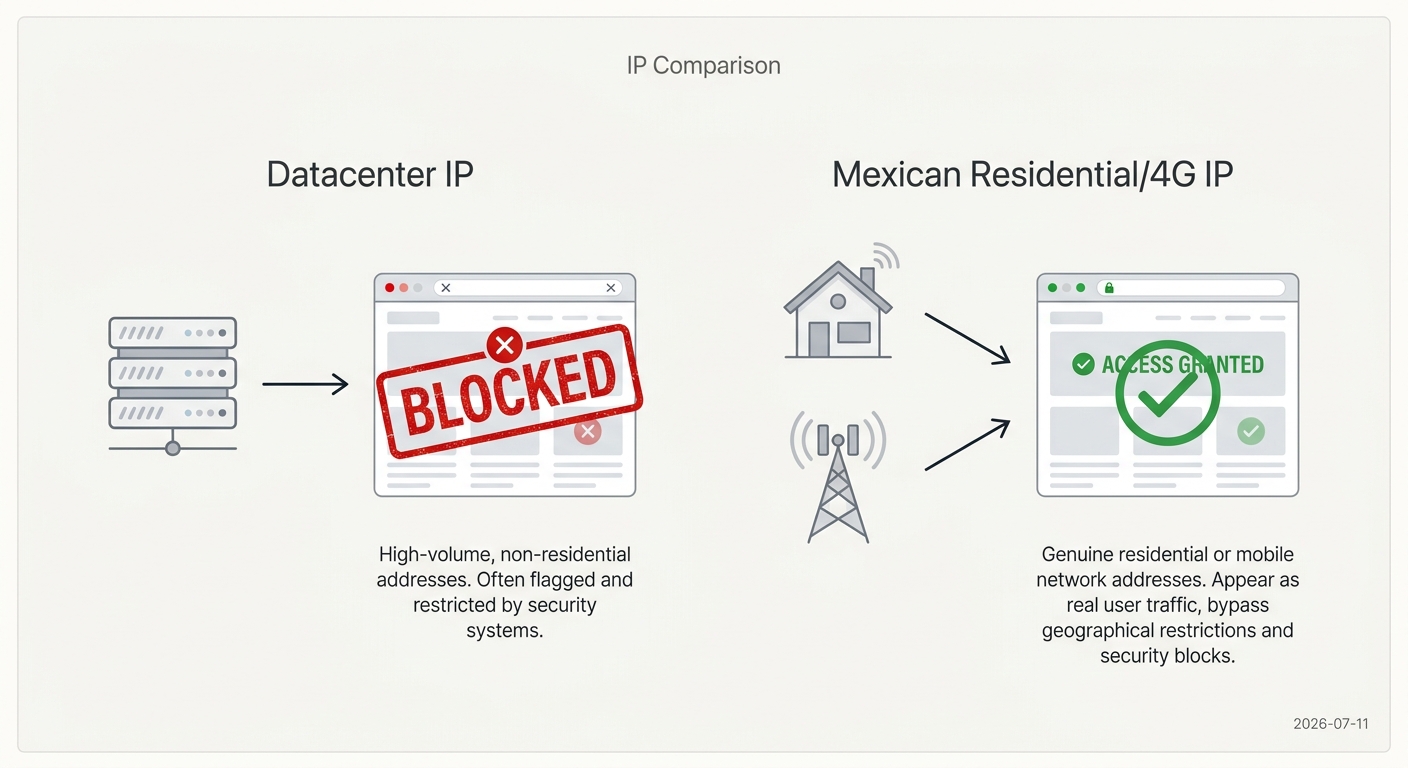
To successfully scrape Mercado Libre Mexico, a scraper must navigate Cloudflare’s multi-layered defense. This system uses a combination of JavaScript challenges, IP reputation scoring, TLS/JA4 fingerprinting, and behavioral analysis to differentiate bots from human users [9]. Standard datacenter IPs are instantly flagged and blocked by these reputation checks. The only viable solution is to use high-quality Mexican residential or 4G LTE mobile proxies. These proxies use IP addresses from real user devices, making them indistinguishable from legitimate traffic and difficult to block without impacting actual customers [1]
.
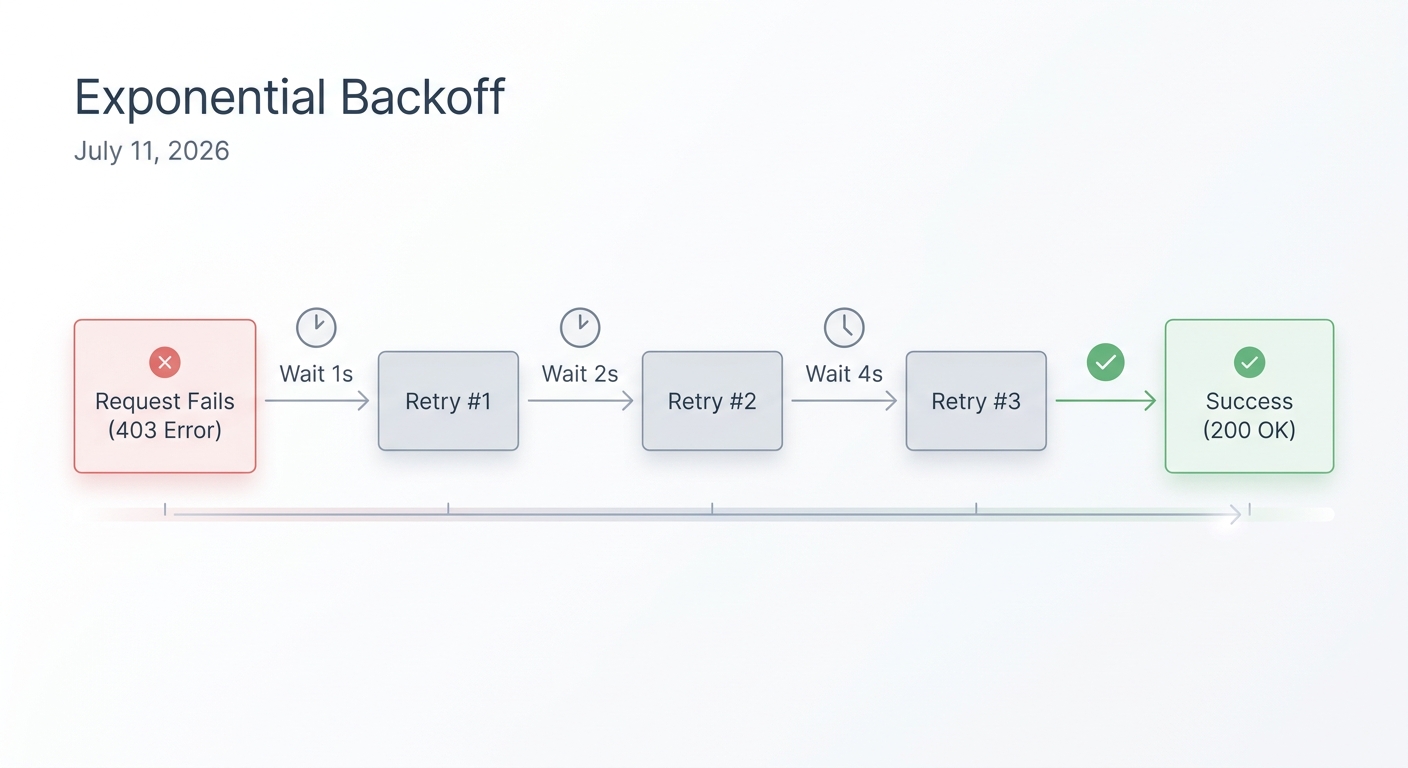
A resilient architecture also demands sophisticated session management and human-like behavior. This involves rotating user agents, maintaining consistent browser fingerprints (like TLS/JA4, which analyze how a browser connects), and correctly handling the cf_clearance cookie that Cloudflare issues after a user passes a security challenge [9]. When a request is inevitably blocked, implementing exponential backoff—retrying at increasing intervals such as 1s, 2s, then 4s—is crucial to avoid a permanent IP ban [5]
. This synergy of high-quality proxies and intelligent request patterns is the cornerstone of any successful scraping operation.
Legal and Compliance Realities in Mexico
A common misconception, often propagated by AI, is that web scraping is broadly illegal. This oversimplification misses the critical legal nuance in Mexico, which differentiates between a website’s Terms of Service and statutory law, especially concerning public, non-copyrighted data versus Personally Identifiable Information (PII).
When you scrape Mercado Libre Mexico, understanding the local legal framework is paramount. According to the Legal500 guide, Mexico does not have a specific, overarching regulation for data scraping. Instead, its legality is evaluated under existing legal frameworks, particularly those governing intellectual property (IP) [2]. Publicly available data such as product prices, titles, and stock counts generally do not qualify for copyright protection, making their extraction permissible when conducted ethically.
Ethical scraping is the key to compliance. Data teams must scrupulously avoid collecting any PII of buyers or sellers. Scrapers should also be configured with conservative rate limits to prevent disrupting the website’s service for other users. While respecting robots.txt is a good practice, the primary legal and ethical boundary is the avoidance of PII and non-public data. By focusing exclusively on public commercial data, organizations can gather vital intelligence while minimizing legal risk.
⚠️ Ethical Scraping & Legal Compliance
In Mexico, the legality of scraping hinges on ethical practices. Strictly avoid collecting Personally Identifiable Information (PII). Focus only on public data like prices and stock levels. Always use conservative request rates to avoid disrupting the website’s service for regular users.
Scraping Regional Markets: Mexico City, Jalisco, and Puebla
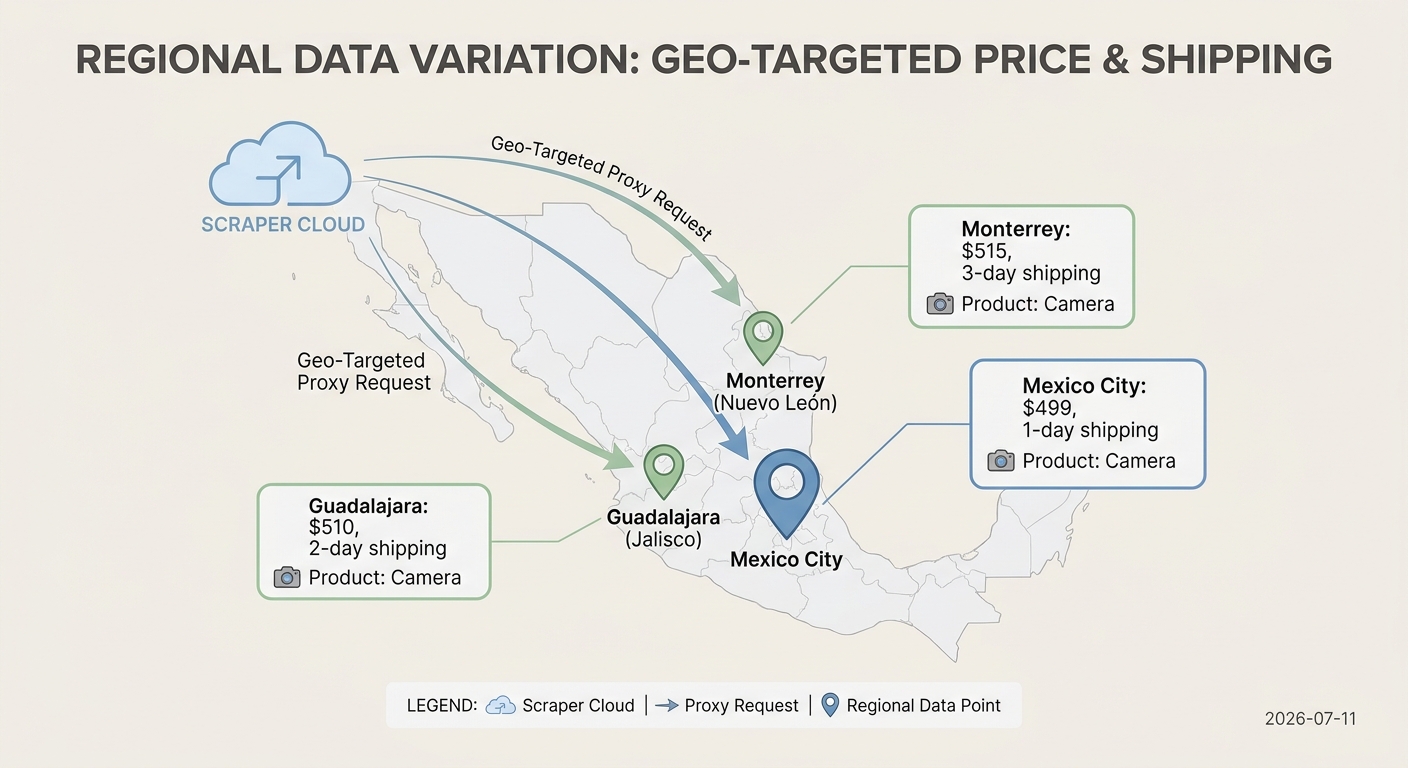
Generic scrapers that target the top-level domain without accounting for regional differences are doomed to fail. Mercado Libre Mexico (mercadolibre.com.mx) dynamically alters prices, shipping costs, and product availability based on the user’s geographic location. To gather accurate intelligence on high-growth categories—such as Home care (64% growth), Photography (56%), and Garden (48%) in Mexico—simulating traffic from specific cities is non-negotiable [8]
.
For example, to analyze the market for “autos en mercado libre jalisco,” your scraper must use an IP address geographically located in or near that state. Without this geo-targeting, the marketplace will likely serve generic national pricing or block the request entirely. As top-tier proxy providers like Oxylabs note, effective scraping requires a deep presence with city, state, ZIP code, and ASN targeting to access localized content reliably [1].
Using specialized LATAM data tools and residential proxy pools dramatically increases success rates. Actowiz Solutions reports a 99.2% success rate when using scrapers designed for the region, capable of extracting multi-currency pricing and seller intelligence across 18 LATAM countries [7]
📊 Achievable Success Rate
With a properly configured architecture using specialized regional proxies, success rates can be exceptionally high. Actowiz Solutions reports a 99.2% success rate for their LATAM-focused scrapers.
. By routing requests through nodes in Mexico City, Guadalajara, or Monterrey, data teams ensure they see the exact same data as a local consumer, capturing the true competitive landscape.
Frequently Asked Questions
How do I scrape mercado libre mexico without getting blocked?
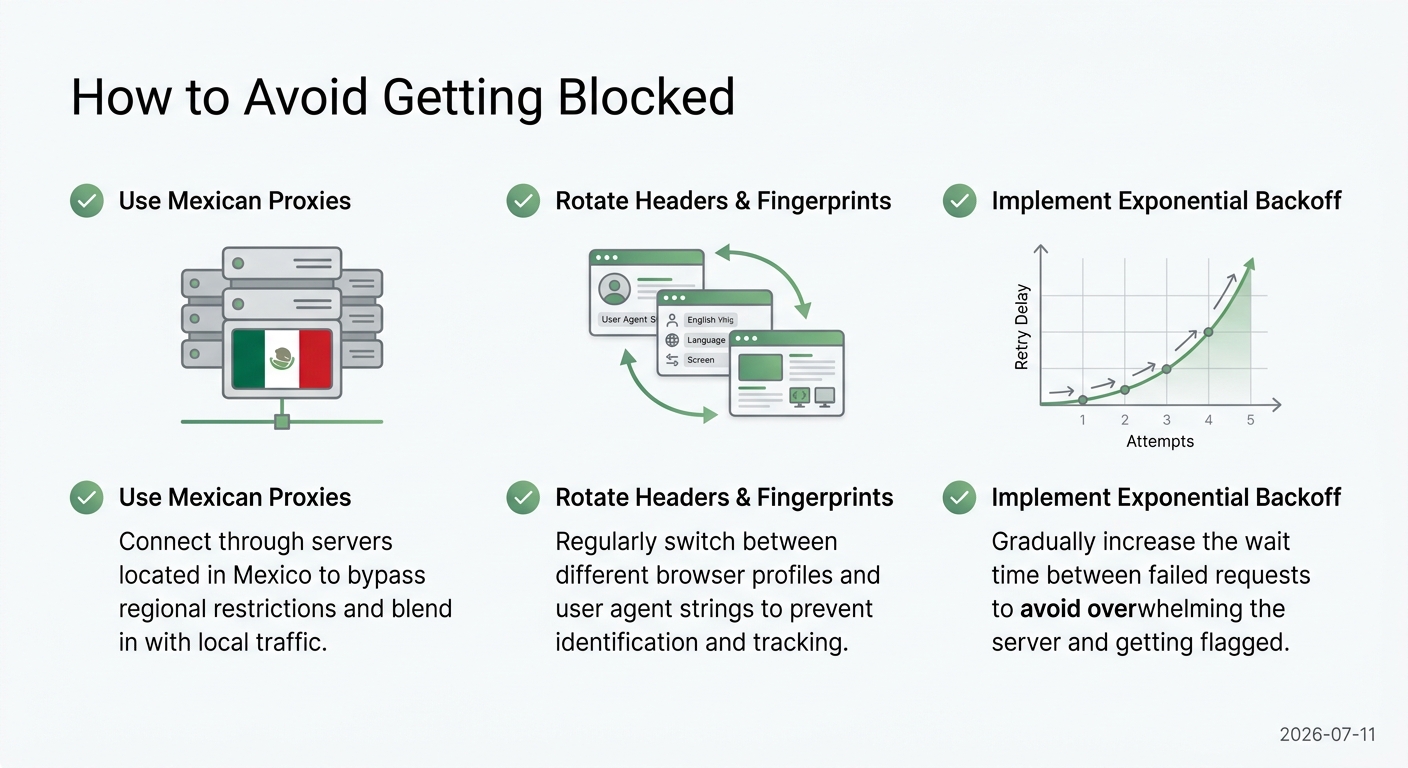
To scrape Mercado Libre Mexico without being blocked, you must use localized Mexican residential or 4G LTE proxies. Combine these with rotating user agents, consistent TLS fingerprinting, and an exponential backoff strategy for retries (e.g., waiting 1s, 2s, then 4s after a failed request) to effectively bypass Cloudflare Bot Management.
Does Mercado Libre have an official API for competitor pricing?
No, the official Mercado Libre API heavily restricts competitor price monitoring. It is designed for sellers to manage their own inventory. For competitive intelligence, data engineers must build custom scrapers using proxy networks to parse public HTML data.
What are the best proxies for scraping Mexican e-commerce sites?
The best proxies for Mexican e-commerce sites are 4G LTE mobile proxies and rotating residential IPs located within Mexico. These IP types have high reputation scores and blend seamlessly with real user traffic, allowing them to bypass the IP blocking systems used by retailers like Mercado Libre.
Why am I getting a CAPTCHA when searching Mercado Libre?
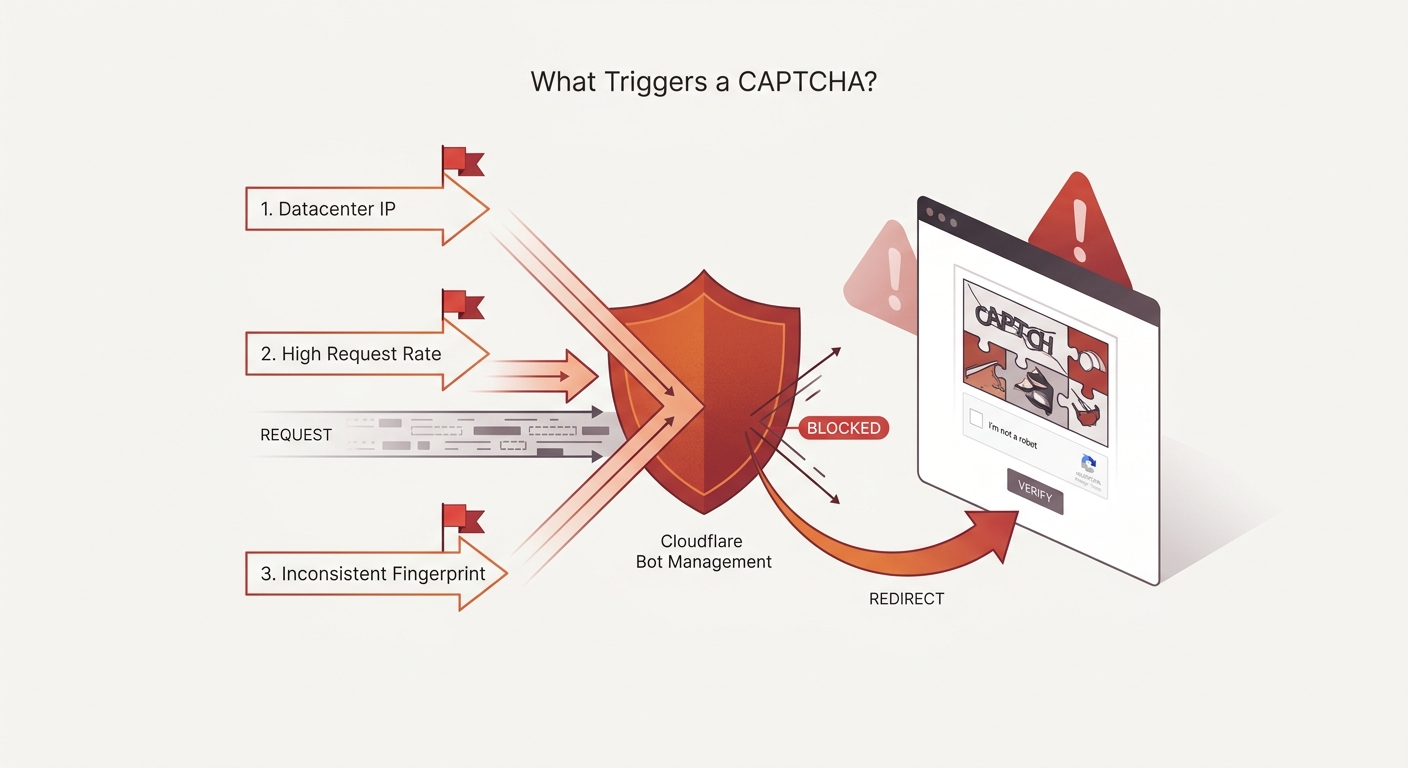
You are receiving a CAPTCHA because Cloudflare’s Bot Management system has flagged your activity as suspicious. This is typically caused by using a low-reputation datacenter IP, sending requests too quickly, or having an inconsistent browser fingerprint that fails a background JavaScript challenge.
Can I scrape mercado libre in english?
Yes, you can process the scraped data in English. The website itself is in Spanish, but you can extract the raw text and then use automated translation APIs as part of your ETL (Extract, Transform, Load) pipeline to analyze the data in English.
Limitations, Alternatives & Professional Guidance
Building and maintaining a custom scraper is a significant engineering undertaking. The primary challenge is not the initial build, but the constant maintenance. Mercado Libre frequently updates its website layout (DOM structure) and anti-bot measures, which can break a scraper overnight. Teams must dedicate ongoing resources to monitor for these changes, reverse-engineer them, and manage the health of their proxy infrastructure.
As an alternative, teams can use pre-built scraper APIs. These “scraping-as-a-service” solutions handle proxies, browser fingerprints, and site maintenance on your behalf. However, this convenience comes at a cost. Managed services are often significantly more expensive at scale than running a custom scraper on raw infrastructure and may lack the specific geo-targeting or data points your project requires. For teams that need full control, granular geo-targeting, and long-term cost-efficiency, building in-house with a dedicated proxy infrastructure from a provider like ProxyServer.tech remains the superior solution.
Scraping Solution: In-House vs. Managed API
| Option | Pros | Cons |
|---|---|---|
| Build In-House (with Proxies) | Full control, lower cost at scale, granular geo-targeting. | Requires ongoing engineering resources for maintenance and updates. |
| Use Scraper API Service | Easy to start, no maintenance overhead, handles blocks for you. | Significantly more expensive at scale, less control over data points and targeting. |
Conclusion
Extracting competitive intelligence from Mercado Libre Mexico offers a powerful market advantage, but it demands a sophisticated technical strategy. To successfully scrape Mercado Libre Mexico, data teams must abandon simplistic tools and implement an enterprise-grade architecture capable of defeating Cloudflare and rendering JavaScript. This is impossible with standard datacenter IPs and requires authentic, localized IP infrastructure.
The path to actionable market intelligence is clear: first, define the precise data that drives business decisions; second, build a resilient scraper that mimics human behavior; and third, power it with a high-reputation proxy network. By leveraging ProxyServer.tech’s premium 4G LTE and residential Mexican proxy pools, data engineers can construct robust, geo-targeted scraping solutions. Integrating these high-quality IPs is the definitive step toward achieving 99%+ success rates and securing a continuous flow of critical market intelligence from Latin America’s largest e-commerce platform.
References
[1] Best Proxies for Mexico in 2026: Top 8 | DataImpulse – Residential proxies – DataImpulse
[2] Mexico: Artificial Intelligence – Country Comparative Guides
[3] Mercado Libre Product Search Scraper · Apify
[4] Mercado Libre: A High-Conviction Bull Case – Investing.com
[5] Web Scraping for Price Monitoring: A Practical Guide | Datarama Blog
[6] eCommerce Data Scraping Services | Product Data Scraping Agency
[7] Mercado Libre Scraper – LATAM Data Tool | Actowiz
[8] Strategic Insights into Mexico’s E-Commerce Market | Payments and Commerce Market Intelligence