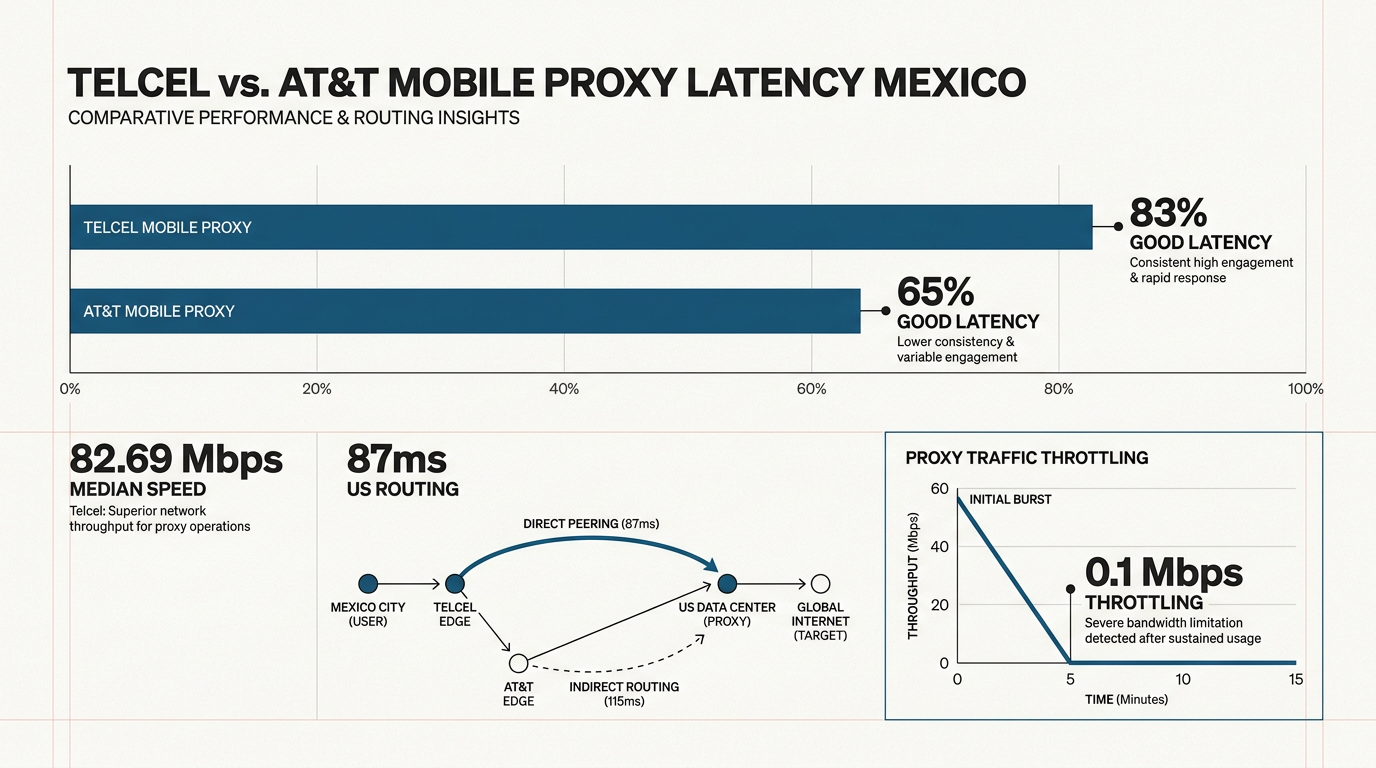
For US businesses routing traffic through Mexican mobile proxies, AT&T Mexico scored best on latency in WePlan Analytics’ January 2025 benchmark, with 83% of its measurements rated good or excellent, although Ookla’s Speedtest data for January–June 2025 gave Telcel the lowest median latency (63 ms). However, Telcel offers superior raw throughput, boasting a median download speed of 82.69 Mbps (Ookla, H1 2025). Crucially, US roaming SIMs can be throttled hard in Mexico: Cricket, AT&T’s US prepaid brand, warns that data used on Mexican networks other than AT&T Mexico may be reduced to 2G speeds, and users report speeds as low as 0.1 Mbps. For optimal performance, US data centers should connect to native Mexican SIM gateways.
Introduction
Mexico’s digital economy is expanding rapidly, making it a prime target for US-based e-commerce scraping, localized ad verification, and market research. When US-based developers and businesses configure automation, web scraping, or ad verification tasks targeting the Mexican market, connection speed and reliability are critical factors. However, evaluating mobile networks for proxy use requires a fundamentally different approach than standard consumer speed tests. While standard queries often ask which mobile network is best in Mexico, proxy users must specifically analyze how data packets route from US data centers across the border to Mexican cellular towers and back.
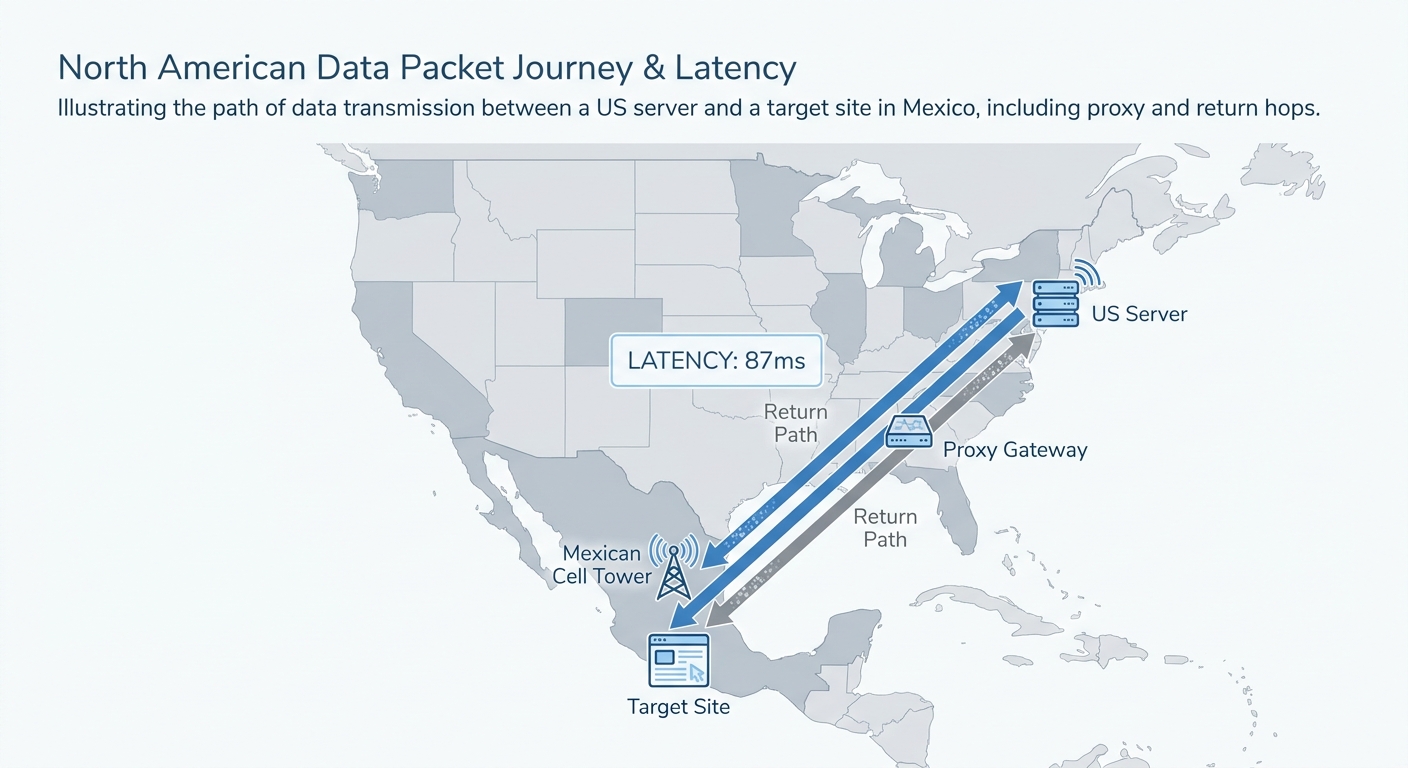
This guide provides a technical evaluation of telcel vs att mobile proxy latency mexico, specifically tailored for US routing architectures. We analyze published latency and speed benchmarks, 4G/5G spectrum deployments, and the performance differences between native Mexican SIM cards and US roaming agreements. By examining infrastructure data and industry benchmarks, this analysis seeks to determine whether Telcel’s massive throughput or AT&T’s optimized latency provides a more effective foundation for your mobile proxy architecture.
💡 Why Consumer Speed Tests Mislead Proxy Buyers
Standard speed tests measure bandwidth for a single user streaming video. Proxy infrastructure requires a fundamentally different analysis: packet routing paths, BGP peering agreements, and cross-border latency. A 100 Mbps network with 300ms latency will underperform a 20 Mbps network at 80ms for API automation.
The distinction matters because proxy infrastructure decisions directly impact automation success rates, ad verification accuracy, and scraping efficiency. A misinformed carrier choice can lead to timeout cascades, failed checkouts, and blocked accounts — all costly outcomes for businesses operating at scale.
About the Author
Written by the Network Engineering Team at ProxyServer.tech. Our team specializes in deploying and maintaining high-availability 4G/5G mobile proxy infrastructure in Mexico for cross-border use. Our engineers have hands-on experience configuring proxy gateway farms in Mexico City, giving us direct visibility into real-world carrier performance under production loads.
ProxyServer.tech Network Engineering Expertise
Cross-Border Infrastructure
Operating cross-border mobile proxy infrastructure between Mexico and the US with optimized routing paths.
Gateway Farm Operations
Hands-on proxy gateway farms deployed in Mexico City under production loads.
Real-World Carrier Visibility
Direct visibility into Telcel and AT&T Mexico carrier performance under automated traffic conditions.
Native SIM Architecture
Specialized in configuring native Mexican commercial SIM plans that bypass roaming throttles entirely.
Transparency Statement
ProxyServer.tech is a commercial provider of premium Mexican mobile proxies. However, the latency benchmarks, carrier comparisons, and throughput data presented in this guide are sourced from independent telecommunications reports (Ookla Speedtest, Opensignal, WePlan Analytics), carrier terms, and practitioner reports to ensure an unbiased technical evaluation. Where our internal infrastructure data is referenced, it is explicitly labeled as such.
💡 Transparency & Data Sources
Latency benchmarks and carrier comparisons are sourced from independent telecommunications reports (Ookla Speedtest, Opensignal, WePlan Analytics), carrier terms, and practitioner reports. Internal infrastructure data is explicitly labeled where referenced.
What the Community Says
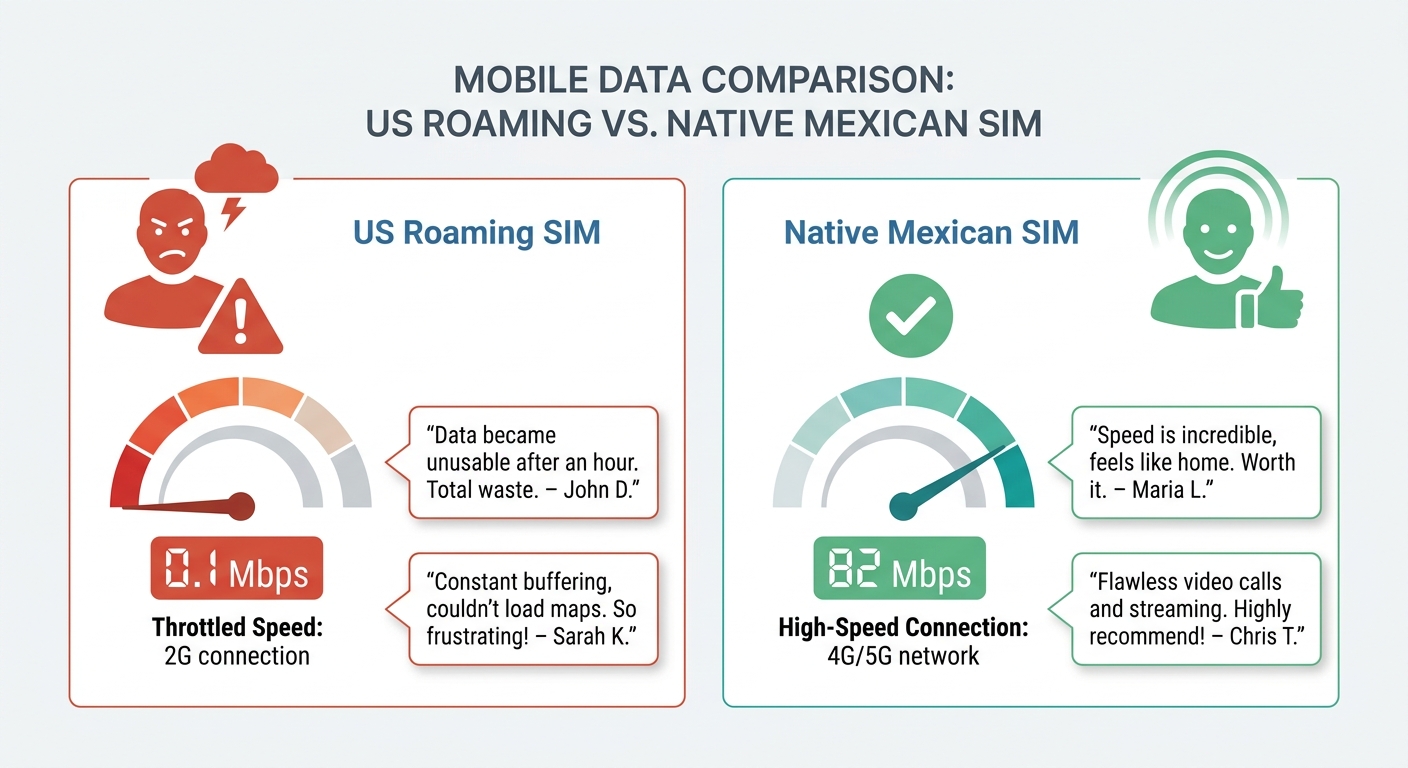
“I use ATT on my phone and it connects to the Telcel network in Baja. Upload/download speeds are only 0.1/0.2 Mbps.” — Practitioner on Facebook TalkBaja Group (July 2026) [1]
Reports like this match what US carriers’ own roaming terms warn about: US SIMs roaming in Mexico can be slowed sharply, while native Mexican carrier connections are not subject to roaming limits. This real-world feedback aligns with the technical infrastructure data we examine throughout this guide.
Proxy Gateway Routing vs. Consumer Speed
When researching telecommunications infrastructure, generic AI responses and consumer blogs typically state that Telcel is the faster network because it demonstrates higher median download speeds. While this is generally accurate for a user standing in Mexico City streaming a video, this consumer-centric view fails to account for how proxy traffic actually routes back to US servers. For developers, raw download speed on the device does not equal low latency for API calls.
Evaluating mobile proxies requires mapping the exact journey of a data packet. When a US-based application initiates a request, the packet travels from the US Server to a Proxy Gateway located in Mexico. From the gateway, it is pushed over the air to a Mexican Cell Tower, routed to the Target Site, and then must complete the entire journey in reverse. Every hop introduces physical distance and processing time.
Consumer Speed vs. Proxy Gateway Routing
| Option | Pros | Cons | Score |
|---|---|---|---|
| Consumer Speed Test | Measures raw download/upload bandwidth for streaming | Ignores routing hops, BGP paths, and cross-border latency |
4/10
|
| Proxy Gateway Routing | Maps exact packet journey, measures real-world latency per hop | Requires specialized infrastructure knowledge to evaluate |
9/10
|

Crossing the US-Mexico border usually involves routing through interconnection points along the border, such as Laredo, Texas. The physical distance from Mexico City to these border crossings is over 1,000 kilometers, establishing a hard floor for latency. Because the data must cross these international peering points, the routing protocols used by the specific cellular carrier become the primary bottleneck. Border Gateway Protocol (BGP) configurations dictate how traffic exits the Mexican carrier’s network and enters the US backbone. Carriers with direct peering agreements with US Tier 1 providers minimize hops, whereas those relying on third-party transit introduce additional latency.
💡 The 1,000 km Latency Floor
The fiber distance from Mexico City to the US border (for example, Laredo, Texas) exceeds 1,000 kilometers. Light in fiber covers roughly 200 km per millisecond, so that distance alone adds about 10 ms of round-trip time that cannot be bypassed; the rest of a mobile proxy’s latency comes from the cellular radio link, the carrier’s core network and routing.
Our internal infrastructure data suggests that relying on generic data center IPs masks these routing realities. True mobile proxies route through real Mexican carrier networks, such as Telcel and AT&T, to acquire genuine cellular IP addresses [6].
For a proxy user in New York optimizing for API scraping, automated checkout bots, or real-time inventory monitoring, prioritizing low round-trip time is far more critical than raw bandwidth. A network offering 100 Mbps throughput but 300ms of routing latency will consistently underperform a 20 Mbps network with 80ms latency when executing rapid, sequential API calls. The reason is straightforward: API calls typically transfer small payloads (2-50 KB per request), making throughput largely irrelevant beyond a modest threshold. Latency, however, compounds with every sequential request in an automation chain.
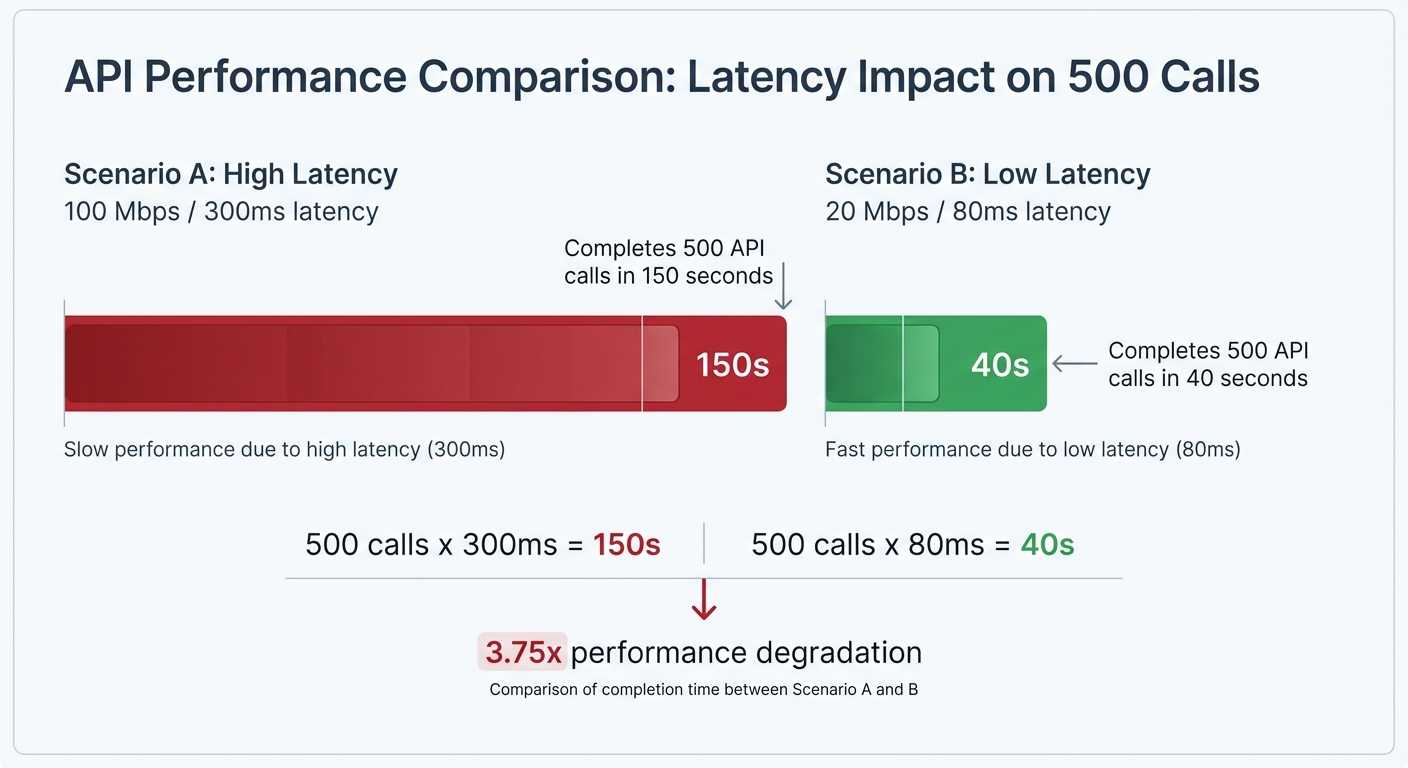
Consider a scraping workflow executing 500 sequential API calls. At 80ms latency per call, the total cycle completes in 40 seconds. At 300ms latency, the same workflow takes 150 seconds — a 3.75x performance degradation that has nothing to do with bandwidth. Understanding this distinction between consumer speed and gateway routing is the foundational step in selecting the correct carrier for cross-border mobile proxy operations.
AT&T Mexico Latency Performance for Real-Time Applications
While AI overviews often provide vague statements about AT&T having “good latency” or being a reliable network, network engineers require hard benchmarking data to justify infrastructure decisions. For real-time, automated applications, AT&T Mexico shows a latency advantage over Telcel in at least one independent benchmark, although not in all of them.
The critical metrics for proxy performance are packet delay variation (jitter) and ping. Jitter measures the inconsistency of response times; high jitter leads to connection timeouts and failed automation sequences. According to WePlan Analytics’ Mobile Network Benchmark Report for Mexico (January 2025), AT&T has better latency than its competitors, with 83% of its measurements rated as good or excellent [3]
.
Ookla’s Speedtest data for January–June 2025 points the other way, however, crediting Telcel with the lowest median latency in Mexico (63 ms) [4], so the latency gap between the two carriers is small and depends on how it is measured; test both against your own targets before committing. Automated ticketing bots, real-time ad verification scripts, and high-frequency trading APIs operate in environments where milliseconds dictate success or failure. When a script needs to verify an ad placement or secure a limited-release item, consistent, low-jitter routing supports higher success rates than a connection with higher bandwidth but erratic ping times.
✅ When to Choose AT&T Mexico
AT&T’s strong latency rating in WePlan’s benchmark (83% of measurements good or excellent) makes it worth testing for sneaker bot checkouts, real-time ad verification, and high-frequency API calls. In environments where milliseconds dictate success, consistent latency matters more than peak bandwidth.
After acquiring Iusacell and Nextel Mexico in 2015, AT&T invested heavily in building out its Mexican network, which remains smaller in geographic coverage than Telcel’s.
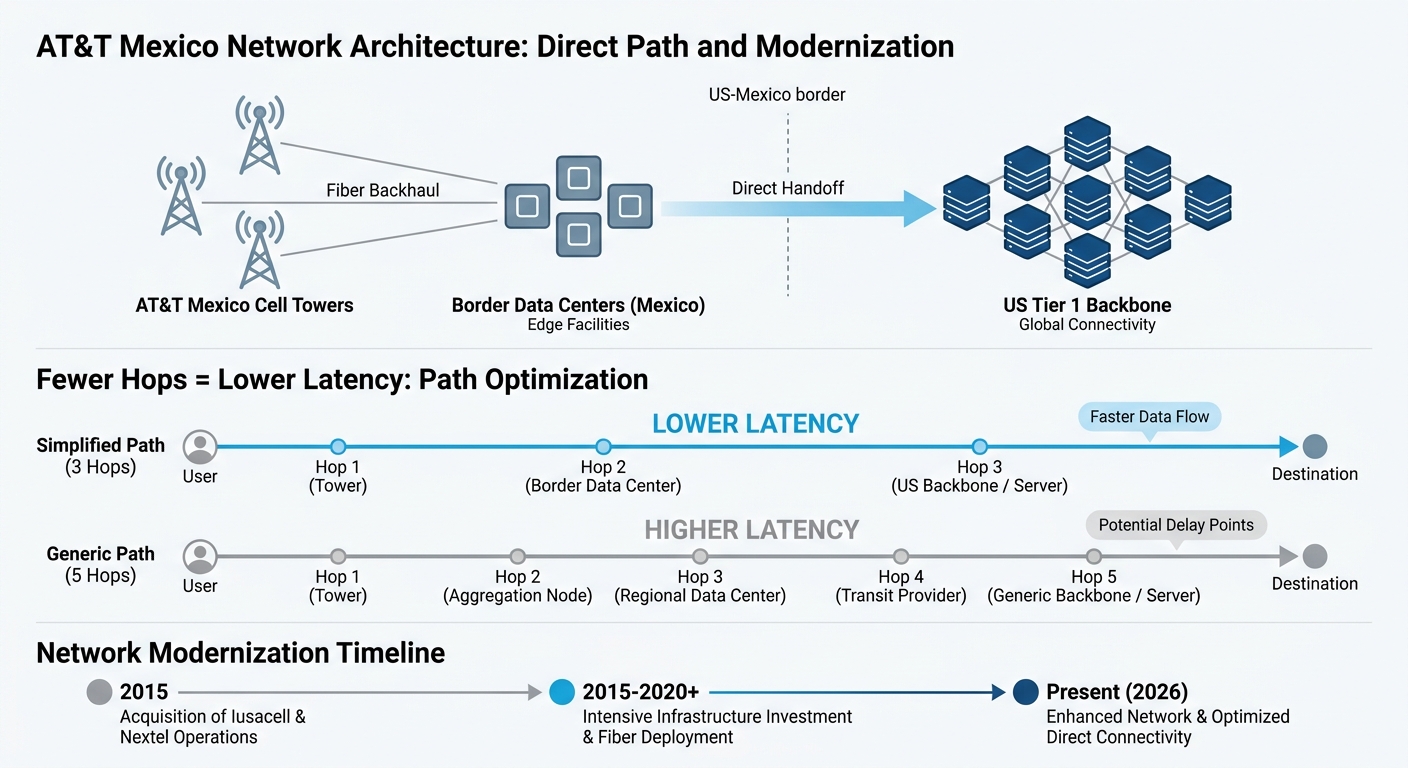
To contextualize this for US buyers, it is helpful to compare these dynamics to standard US carrier metrics. When US consumers debate t mobile vs att or ask is t mobile better than at&t, they are usually weighing rural coverage against urban speed. Similarly, in the US enterprise space, the att vs verizon debate often centers on enterprise support and fiber integration. In Mexico, the dynamic shifts: Telcel is the ubiquitous coverage and speed leader, while AT&T is the smaller challenger that some benchmarks rate highly for latency. Understanding this market positioning helps developers align their proxy purchases with their specific software requirements.
US Carrier Roaming Limitations for Mexican Proxies
A common mistake made by US businesses attempting to build their own proxy infrastructure in Mexico is relying on North American roaming agreements. General advice often suggests that US SIMs (such as those from AT&T US, T-Mobile, or Verizon) work seamlessly in Mexico. While they do connect to towers, US roaming SIMs are subject to plan-based speed limits and, on non-partner networks, possible 2G throttling, which makes them a poor fit for high-speed proxy deployments.
Cross-border carrier roaming agreements are built on wholesale data costs. When a US carrier’s customer uses data on a Mexican network, the US carrier must pay the Mexican operator for that bandwidth. To control these costs, US carriers implement aggressive data deprioritization and throttling protocols for roaming devices. A US business cannot simply purchase a stack of T-Mobile or AT&T US SIM cards, place them in a proxy farm located in Mexico, and expect domestic performance.
⚠️ The Roaming Trap
US SIM cards placed in Mexican proxy farms will NOT deliver domestic performance. Cross-border roaming agreements trigger aggressive data deprioritization, speed caps as low as 0.1 Mbps, and additional routing hops back to the US carrier’s home network before reaching the open internet.
Real practitioner data exposes this “roaming trap” clearly. Users attempting to utilize US SIMs report severe network friction. For instance, practitioner data from the Facebook TalkBaja group indicates that using a US AT&T SIM roaming on the Telcel network in Baja drops upload and download speeds to an unusable 0.1 and 0.2 Mbps, respectively [1]
. Similarly, Cricket Wireless’s own roaming terms warn that data used on Mexican networks other than AT&T Mexico may be reduced to 2G speeds [2].
The technical explanation for this throttling involves two layers. First, many US plans include only a limited high-speed roaming allowance, after which speeds are reduced sharply (Cricket, for example, cuts non-unlimited plans to a maximum of 128 kbps) [2]. Second, the Mexican host network deprioritizes roaming traffic below its own native customers during periods of network congestion. Since Mexico City and other major urban centers experience significant congestion during peak hours, roaming traffic is consistently pushed to the back of the queue. Additionally, roaming traffic is encapsulated in GPRS Tunneling Protocol (GTP) tunnels that route back to the US carrier’s home network before accessing the open internet, adding an unnecessary transnational round-trip.

When evaluating what’s better at&t or t mobile for international proxy use, the answer is neither. Connecting through a roaming agreement introduces an additional routing hop back to the US carrier’s home network before accessing the open internet, adding massive latency on top of the bandwidth throttle. Therefore, native Mexican SIMs — direct commercial accounts with Telcel or AT&T Mexico — are an absolute technical requirement. Only native SIMs bypass roaming throttles and provide the direct, unencumbered cellular IPs required for professional-grade proxy infrastructure.
⚠️ Native SIMs Are Mandatory
Only native Mexican SIM cards with direct commercial data plans bypass roaming throttles and provide the direct, unencumbered cellular IPs required for professional-grade proxy infrastructure. There is no workaround — US SIMs cannot achieve proxy-grade performance in Mexico.
Telcel 5G Spectrum Deployment and Proxy Throughput
While AT&T optimizes for latency, Telcel remains the dominant force in raw throughput and market penetration. Basic coverage maps show Telcel has the widest reach, holding about 57% of the national mobile market [3]. However, for proxy engineers, the more important factor is how Telcel’s specific 3.5 GHz spectrum deployment impacts heavy scraping tasks.
Independent telecommunications research demonstrates Telcel’s substantial advantage in bandwidth. Opensignal’s October 2023 report found Telcel’s 5G download speed (212 Mbps) nearly four times AT&T’s (54.7 Mbps) [5]
. Furthermore, Ookla’s Speedtest data for January–June 2025 recorded a median download speed of 82.69 Mbps for Telcel, versus 35.06 Mbps for AT&T [4]. This raw speed is helped by Telcel’s 5G rollout, which relies heavily on the 3.5 GHz band; Telcel says its 5G network reached about 60% of Mexico’s population by the end of 2025 [9], although the regulator’s estimate for Q2 2026 put AT&T’s 5G population coverage (52.5%) slightly ahead of Telcel’s (47.5%) [8].
The 3.5 GHz band, often referred to as C-band, provides an optimal balance of geographic range and massive data capacity. For proxy users, this specific infrastructure deployment is highly advantageous for heavy data-extraction tasks. Use cases such as bulk video scraping, large-scale image downloading for machine learning datasets, or comprehensive e-commerce catalog extraction benefit immensely from this bandwidth. In these scenarios, the sheer volume of data being moved makes Telcel’s 82.69 Mbps throughput far more valuable than saving a few milliseconds of latency on the initial connection.
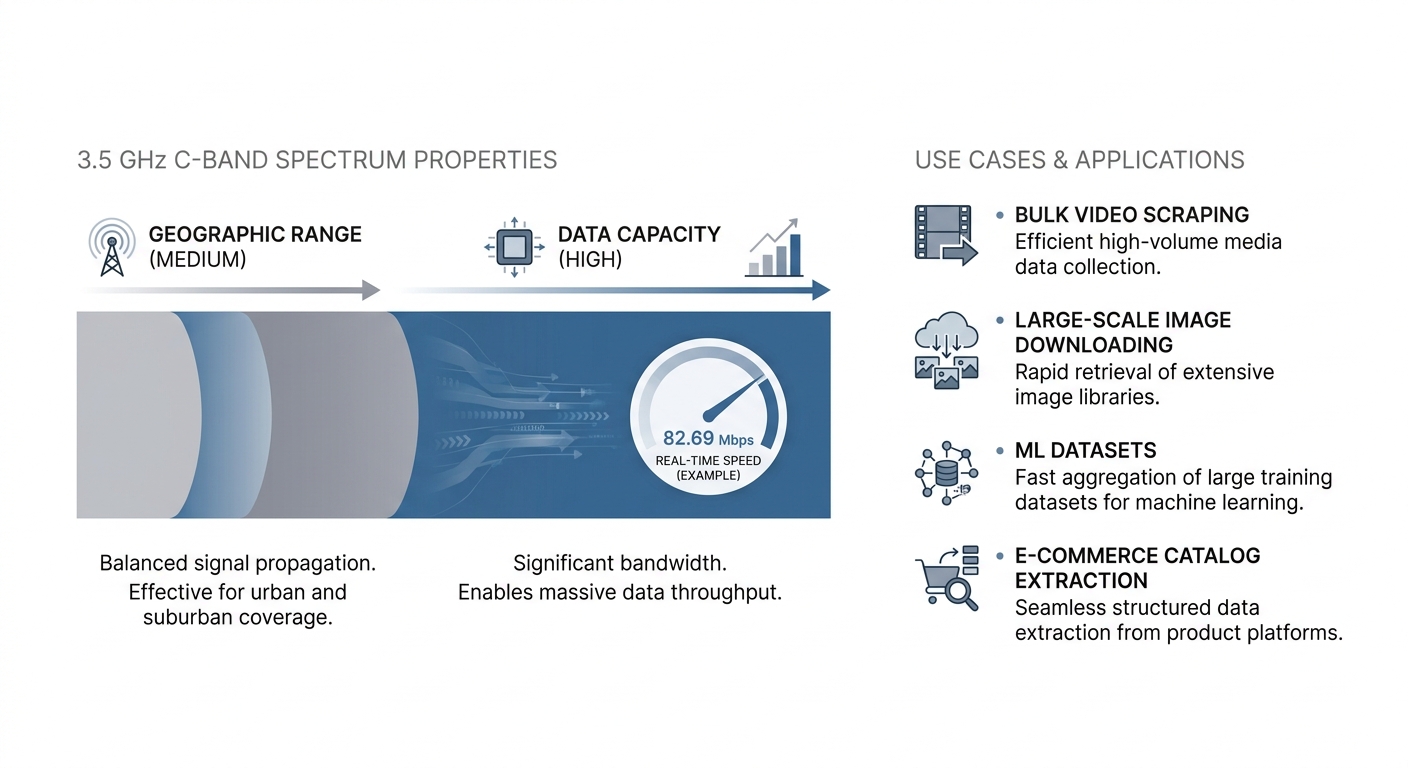
Ideal Workloads for Telcel’s High Throughput
Bulk Video Scraping
High-bandwidth video asset extraction benefits from 82.69 Mbps median speeds without bottlenecking.
ML Dataset Images
Large-scale image downloading for machine learning training sets requires maximum bandwidth.
E-Commerce Catalogs
Comprehensive product catalog extraction with high-resolution images demands sustained throughput.
IP Diversity Rotation
A majority market share (about 57%) provides a vast pool of cellular IPs across multiple regions for diverse signatures.
Telcel’s market dominance also translates to IP diversity — a critical factor for proxy rotation. With about 57% of the market, Telcel controls a vast pool of cellular IP addresses across multiple regions. This larger IP pool means proxy providers can offer more diverse geographic IP signatures, reducing the likelihood of pattern detection by sophisticated anti-bot systems. However, because Telcel, like other mobile carriers, uses Carrier-Grade NAT (CGNAT) to manage its massive user base, public IPs are shared and assigned by the carrier; mobile proxy providers typically obtain a fresh IP by forcing the modem to reconnect. ProxyServer.tech, for example, lets you trigger rotation via API or set automatic intervals from 60 seconds to 24 hours [7], so rotation intervals should be set so they do not cut active sessions.
✅ CGNAT and IP Rotation
Because mobile carriers use Carrier-Grade NAT, a new IP usually comes from forcing the modem to reconnect rather than from a fixed carrier lease. Proxy operators must configure rotation intervals so reconnects do not break active automation chains.
Telcel’s massive user base does mean its towers handle significantly more concurrent connections, so busy cells can slow down at peak hours, although Ookla still rated Telcel the most consistent mobile network in Mexico in H1 2025 (91.2% of samples meeting its minimum speed thresholds, versus 74.2% for AT&T) [4]. For proxy workloads that require both high throughput and consistent latency, a hybrid approach — routing latency-sensitive requests through AT&T and bulk data transfers through Telcel — often yields the best results.
Strategic Framework: Matching Carrier to Workload
To operationalize this data, proxy architects should utilize a workload-based carrier selection framework. Rather than forcing a single carrier for all tasks, advanced routing configurations can split traffic based on payload size and latency sensitivity. This strategic approach maximizes the strengths of both networks while mitigating their respective weaknesses.
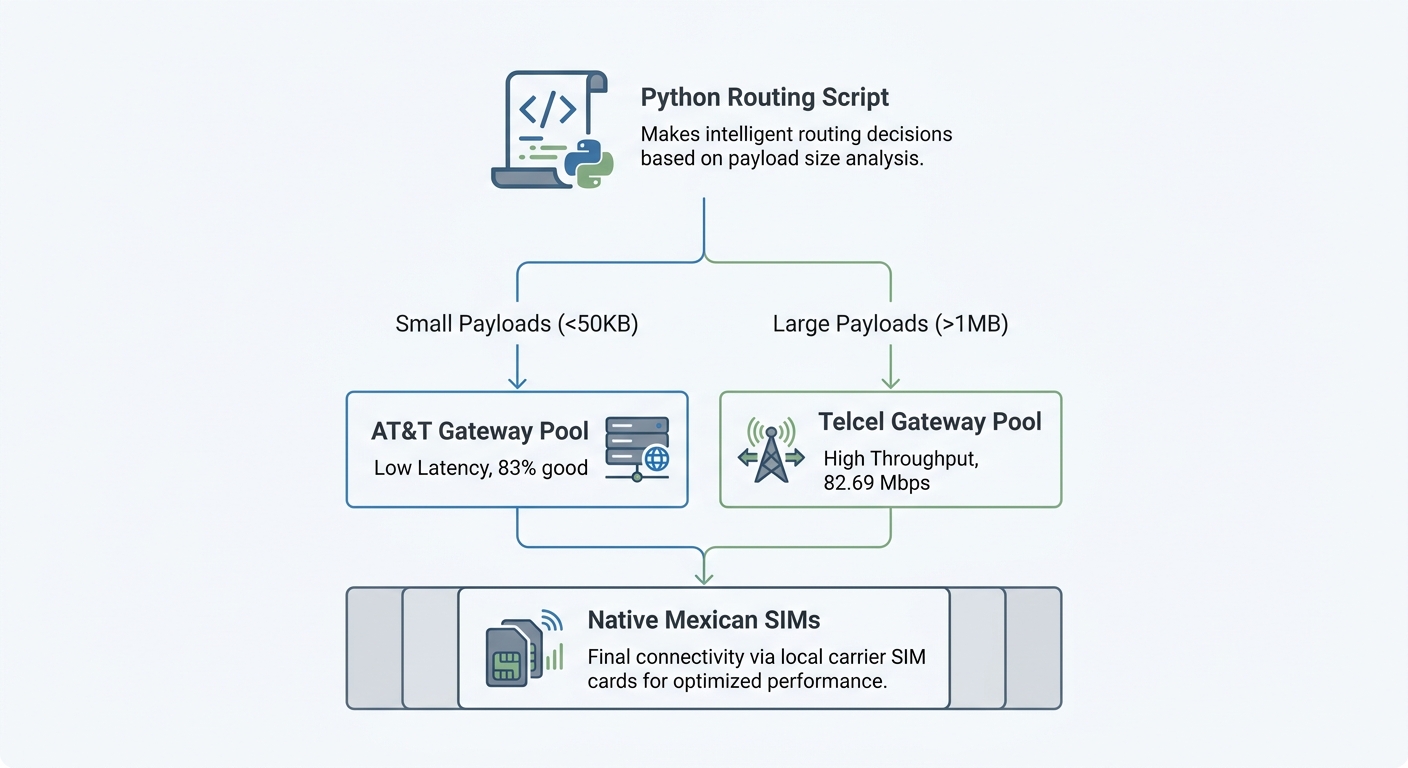
- Latency-Sensitive Micro-Requests (AT&T Mexico): Tasks like sneaker bot checkouts, real-time ad verification, and API token validation require immediate responses. These payloads are small (under 50KB), making latency the primary success driver; AT&T’s 83% good-or-excellent latency rating in WePlan’s benchmark makes it a strong candidate to test.
- High-Throughput Bulk Operations (Telcel): Large-scale data extraction, such as scraping e-commerce product catalogs with high-resolution images, or downloading video assets for machine learning, requires maximum bandwidth. Telcel’s 82.69 Mbps median download speed and 3.5 GHz 5G deployment handle these heavy payloads without bottlenecking the connection.
- Hybrid Routing Architectures: For comprehensive scraping platforms that handle both API navigation and asset downloading, a hybrid gateway farm utilizing both AT&T and Telcel native SIMs provides the most resilient infrastructure. By dynamically routing requests based on payload type, operators can maximize both success rates and data transfer speeds. For example, a Python-based scraping script can evaluate the payload size of an outgoing request. If the payload exceeds 1MB (e.g., downloading an image or video asset), the script routes the request through the Telcel gateway pool. If the payload is under 50KB (e.g., an API GET request or a checkout POST request), the script routes through the AT&T gateway pool.
Carrier Selection Framework: AT&T vs Telcel by Workload
| Option | Pros | Cons | Score |
|---|---|---|---|
| AT&T Mexico — Latency-Sensitive | 83% good-or-excellent latency rating (WePlan, Jan 2025) | Lower raw throughput, smaller geographic coverage |
8/10
|
| Telcel — High-Throughput | 82.69 Mbps median speed, lowest median latency in Ookla’s H1 2025 data, 3.5 GHz 5G, ~57% market share, vast IP pool | Busier cells at peak hours, shared CGNAT IPs |
8/10
|
| Hybrid Routing — Best of Both | Dynamic payload-based routing, maximizes both success rates and speed | Requires more complex infrastructure and configuration |
10/10
|
🔍 Evaluate Outgoing Payload Size
Script inspects the size of each outgoing request before routing decision.
⚡ Route Micro-Requests to AT&T
Payloads under 50KB (API GET, checkout POST) go to AT&T gateway pool for low latency.
📦 Route Bulk Transfers to Telcel
Payloads exceeding 1MB (images, video assets) go to Telcel gateway pool for max throughput.
📶 Execute via Native Mexican SIMs
Both gateway pools use native commercial SIM cards to bypass roaming throttles.
🔄 Monitor & Rotate IPs
Track success rates and schedule IP rotations so they don’t interrupt active sessions.
Frequently Asked Questions
Is AT&T better than Telcel in Mexico?
AT&T Mexico can be a good fit for latency-sensitive applications, while Telcel is superior for raw download speeds and rural coverage. In WePlan Analytics’ January 2025 benchmark, 83% of AT&T’s measurements were rated good or excellent for latency [3], although Ookla’s H1 2025 data credited Telcel with the lowest median latency (63 ms) [4]. However, Telcel offers significantly faster median download speeds at 82.69 Mbps [4]. The right choice depends on whether your workload prioritizes response time (AT&T) or data volume (Telcel).
💡 FAQ: Is AT&T Better Than Telcel in Mexico?
It depends on your workload. AT&T Mexico rates well for latency-sensitive applications (83% good-or-excellent latency in WePlan’s benchmark, though Ookla gives Telcel the lowest median latency), while Telcel is superior for raw download speeds (82.69 Mbps) and rural coverage. The right choice depends on whether you prioritize response time or data volume.
Why is my AT&T service slow in Mexico?
Your AT&T service is likely slow in Mexico because you are using a US-based SIM card subject to roaming throttling.
⚠️ FAQ: Why Is My AT&T Service Slow in Mexico?
US-based SIM cards are subject to roaming throttling when used on Mexican networks. Data is heavily deprioritized, often capping at 2G speeds (0.1-0.2 Mbps). High-speed connections require a native AT&T Mexico SIM card with a direct commercial data plan.
When an AT&T-family SIM roams on a Mexican network other than AT&T Mexico, such as Telcel, data may be reduced to 2G speeds [2], with users reporting 0.1 to 0.2 Mbps [1]. High-speed connections require a native AT&T Mexico SIM card with a direct commercial data plan. US roaming agreements impose bandwidth limits and additional routing hops that degrade performance.
Which mobile network is best in Mexico?
Telcel is generally considered the best overall mobile network in Mexico due to its roughly 57% market share, widest coverage and top speed results [3][4]. It consistently wins independent speed and coverage awards. However, for specialized commercial use cases like mobile proxies, the “best” network depends on whether you need AT&T’s latency profile (83% good-or-excellent rating in WePlan’s benchmark) or Telcel’s high bandwidth (82.69 Mbps median download speed). For most consumer applications, Telcel’s coverage advantage makes it the default choice.
How fast is Telcel internet?
Telcel mobile internet delivered a median download speed of 82.69 Mbps across its networks in January–June 2025, according to Ookla [4]. Opensignal’s October 2023 report found Telcel’s 5G download speed nearly four times AT&T’s [5]. Its 5G network, which relies heavily on 3.5 GHz spectrum and which Telcel says reached about 60% of the population by the end of 2025 [9], enables high-throughput data transfers, making it excellent for heavy web scraping, bulk content downloading, and large-scale data extraction workflows.
Does AT&T own Telcel?
No, AT&T does not own Telcel; they are direct competitors in the Mexican telecommunications market.
💡 FAQ: Does AT&T Own Telcel?
No. Telcel is owned by América Móvil, controlled by Carlos Slim. AT&T operates its own independent network in Mexico after acquiring Iusacell and Nextel Mexico in 2015. They are direct competitors in both consumer and enterprise markets.
Telcel is owned by América Móvil, a massive Mexican telecom corporation controlled by Carlos Slim. AT&T operates its own independent network in Mexico (AT&T Mexico) after acquiring Iusacell and Nextel Mexico in 2015 to build its infrastructure. The two companies compete directly for both consumer and enterprise market share.
What is the best phone carrier in Mexico?
Telcel is the best phone carrier in Mexico for overall coverage and speed, while AT&T Mexico rates best for latency in some benchmarks. For digital nomads and proxy providers, Telcel offers the most consistent connections across the country according to Ookla [4], whereas AT&T can offer responsive routing for automated web tasks. Movistar, while still operational, no longer runs its own radio network and relies on other operators’ infrastructure, mainly AT&T’s, making Telcel and AT&T the two primary networks for proxy infrastructure [3].
Limitations of Mexican Mobile Proxies and Alternatives
While native Mexican mobile proxies offer unparalleled trust scores for local scraping, they are bound by the physical limitations of cellular infrastructure. Cross-border routing to US data centers will always introduce a baseline latency that cannot be bypassed: light in fiber covers roughly 200 km per millisecond, so every 1,000 km of fiber path adds about 10 ms of round-trip time, on top of the delay added by the cellular radio link and carrier routing. Additionally, mobile carrier CGNAT (Carrier-Grade NAT) means public IPs are shared with other subscribers and change when the modem reconnects, so rotation has to be managed by the proxy provider.
⚠️ Physical Limitations of Mexican Mobile Proxies
Cross-border latency has a physical floor set by fiber distance (about 10 ms of round trip per 1,000 km), plus radio and routing overhead. CGNAT means IPs are shared and rotate on modem reconnects. Peak-hour congestion (typically evenings) can elevate latency. If sub-20ms is required, consider Mexican residential or data center proxies — but you sacrifice mobile trust scores.
Another limitation is signal variability. Unlike data center proxies that operate in climate-controlled environments with stable connections, mobile proxies are subject to cellular network congestion during peak hours (typically in the evening). During these windows, even native SIM connections may experience elevated latency and reduced throughput. Proxy operators must account for this variability in their automation scheduling, potentially shifting heavy workloads to off-peak hours.
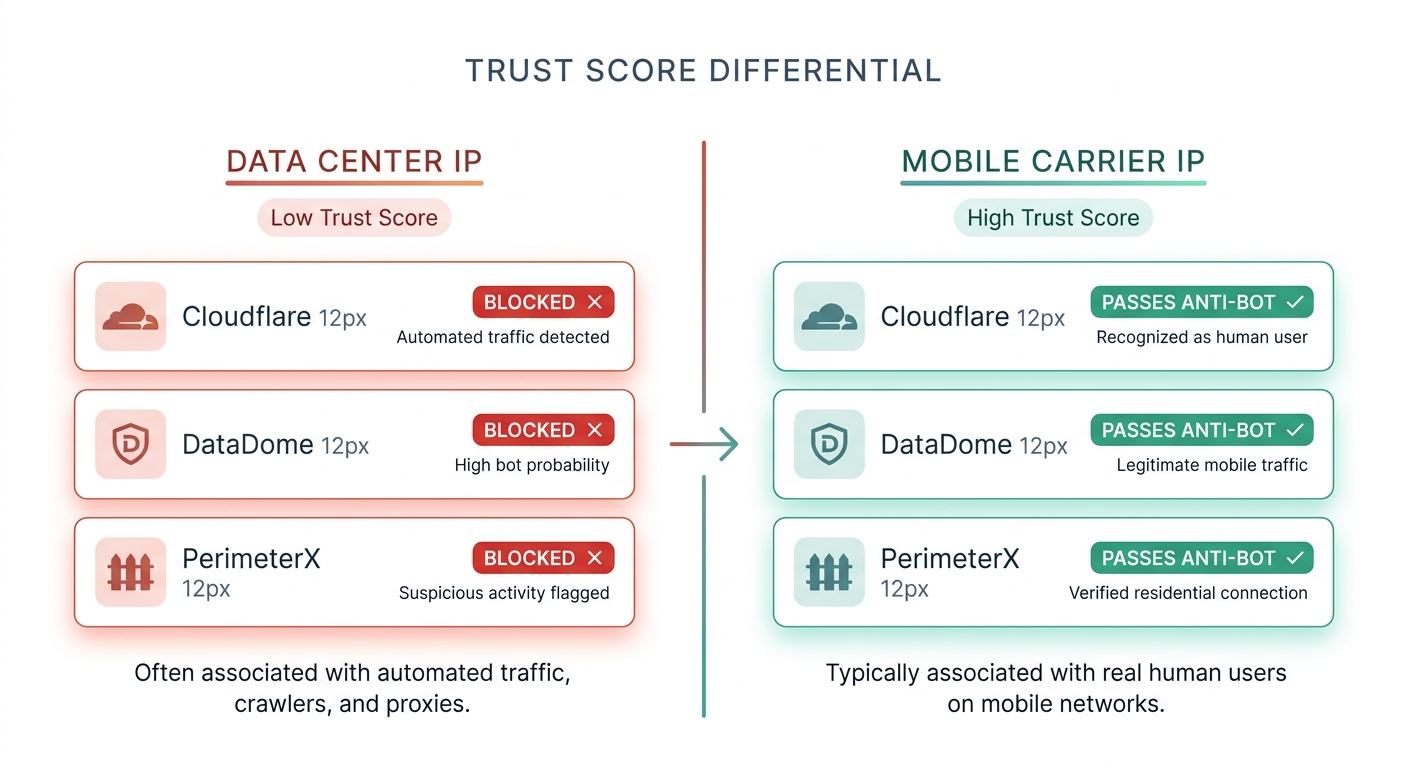
If sub-20ms latency is strictly required, businesses should consider Mexican residential broadband proxies or data center IPs located physically within Mexico. However, these alternatives sacrifice the high trust scores and anti-bot evasion capabilities inherent to 4G/5G mobile networks. Major anti-bot systems like Cloudflare, DataDome, and PerimeterX specifically flag data center IP ranges, while mobile carrier IPs benefit from the implicit trust assigned to consumer cellular devices. Mobile networks are assigned high trust scores because they are associated with real human users, making them significantly harder for anti-bot systems to block without causing massive false positives. This trust differential often makes the latency trade-off worthwhile for scraping and automation workloads.
Finally, regulatory considerations apply. Mexico’s telecom regulator, the Comisión Reguladora de Telecomunicaciones (CRT), which replaced the Federal Telecommunications Institute (IFT) in October 2025, now requires every active mobile line to be linked to its holder (CURP for individuals, RFC for companies), and proxy operators must ensure compliance with local telecommunications regulations. Working with established proxy providers who handle this compliance reduces operational risk for US-based businesses.
Conclusion
Choosing the right foundation for your Mexican mobile proxy infrastructure ultimately depends on your specific routing requirements. As our analysis of telcel vs att mobile proxy latency mexico indicates, AT&T Mexico serves as an effective choice for US businesses executing real-time, latency-sensitive tasks like automated purchasing or API monitoring, supported by its 83% good-or-excellent latency rating in WePlan’s benchmark [3], although Ookla’s data credits Telcel with the lowest median latency [4]. Conversely, Telcel remains the leader for raw throughput, offering 82.69 Mbps median speeds that are ideal for heavy data extraction and high-volume scraping [4].
Regardless of the carrier chosen, relying on US roaming SIMs is associated with severe 2G throttling that renders proxy infrastructure unusable [1][2]. To maintain professional-grade performance, your proxy architecture must utilize native Mexican SIM cards with direct commercial data plans. The distinction between consumer speed and gateway routing latency is not academic — it directly determines whether your automation workflows succeed or fail.
ProxyServer.tech provides premium Mexican mobile proxies directly integrated with both Telcel and AT&T networks, helping ensure your US-based operations maintain optimal speed and avoid throttling across the border. Our infrastructure leverages native carrier connections, optimized routing paths, and continuous performance monitoring to deliver the consistent, reliable cross-border connectivity that modern automation workflows demand.
References
[1] What data speeds can I expect on AT&T with Telcel in Baja? (user post in the TalkBaja Facebook group; individual report, not independently verified)
[2] Cricket Wireless: Coverage in Mexico and Canada (roaming terms)
[3] WePlan Analytics: Mexico Mobile Network Benchmark Report (January 2025)
[4] Ookla: Speedtest Connectivity Report, Mexico H1 2025
[5] Opensignal: Mexico, October 2023, Mobile Network Experience Report
[6] Best Proxies for Mexico in 2026: Top 8
[7] 4G Mobile Proxies in Mexico — Telcel · AT&T · Movistar
[8] Xataka México: AT&T beat Telcel on 5G population coverage in Q2 2026 (CRT estimates)
[9] Expansión: Telcel lleva su red 5G al 60% de los mexicanos (May 2026)