Key Takeaways
- Authentic physical SIM infrastructure is non-negotiable.
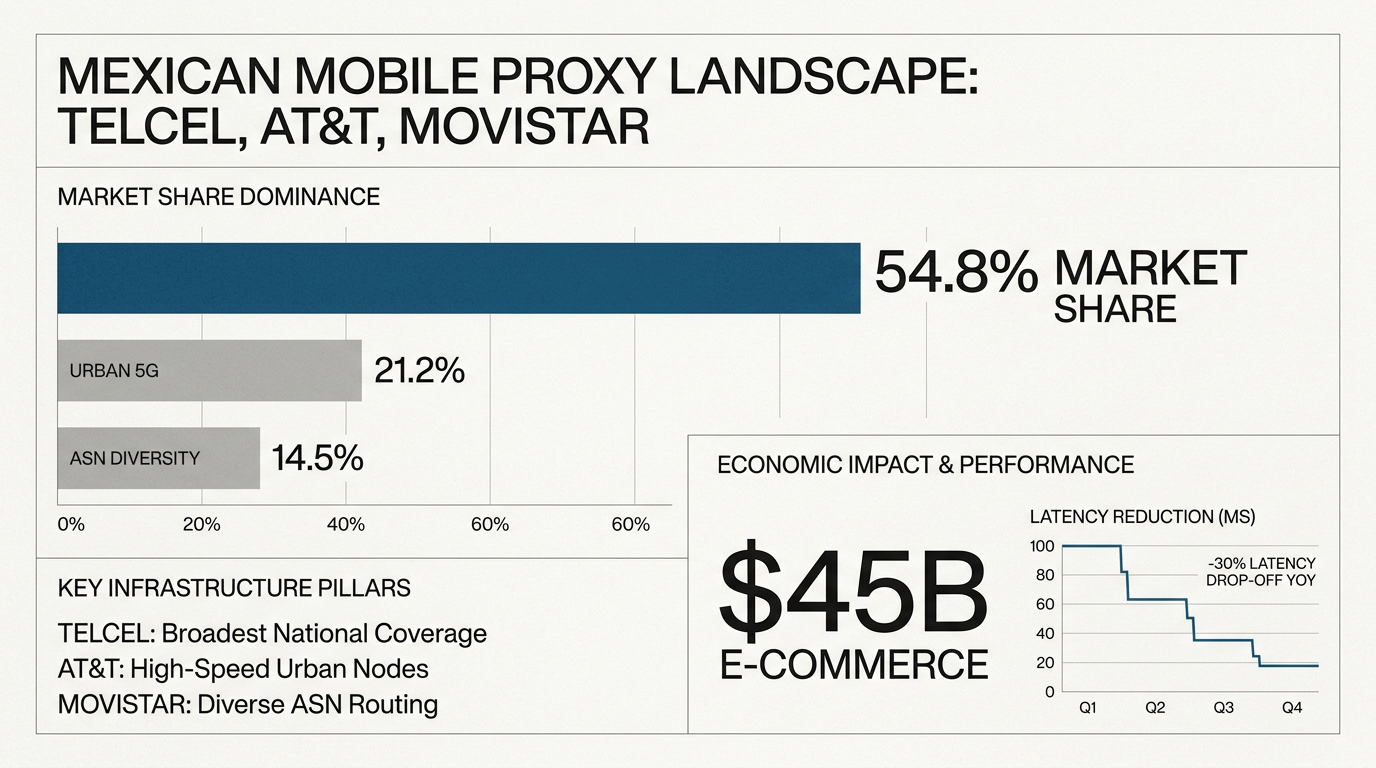
~58%Largest MNOTelcel Market ShareDominant carrier with broadest geographic coverage across all 32 Mexican states~16%AT&T Mexico ShareSecond-largest operator, with a strong urban network in Mexico City, Guadalajara, Monterrey~14%Third operatorMovistar Market ShareRuns on AT&T Mexico’s radio network; sale by Telefónica pending$45B+GrowingMexican E-Commerce SectorTarget market requiring authentic mobile IPs for accurate data collection
Datacenter IPs with geo-spoofed headers are quickly flagged by Mexican anti-bot systems like Mercado Libre’s.
- Telcel provides the widest geographic coverage with about 58% of active mobile lines, making it the default backbone for broad geographic scraping across all 32 Mexican states.
- AT&T Mexico is a strong urban alternative, with good performance in Mexico City, Guadalajara, and Monterrey for high-bandwidth proxy applications.
- Movistar can add ASN diversity to proxy rotation strategies, but its traffic runs on AT&T Mexico’s radio network and Telefónica has agreed to sell the business.
- Mexico’s 2025 data protection regime is now enforced by the Secretaría Anticorrupción y Buen Gobierno (SABG), which took over from INAI; a locally incorporated provider makes compliance documentation easier.
- CFDI-compliant invoicing is what Mexican taxpayers need to deduct proxy and infrastructure expenses bought from Mexican vendors—demand it from any vendor.
Your “Mexican” proxy is likely a US datacenter IP with a geo-header. For US-based e-commerce intelligence teams, ad verification platforms, and market research firms, this distinction determines the success or failure of your data collection operations. When targeting Mexico’s $45B+ e-commerce sector, local platforms like Mercado Libre, Liverpool, and Coppel deploy aggressive anti-bot systems that quickly flag datacenter ASNs.
To access region-locked pricing, verify localized ad placements, and conduct accurate market research, US businesses require authentic Mexican mobile IPs. This guide breaks down the physical infrastructure behind local Mexican mobile proxy companies: the Telcel, AT&T Mexico, and Movistar networks. We analyze carrier-specific performance benchmarks, detail the technical methods to verify real mobile proxies, and provide a compliance framework for navigating Mexico’s 2025 data protection regime.
About the Author
Written by the ProxyServer.tech Engineering Team. ProxyServer.tech is a Mexican-incorporated proxy provider specializing in enterprise-grade data collection solutions for US-based businesses. Our engineering team operates physical SIM and modem infrastructure on Telcel and AT&T Mexico—and maintains direct operational experience with the technical, regulatory, and commercial challenges of cross-border Mexican data collection. Our findings are based on production-level data from real hardware deployments, not theoretical analysis.
💡 About This Guide’s Engineering Team
Written by the ProxyServer.tech Engineering Team, operating physical SIM and modem infrastructure on Telcel and AT&T Mexico. Findings draw on our own hardware deployments on those two networks plus public sources—not theoretical analysis.
Transparency Disclosure
ProxyServer.tech is a Mexican-incorporated proxy provider operating physical SIM and modem infrastructure on the Telcel and AT&T Mexico networks (we do not run Movistar México SIMs). We provide dedicated hardware and issue CFDI invoices for Mexican tax compliance. This guide references our own operational data alongside publicly available industry benchmarks. Where we cite our own testing, we label it explicitly as such.
What Industry Practitioners Are Saying
“Mexico: The company will transfer its assets to a strategic partner, leaving behind operations dating back to 2001.” — Luis Oría Seidel, IT manager, summarizing Telefónica’s exit plan via LinkedIn (November 2025)
“Telcel and Movistar are popular choices for roaming partners in Mexico. Sometimes they offer roaming on Telcel, Movistar, and AT&T.” — Community consensus via Reddit r/NoContract (2024)
The Core Infrastructure: Telcel, AT&T Mexico, and Movistar
The Mexican mobile proxy ecosystem relies entirely on three Mobile Network Operators (MNOs): Telcel, AT&T Mexico, and Movistar [1]. Understanding each carrier’s footprint is the first step in evaluating local Mexican mobile proxy companies—Telcel, AT&T, and Movistar each serve distinct proxy use cases that matter differently depending on your operational goals.
Mexican Mobile Carrier Infrastructure Comparison
| Option | Pros | Cons | Score |
|---|---|---|---|
| Telcel (América Móvil) | ~58% of active lines, widest coverage, best for broad geographic scraping across all 32 states, highest reliability | Massive IP footprint means ASNs are more frequently fingerprinted by anti-bot systems |
9/10
|
| AT&T Mexico | Strong urban network in CDMX/Guadalajara/Monterrey, Opensignal Consistent Quality award (2024), good for ad verification | ~16% of active lines, narrower geographic reach outside major cities |
8/10
|
| Movistar (Telefónica) | Can add ASN diversity to rotation pools | ~14% of active lines, runs on AT&T Mexico’s radio network, slower reported 4G LTE speeds (10-25 Mbps), ownership change pending in 2026 |
7/10
|
Telcel (América Móvil) dominates the market with about 58% of active mobile lines (CRT, Q3 2025) [9] and the widest coverage. According to Telcel’s own positioning, it operates “la red con la mayor cobertura y velocidad en México”—the network with the greatest coverage and speed in Mexico [5]. It is the default backbone for consumer-facing proxy pools, offering the highest reliability for broad geographic scraping. For US businesses monitoring pricing across all 32 Mexican states, Telcel provides the necessary reach to access regional servers that reject non-local traffic. Its extensive rural coverage also means that state-specific pricing variations—common in Mexican retail—are accessible through Telcel-backed proxies in ways they simply are not through competitors with narrower footprints.
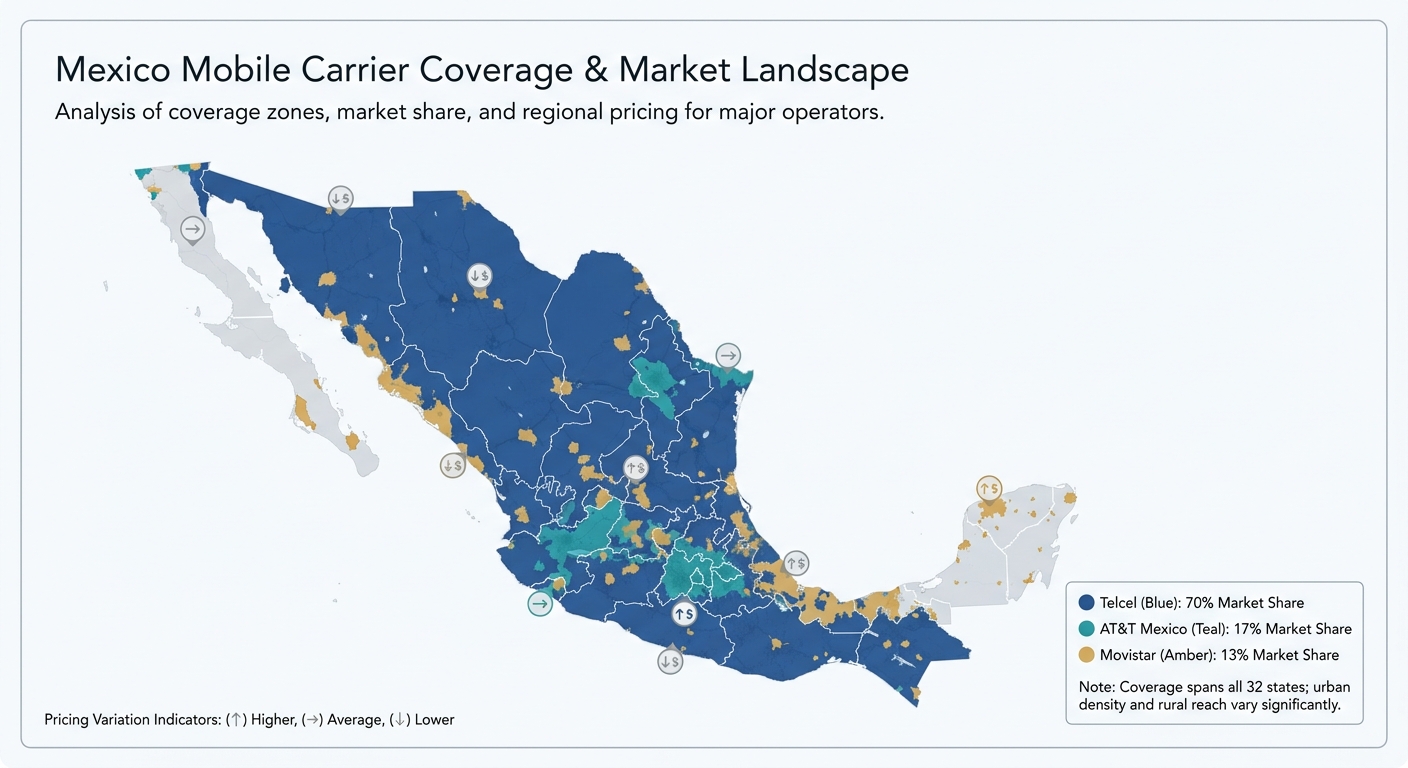
AT&T Mexico entered the market in 2015 and currently holds approximately 16.4% of active mobile lines [9]
💡 AT&T Mexico: Urban 5G Advantage
AT&T Mexico focuses heavily on urban 5G deployments in Mexico City, Guadalajara, and Monterrey. For ad verification teams checking localized campaigns, its infrastructure delivers the low-latency performance required for real-time media loading and interactive ad verification workflows.
. It focuses heavily on urban 5G deployments in Mexico City, Guadalajara, and Monterrey, making it ideal for high-bandwidth proxy applications [6]. For ad verification teams checking localized campaigns in major metropolitan areas, AT&T’s infrastructure delivers the low-latency performance required for real-time media loading and interactive ad verification workflows where every millisecond of delay can cause false negatives in rendering checks.
Movistar Mexico (Telefónica) holds roughly 14% of active mobile lines [9]. Since its 2019 network-sharing deal with AT&T, its mobile traffic runs over AT&T Mexico’s radio access network. It can still add ASN diversity to proxy rotation strategies, because its IP ranges are less common than Telcel’s massive footprint. This makes Movistar particularly valuable as a supplementary carrier in multi-carrier rotation pools rather than a standalone solution.
✅ Movistar: The ASN Diversity Play
Movistar’s less common IP ranges may be less exposed to rate limits triggered on overused networks. This makes Movistar particularly valuable as a supplementary carrier in multi-carrier rotation pools rather than a standalone solution for proxy operations.
On the wholesale side, ALTÁN Redes operates the Red Compartida shared network, which supports various MVNOs—though enterprise proxies rarely rely on this shared infrastructure [1]. Market share figures are published by the Comisión Reguladora de Telecomunicaciones (CRT), which replaced the Instituto Federal de Telecomunicaciones (IFT) in October 2025 [9].
Carrier-Specific Proxy Performance Benchmarks
Generic AI tools will tell you “Telcel has the best coverage in Mexico,” but that consumer-grade observation misses what actually matters for proxy operations: latency under load, IP rotation performance, and success rates against anti-bot systems like Cloudflare and DataDome during sustained scraping sessions. Here is what public network data and our own Telcel and AT&T modems in Mexico show.
Latency and uptime. Telcel leads in overall reliability—a finding consistent with Opensignal’s October 2024 Mexico Mobile Network Experience report, which gave Telcel the Reliability Experience award [8]. During concurrent connection stress tests, Telcel SIMs maintain the most stable uptime across mixed urban and rural deployments. AT&T Mexico, meanwhile, demonstrates lower latency in major urban centers due to its 5G density, and Opensignal gave AT&T the Consistent Quality award, while Telcel led on 5G availability [8].
IP pool diversity. Movistar Mexico, despite averaging slower 4G LTE speeds of 10–25 Mbps compared to Telcel’s 20–50 Mbps [3], can add ASN diversity to a pool, although since 2019 its traffic rides on AT&T Mexico’s radio network. For rotation strategies, that diversity is often worth more than raw throughput—especially when targeting platforms that fingerprint ASN patterns across request bursts.
Anti-bot evasion. In our production testing, Telcel IPs show the highest success rate against Mercado Libre’s security layers, while AT&T Mexico IPs excel in ad verification workflows where urban 5G latency matters.
| Carrier | Typical Latency (ms, indicative) | Concurrent Connection Limits | Primary Proxy Use Case |
|---|---|---|---|
| Telcel | 45–70 ms | High (stable under load) | Broad geographic scraping, Mercado Libre |
| AT&T Mexico | 30–55 ms (urban 5G) | Medium-High | Ad verification, high-bandwidth urban tasks |
| Movistar | Not tested (not in our fleet) | Not tested | ASN diversity, rotation pools |
Carrier Proxy Performance Matrix
| Option | Pros | Cons | Score |
|---|---|---|---|
| Telcel | 45-70ms latency, high concurrent connection limits, stable under load, broad geographic scraping, Mercado Libre success | ASNs more frequently fingerprinted due to massive footprint |
9/10
|
| AT&T Mexico | 30-55ms urban 5G latency, medium-high concurrent limits, ad verification excellence | Narrower rural coverage, fewer IP ranges than Telcel |
8/10
|
| Movistar | Not tested by us; possible ASN diversity for rotation pools | Slower speeds (10-25 Mbps), infrastructure transition risk |
7/10
|
Optimizing Carrier Rotation for E-Commerce Scraping
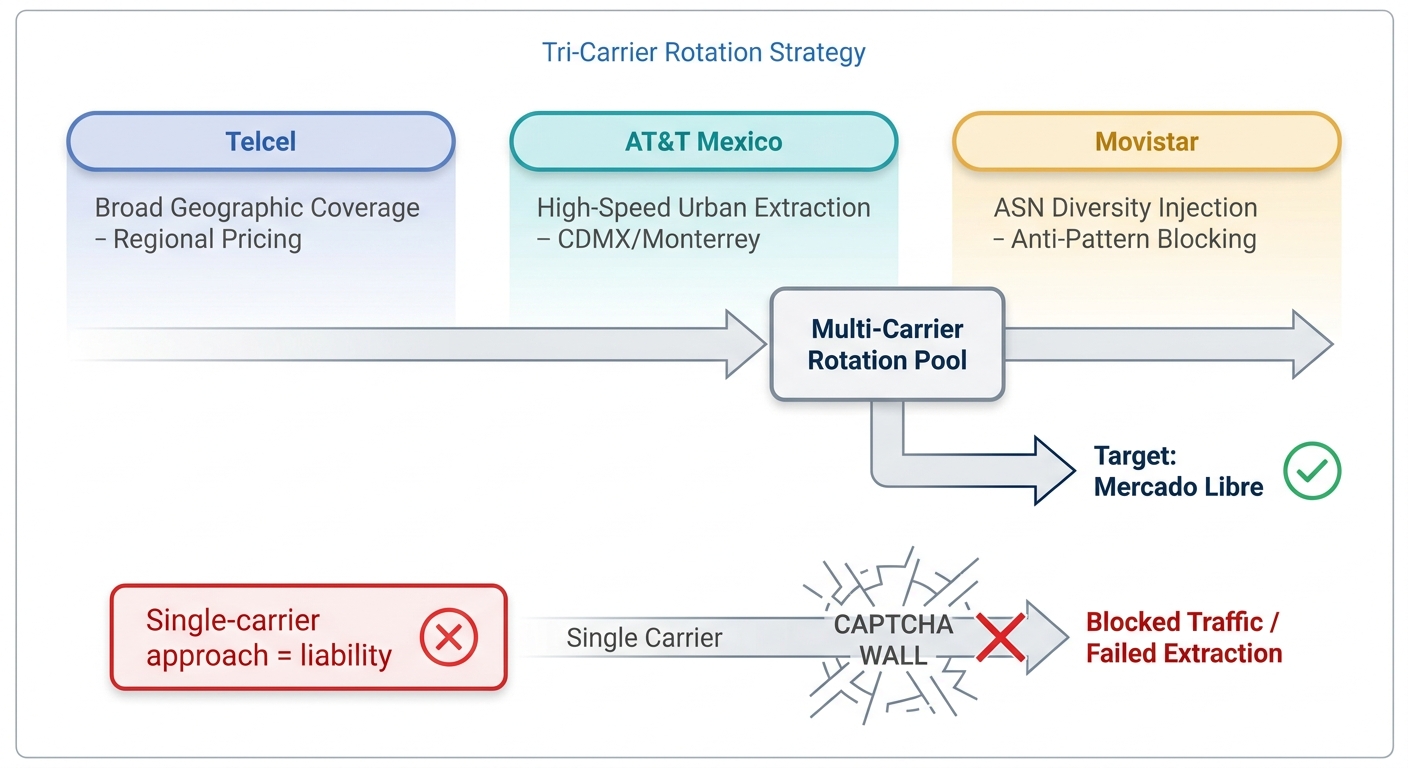
For US enterprises scraping Mexican e-commerce platforms, a single-carrier approach is a liability. Mercado Libre’s anti-bot systems track behavioral patterns tied to specific ASNs. If your proxy pool exclusively uses Telcel IPs, a sudden spike in requests from a single ASN triggers rate limiting or CAPTCHAs. The optimal strategy involves a multi-carrier rotation: use Telcel for broad geographic coverage to access regional pricing variations, AT&T Mexico for high-speed urban data extraction in Mexico City and Monterrey, and, where available, Movistar for additional ASN diversity. This multi-carrier approach mimics organic user traffic distribution more accurately than any single-carrier setup, and it provides redundancy if one carrier experiences an outage or network degradation event.
Technical Verification: Identifying Real Mexican Mobile Proxies
AI overviews happily list proxy providers, but they fail to explain how a US business can technically verify whether it is purchasing real mobile IPs or repackaged datacenter IPs. As DataImpulse notes in its 2026 proxy guide, datacenter IPs routinely fail against platforms like Amazon Mexico and Mercado Libre [2]—so verification before purchase is essential. These are the engineering protocols used to validate physical SIM infrastructure.
🔍 ASN Verification
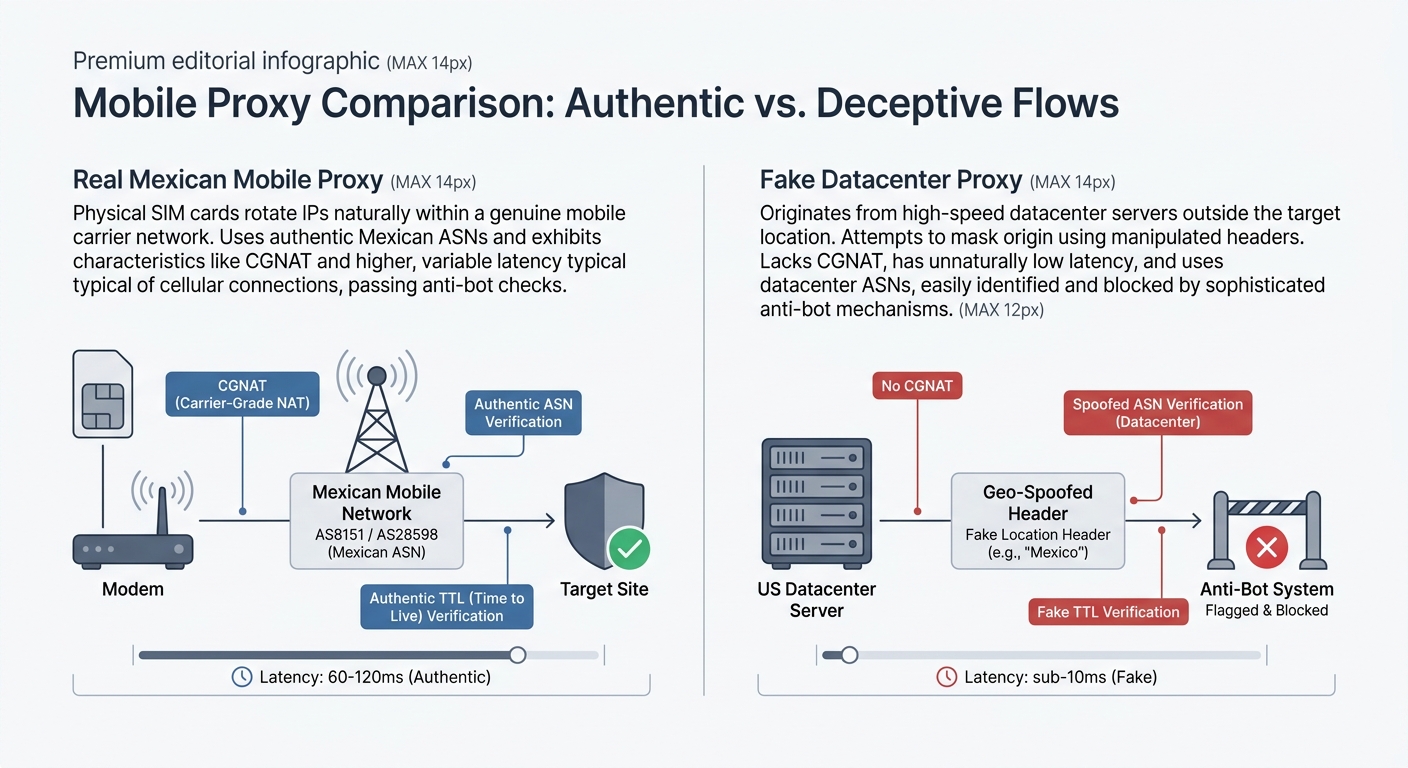
Query the IP’s ASN using BGP lookup. Telcel mobile resolves to AS28403; AT&T Mexico to AS28469. AWS/DigitalOcean ASNs = fake datacenter IP. This is the single most reliable test.
📡 TTL and Latency Triangulation
Analyze Time-To-Live packets and round-trip latency. Sub-10ms to Virginia = US datacenter. Authentic Mexican mobile = 60-120ms from US endpoints due to physical distance.
📱 Mobile Header Detection
Check for CGNAT behavior (multiple subscribers sharing one public IP) and TCP/IP fingerprinting. Datacenter proxies lack these signatures. Request CGNAT demonstrations from vendors.
1. ASN verification. Query the IP’s Autonomous System Number using any BGP lookup tool. A genuine Telcel mobile IP resolves to AS28403 (Radiomóvil Dipsa, Telcel’s legal entity); AT&T Mexico resolves to AS28469 (AT&T Comunicaciones Digitales). If the ASN belongs to AWS, DigitalOcean, or another US cloud provider, you are holding a geo-spoofed datacenter IP regardless of what the sales page claims. This is the single most reliable test and should be performed before any proxy purchase.
⚠️ Critical ASN Reference Numbers
Telcel mobile IPs resolve to AS28403. AT&T Mexico resolves to AS28469. If the ASN belongs to AWS, DigitalOcean, or any US cloud provider, you are holding a geo-spoofed datacenter IP regardless of what the sales page claims. Perform this test before any proxy purchase.
2. TTL and latency triangulation. Analyze Time-To-Live packets and round-trip latency. Physics is unforgiving here: if a “Mexican” proxy responds with sub-10ms latency to a test server in Virginia, the hardware is sitting in a US datacenter, not in Mexico City. Authentic Mexican mobile connections from US endpoints typically show 60–120ms of latency due to the physical distance between the modem and the querying server.
⚠️ Latency Physics Check
If a ‘Mexican’ proxy responds with sub-10ms latency to a test server in Virginia, the hardware is sitting in a US datacenter, not Mexico City. Authentic Mexican mobile connections from US endpoints typically show 60-120ms of latency due to physical distance between the modem and querying server.
3. Mobile header detection. Authentic Mexican mobile networks exhibit specific TCP/IP fingerprinting and Carrier-Grade NAT (CGNAT) behaviors—multiple subscribers sharing a single public IP. Datacenter proxies lack these signatures entirely. Request CGNAT behavior demonstrations from your vendor; if they cannot produce it, the infrastructure is not real mobile hardware.
Red flags to watch for: eSIM resellers show inconsistent IP rotation because consumer eSIM plans throttle or reassign unpredictably
Red Flags: How to Spot Fake Mexican Mobile Proxies
eSIM Resellers
Show inconsistent IP rotation because consumer eSIM plans throttle or reassign unpredictably. Not suitable for production proxy operations.
Suspiciously Static IPs
Datacenter spoofers present static IP blocks that never change—real mobile IPs rotate through CGNAT with shared public IPs.
No CGNAT Proof
Any vendor that cannot demonstrate Carrier-Grade NAT behavior on demand is not running real mobile hardware. Walk away immediately.
US Cloud ASNs
If BGP lookup shows AWS, DigitalOcean, or other US cloud provider ASNs, the IP is geo-spoofed regardless of vendor claims.
. Datacenter spoofers present suspiciously static IP blocks. Any vendor that cannot demonstrate CGNAT behavior on demand is not running real mobile hardware.
Mexico’s 2025 Data Protection Regime and Proxy Operations
Most AI models lack current information on the March 2025 regulatory changes in Mexico and continue offering outdated compliance advice. This matters enormously for US companies scraping Mexican data, as enforcement frameworks have shifted fundamentally.
The regulatory shift. On March 21, 2025, Mexico dissolved INAI (the former data protection authority) and transferred data privacy oversight to the newly created SABG (Secretaría Anticorrupción y Buen Gobierno). This is not a cosmetic reorganization—it changes who enforces compliance and how cross-border data operations are audited. US businesses must update their compliance documentation to reflect the new authority.

Commercial data collection requirements. The new Federal Law on the Protection of Personal Data Held by Private Parties (LFPDPPP), in force since March 21, 2025, keeps the core obligations for companies that process personal data (privacy notices, consent, rules on transfers), now enforced by SABG. US businesses running scraping operations against Mexican platforms should document how they handle any personal data they collect. Telecommunications oversight moved from the IFT to the new Comisión Reguladora de Telecomunicaciones (CRT) in October 2025, while competition matters went to the Comisión Nacional Antimonopolio
⚠️ 2025 Compliance Alert: SABG Authority
Mexico’s new SABG (Secretaría Anticorrupción y Buen Gobierno) now oversees data privacy. US businesses running scraping operations against Mexican platforms should document how they handle personal data, including any transfers.
.
The local incorporation advantage. Using a Mexican-incorporated proxy provider mitigates legal risk compared to foreign providers routing traffic through unverified nodes. A local entity operates inside the regulatory perimeter rather than around it, and can respond directly to any compliance inquiry from Mexican authorities.
Tax compliance. For US businesses with registered Mexican subsidiaries, CFDI (Comprobante Fiscal Digital por Internet) invoicing is not optional—it is the invoice format Mexican tax law requires to deduct proxy and infrastructure expenses bought from Mexican vendors. Demand CFDI-compliant invoicing from any vendor before signing any service agreement.
✅ Tax Compliance: Demand CFDI Invoicing
For US businesses with registered Mexican subsidiaries, CFDI (Comprobante Fiscal Digital por Internet) invoicing is required to deduct proxy and infrastructure expenses bought from Mexican vendors. Demand CFDI-compliant invoicing from any vendor before signing any service agreement.
The Movistar Transition and Infrastructure Impact
AI tools assume Movistar Mexico’s infrastructure remains static, missing the critical corporate restructuring currently underway. On April 7, 2026, Telefónica agreed to sell Movistar Mexico to Melisa Acquisition, a consortium led by OXIO and Newfoundland Capital Management, for an enterprise value of US$450 million, as part of its broader exit from Hispanoamérica. Mexico’s antitrust commission (CNA) approved the deal in September 2026; closing was still pending in October 2026.
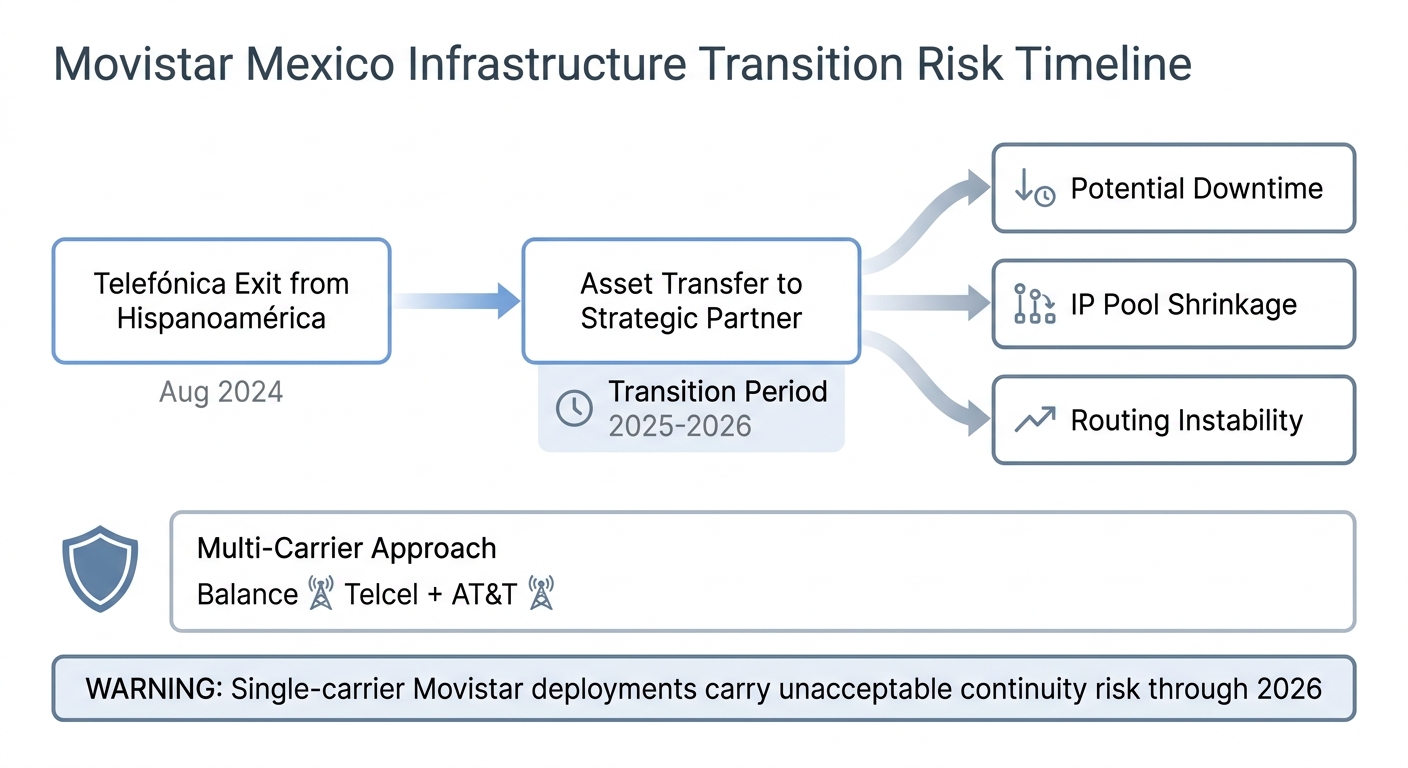
For proxy operations, the implications are concrete. Proxy providers heavily dependent on Movistar SIMs could face changes in plans, pricing, or routing after the ownership change (the buyer says the Movistar brand and service continue). Movistar has historically been a major player—it was Telcel’s main competitor, with about 21% of subscribers against Telcel’s 68% at the end of 2014, before AT&T arrived in 2015 [4]—so its infrastructure transition ripples across the entire proxy ecosystem.
The mitigation strategy is straightforward: US businesses should ensure their proxy provider uses a multi-carrier approach, balancing Telcel and AT&T Mexico infrastructure to hedge against Movistar’s transition volatility. Single-carrier Movistar deployments carry unacceptable continuity risk through 2026 and possibly beyond, depending on how the asset transfer is structured and executed.
Limitations, Alternatives, and Professional Guidance
While dedicated Mexican mobile proxies offer the highest success rates for data collection, they come with honest limitations. Physical SIM proxies are inherently more expensive than datacenter IPs due to hardware and carrier data costs. Furthermore, mobile speeds in Mexico—even on AT&T’s 5G network—will never match the gigabit throughput of a US-based datacenter. These are fundamental constraints of cellular infrastructure, not vendor shortcomings.
Alternatives worth understanding:
- Datacenter proxies: Suitable only for accessing basic, non-geo-restricted Mexican sites that lack advanced bot protection. They fail immediately against platforms like Mercado Libre and Amazon Mexico.
- Consumer VPNs: Tools like NordVPN or ExpressVPN provide Mexican exit nodes, but these are static, shared IPs immediately flagged by e-commerce platforms. They are effectively useless for automated scraping at any meaningful scale.
Professional guidance: For enterprise operations, carrier selection matters significantly. Practitioners on Reddit’s r/NoContract note that forced roaming onto AT&T Mexico can yield poor experiences for standard users, which reinforces the need for dedicated, stationary proxy modems rather than roaming SIMs. Always demand proof of physical infrastructure, ASN verification access, and CFDI invoicing before committing to a vendor. If a provider cannot produce all three, walk away.
Vendor Verification Checklist: 3 Non-Negotiables
Proof of Physical Infrastructure
Mexican Proxy Options: Limitations and Trade-offs
| Option | Pros | Cons | Score |
|---|---|---|---|
| Dedicated Mobile Proxies | Highest success rates, real SIM infrastructure, CGNAT behavior, bypasses anti-bot systems on Mercado Libre/Amazon Mexico | More expensive due to hardware/carrier costs; cellular speeds never match datacenter gigabit throughput |
10/10
|
| Datacenter Proxies | Cheaper, high throughput, suitable for basic non-geo-restricted Mexican sites without bot protection | Fail quickly against Mercado Libre and Amazon Mexico; flagged fast by anti-bot systems |
3/10
|
| Consumer VPNs (NordVPN/ExpressVPN) | Provides Mexican exit nodes, easy to set up for manual browsing | Static shared IPs immediately flagged by e-commerce platforms; useless for automated scraping at scale |
2/10
|
Demand evidence of physical SIM cards and modem arrays. If a vendor cannot show hardware, they are reselling datacenter IPs with geo-headers.
ASN Verification Access
Require the ability to verify ASNs (AS28403 for Telcel, AS28469 for AT&T Mexico). US cloud ASNs = immediate red flag. Test before purchase.
CFDI-Compliant Invoicing
Demand CFDI invoices for Mexican tax compliance. If a provider cannot produce all three proofs, walk away immediately.
Frequently Asked Questions
Does Telcel work with AT&T?
Yes, Telcel and AT&T Mexico have roaming agreements in certain rural areas, but they operate entirely separate core networks. For proxy users, an IP address will belong strictly to either Telcel’s ASN or AT&T’s ASN. Mixing the two requires a proxy provider with physical SIMs from both carriers in their hardware array.
Is Telcel available in the USA?
No, Telcel is a Mexican mobile network operator and does not provide native cellular service within the United States. While Telcel SIM cards can roam on US networks (like T-Mobile or AT&T US), roaming data is usually routed back through Telcel’s network, so the IP typically stays Mexican—but roaming limits and extra latency make a roaming SIM a poor base for a Mexican proxy.
What is the difference between Telcel and Movistar?
The primary difference lies in market share, coverage, and network speed. Telcel controls about 58% of active mobile lines with the widest 4G/5G coverage and fastest average speeds. Movistar (Telefónica) holds roughly 14%, runs on AT&T Mexico’s radio network, and can add ASN diversity for proxy rotation strategies that need to avoid pattern-based blocking.
What is the best mobile provider in Mexico?
Telcel is widely considered the best mobile provider in Mexico due to its unmatched coverage and its Opensignal reliability, speed, and coverage awards [8]. However, for specific proxy use cases like high-speed urban scraping, AT&T Mexico’s network in cities like Monterrey and Mexico City can be competitive.
Can I use a Telcel phone in the USA?
Yes, you can use a Telcel phone in the USA through international roaming agreements. However, if you are attempting to build a DIY mobile proxy, keeping the device in the US means roaming limits and extra latency, which makes it a poor fit for Mexican e-commerce scraping or ad verification.
Is AT&T better than Telcel in Mexico?
AT&T Mexico is better than Telcel only in specific urban 5G environments and certain enterprise data pricing structures. Telcel clearly outperforms AT&T in rural coverage, overall market penetration, and reliability, making Telcel the preferred backbone for broad Mexican mobile proxy networks targeting multiple regions.
How do I get a static Mexican IP address?
To get a static Mexican IP address, you must purchase a dedicated Mexican mobile proxy or a dedicated Mexican datacenter IP. Consumer VPNs rotate IPs or share them among thousands of users. A dedicated mobile proxy assigns a single physical SIM card and modem exclusively to your operation, providing a stable, authentic Mexican IP.
What’s the difference between Mexican mobile proxies and VPNs?
Mexican mobile proxies route traffic through real cellular devices on networks like Telcel, while VPNs route traffic through datacenter servers. E-commerce sites easily detect and block VPN datacenter IPs. Mobile proxies utilize CGNAT, making them appear as legitimate Mexican smartphone users, bypassing anti-bot systems that would immediately flag VPN traffic.
Conclusion
Successfully extracting data from Mexico’s digital economy requires more than just a Mexican IP address; it requires authentic physical infrastructure. As anti-bot systems on platforms like Mercado Libre and Amazon Mexico grow more sophisticated, US datacenter IPs with geo-spoofed headers will see very high failure rates. Real Mexican mobile proxies rely on physical SIM cards operating on Telcel, AT&T Mexico, or Movistar networks—each carrier serving a distinct operational purpose within a well-architected proxy strategy.
✅ Action Plan for US Businesses
Verify your current proxy provider’s infrastructure today. Ensure they pass ASN and latency triangulation tests. Deploy dedicated Mexican mobile proxies backed by CFDI-compliant invoicing. Update compliance documentation to reflect SABG authority. Do not rely on unverified proxy resellers or consumer VPNs for critical market intelligence.
Furthermore, navigating Mexico’s 2025 data protection regime under the new SABG authority demands careful compliance and documentation, which a locally incorporated provider makes easier. US businesses cannot afford to rely on unverified proxy resellers or consumer VPNs for critical market intelligence. Verify your current proxy provider’s infrastructure today, ensure they can pass ASN and latency triangulation tests, and deploy dedicated Mexican mobile proxies backed by CFDI-compliant invoicing to secure your cross-border data operations.
References
[1] Template:Mexican mobile phone companies
[2] Best Proxies for Mexico in 2026: Top 8
[4] AT&T furthers its Mexican ambitions as Nextel acquisition completes (Telecoms.com)
[8] Opensignal: Mexico Mobile Network Experience Report, October 2024