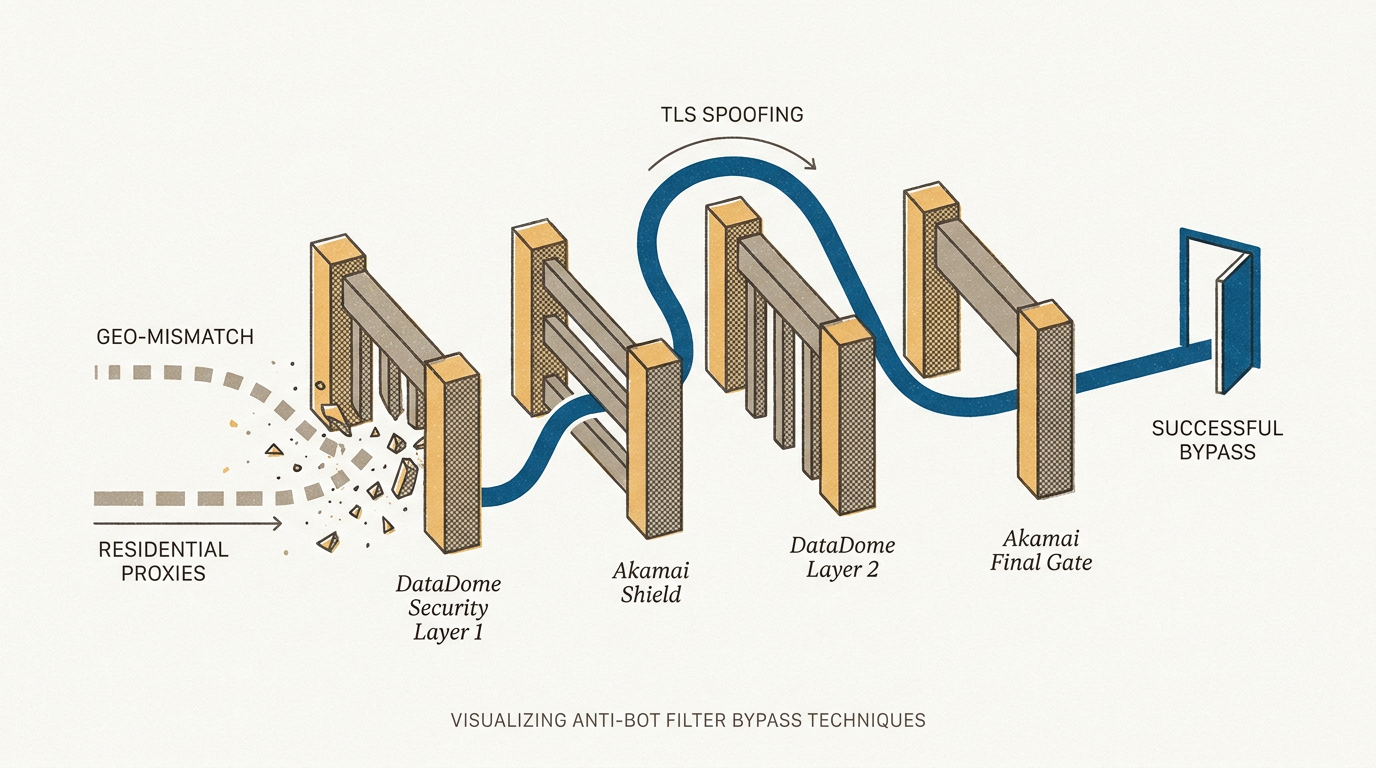
To get past anti-bot protections such as DataDome or Akamai Bot Manager on large Mexican e-commerce sites, you must satisfy both the IP reputation layer and the TLS fingerprinting checks. Datacenter IPs and proxies that only geolocate to Mexico are easily flagged. In 2026, an effective method is combining real Mexican 4G mobile proxies (Telcel, AT&T) with a real browser engine whose TLS and browser fingerprints are consistent, such as Camoufox or a carefully configured Playwright setup.
⚠️ Key Takeaway: Two Layers You Must Defeat
To get past DataDome or Akamai Bot Manager on large Mexican e-commerce sites, you must satisfy BOTH the IP reputation layer AND the TLS fingerprinting checks. Datacenter IPs and proxies that only geolocate to Mexico are easily flagged. The 2026 approach: real Mexican 4G mobile proxies (Telcel, AT&T) paired with a real browser engine with consistent TLS and browser fingerprints, such as Camoufox.
Introduction
The Mexican e-commerce sector is expanding rapidly, making localized pricing and inventory data highly valuable for US developers and enterprise data teams. However, scraping large Mexican retailers has become a high-stakes technical challenge. Sites such as Coppel and Liverpool are served through Akamai (Liverpool sets Akamai Bot Manager cookies), and vendors like DataDome protect many other e-commerce sites, so standard scraping setups often trigger instant blocks or endless CAPTCHA loops.
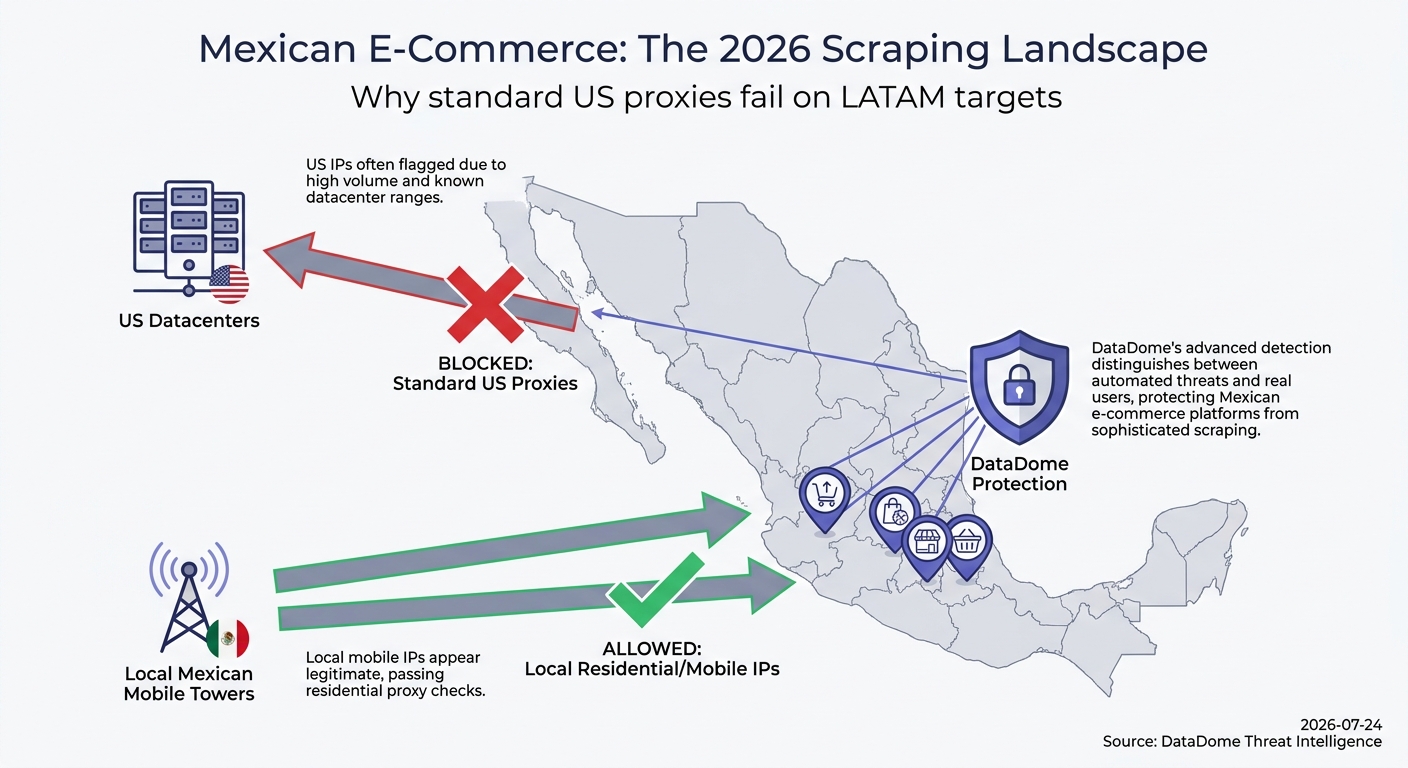
This guide breaks down exactly why legacy bypass tools fail in 2026 and provides a concrete, code-ready blueprint for bypassing DataDome. You will learn how to align your TLS fingerprinting with real Mexican IP reputation using hardware-backed 4G mobile proxies, for more reliable data extraction. Whether your goal is to bypass datadome scraping mexico or simply to optimize your existing architecture, understanding these modern detection layers may help you maintain consistent access to vital e-commerce data. We will cover the critical failures of spoofed residential proxies, the reality of per-customer machine learning models, and the exact cost breakdown of building your own infrastructure versus relying on managed APIs.
Author Credentials
Name: The ProxyServer.tech Engineering Team
Bio: Enterprise proxy infrastructure specialists operating physical 4G/5G mobile modems in Mexico City. Experts in reverse-engineering anti-bot systems and optimizing high-volume web scraping architectures.
Author Credentials
ProxyServer.tech Engineering Team
Enterprise proxy infrastructure specialists operating physical 4G/5G mobile modems in Mexico City.
Anti-Bot Reverse Engineering
Experts in reverse-engineering DataDome, Akamai, and other modern anti-bot protection systems.
High-Volume Architecture
Specialists in optimizing large-scale web scraping architectures for enterprise data teams.
Transparency Disclosure
This guide contains technical analysis based on publicly documented behaviour of DataDome’s and Akamai’s protection layers and community reports. While we recommend our own Mexican 4G mobile proxies for optimal results, the fingerprinting and bypass methodologies discussed apply universally to modern web scraping frameworks.
Expert Consensus Box
“Try playwright in combination with pupeteer stealth and make your script much slower. Use more proxies to balance the speed.” — r/webscraping thread (May 2025)
Expert Community Consensus
💡r/webscraping (May 2025)
Try Playwright in combination with Puppeteer Stealth and make your script much slower. Use more proxies to balance the speed.
⚠️Stack Overflow (2022)
If you’re using Selenium to bypass DataDome, you need to patch many of these holes to get out of the low trust zone.
“If you’re using Selenium to bypass Datadome, you need to patch many of these holes to get out of the low trust zone.” — Stack Overflow answer (Aug 2022)
The “Fake” Mexican IP Trap and IP Reputation Failures
When developers attempt to bypass datadome scraping mexico, a common piece of generic advice is to “use a Mexican residential proxy network to bypass location checks.” However, this approach misses a critical reality of modern bot detection. Not every IP sold as “Mexican” is a genuine Mexican residential or mobile connection; some are datacenter or hosting IPs that merely geolocate to Mexico.
Anti-bot IP reputation layers such as DataDome’s score each IP by connection type (datacenter, ISP or mobile), history and geolocation [2], so these IPs are flagged quickly on protected sites.
To verify if your proxy is truly Mexican, you can inspect the ASN and routing path using tools like IPinfo.io or MaxMind. If the ASN belongs to a datacenter provider (e.g., AWS, DigitalOcean, or a commercial proxy network) rather than a local ISP (e.g., Telcel, AT&T, or Movistar), anti-bot systems are far more likely to flag it. Developers must audit their proxy providers by running a simple cURL request to an IP geolocation API before initiating any scraping tasks. If the ASN does not belong to a Mexican ISP or mobile carrier, the IP is not a genuine Mexican connection.
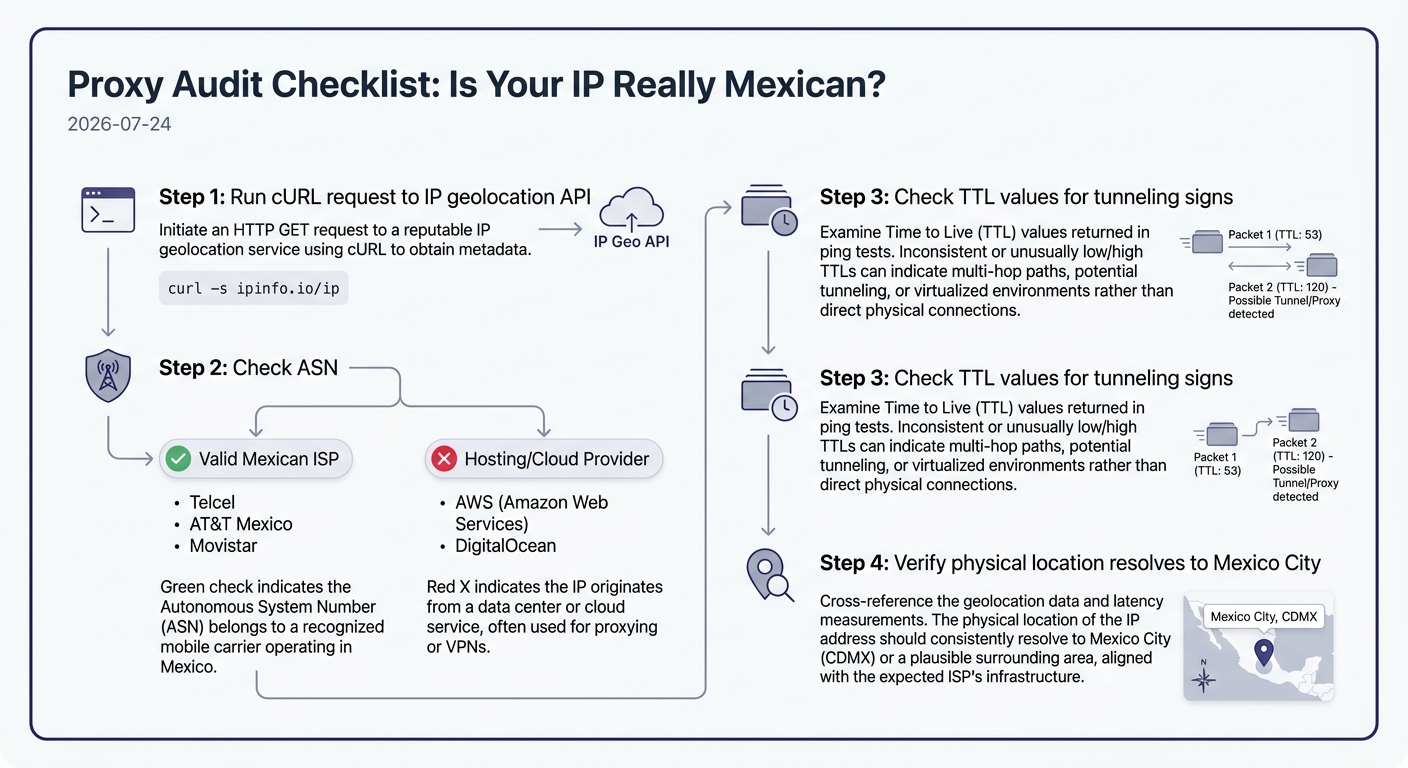
To overcome this, your scraper must fully mirror a real user, satisfying all detection layers simultaneously [2]. ProxyServer.tech operates physical hardware modems in Mexico City, providing native Mexican IP addresses that pass strict ASN checks. DataDome scores IP reputation using signals such as connection type (datacenter vs. ISP vs. mobile), history and geolocation [2].
| Feature | Real SIM (Telcel/AT&T) | Spoofed Residential Proxy |
|---|---|---|
| ASN Type | Native Mobile ISP | Datacenter / Commercial |
| Geo-Routing | Local Mexico City | May not actually be in Mexico |
| Detection Rate | Lower | High |
Real SIM vs. Spoofed Residential Proxy
| Option | Pros | Cons | Score |
|---|---|---|---|
| Real SIM (Telcel/AT&T) | Native Mobile ISP ASN — passes strict ASN checks. Local Mexican carrier routing. Lower detection risk. | Requires physical hardware infrastructure in Mexico. Higher upfront setup complexity. |
9/10
|
| Spoofed Residential Proxy | Easy to acquire. Cheap per-IP pricing. Large IP pools available. | Datacenter/commercial ASN — easily flagged by IP reputation checks. Location may not match Mexico. High detection rate. |
3/10
|
Real SIM-backed hardware modems look like genuine Mexican mobile users, which may help reduce detection rates compared to legacy methods. By relying on authentic mobile proxies instead of datacenter-backed residential proxies, developers can establish a much stronger foundation for their scraping operations.
Navigating Per-Customer ML Models on Mexican Retail Sites
A common misconception is that DataDome uses a standard set of rules to block bots globally. What this overlooks is that DataDome says it runs more than 85,000 customer-specific and use-case-specific AI models [5]. A bypass configuration that works on a US retailer can fail on a Mexican retailer because the baseline behavioral analysis and traffic patterns differ.
Success rates vary significantly by method and target. Mexican retail sites expect specific navigation flows, localized headers (es-MX), and mobile-heavy traffic distributions. During Hot Sale 2025, AMVO reported that 74% of campaign traffic came from mobile [7]. Anti-bot models learn each site’s normal traffic mix, so a desktop User-Agent combined with a mobile carrier IP address can look inconsistent.
To navigate these per-customer ML models, developers must implement precise session warm-up methodologies. Warming up a session on the target’s Mexican homepage to build trust before executing search queries is a common approach. This involves loading the homepage, fetching static assets, and simulating human-like scroll events over several seconds.
A proper session warm-up sequence for Mexican targets should follow these steps:
🏠 Initial Homepage Load
Navigate to the target’s Mexican homepage (e.g., mercadolibre.com.mx) and wait for full DOM and asset rendering.
📦 Asset Fetching
Ensure your scraper naturally fetches CSS, JavaScript, and image files to mimic a real browser load completely.
🖱️ Human Simulation
Execute randomized mouse movements and scroll events for 3-5 seconds. Anti-bot scripts such as DataDome’s and Akamai’s collect mouse and scroll behaviour.
🔍 Localized Search
Only after establishing baseline trust, input a search query. Ensure Accept-Language header is set to es-MX.
- Initial Homepage Load: Navigate to the target’s Mexican homepage (e.g.,
mercadolibre.com.mx) and wait for full DOM and asset rendering. - Asset Fetching: Ensure your scraper naturally fetches CSS, JavaScript, and image files to mimic a real browser load.
- Human Simulation: Execute randomized mouse movements and scroll events for 3-5 seconds. Anti-bot scripts such as DataDome’s and Akamai’s collect mouse and scroll behaviour.
- Localized Search: Only after establishing this baseline trust should you input a search query or navigate to a specific product page. Ensure your
Accept-Languageheader is set toes-MX.
By aligning your behavioral analysis footprint with local consumer habits, your scraping architecture can support more reliable extraction. Ignoring these localized ML models is associated with higher block rates, even when using premium proxies. Bypassing Datadome in 2026 requires a combination of fingerprint management, behavioral simulation, and proxy rotation [3].
Spoofing TLS and HTTP/2 Fingerprints in 2026
Many legacy tutorials suggest that you simply rotate your User-Agent to avoid detection. In 2026, simply changing a User-Agent is a highly detectable action. DataDome inspects TLS fingerprints (JA3/JA4) and HTTP/2 settings [3][4], and Akamai has published research on passive HTTP/2 client fingerprinting.
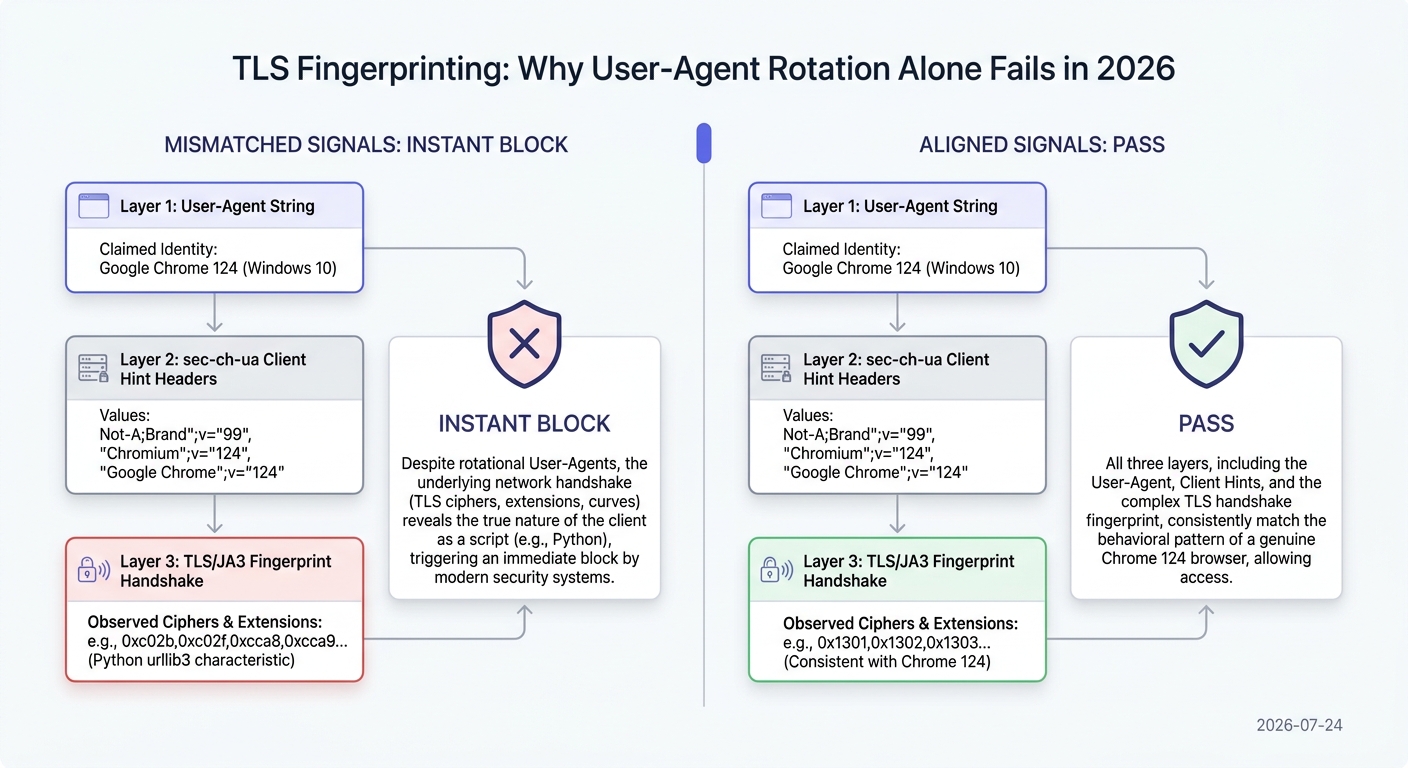
If the User-Agent claims to be Chrome 124 but the TLS cipher suite matches a standard Python requests library, the request is likely to be challenged with a CAPTCHA or blocked. Python’s requests library relies on urllib3, which presents a distinct TLS fingerprint that anti-bot systems such as DataDome can easily tell apart from a real browser [4]. Browser fingerprinting and device fingerprinting are tied together tightly at the network layer. If you’re using Selenium to bypass Datadome, you need to patch many of these holes to get out of the low trust zone [8].
A frequent mistake developers make is updating the User-Agent but forgetting the sec-ch-ua
⚠️ Critical Mistake: Forgetting sec-ch-ua Headers
A frequent mistake is updating the User-Agent but forgetting the sec-ch-ua client hint headers that modern Chrome browsers automatically send. DataDome cross-references these headers with the TLS handshake. If your sec-ch-ua claims Chrome 124 but your TLS fingerprint matches an older Python library, the request is likely to be challenged or blocked. Additionally, not setting Accept-Language to es-MX,es;q=0.9 on Mexican targets makes the request look less like a local user, regardless of proxy location.
client hint headers, which modern Chrome browsers automatically send. DataDome cross-references these headers with the TLS handshake. If your sec-ch-ua claims to be Chrome 124 but your TLS fingerprint matches an older Python library, the request is likely to be challenged or blocked. Additionally, not setting the Accept-Language header to es-MX,es;q=0.9 on Mexican targets makes the request look less like a local user, regardless of your proxy location.
A DataDome bypass is a technique or service that allows automated requests to pass through DataDome’s multi-layer bot protection (including CAPTCHA and device fingerprinting). The most effective solution involves utilizing modern frameworks like Nodriver, Camoufox, or Playwright with stealth patches to align the TLS cipher suite with the browser headers. Tools like Camoufox, a Firefox build, report spoofed fingerprint values from C++ rather than relying on JavaScript injections, which anti-bot scripts can detect; its TLS handshake stays that of stock Firefox.
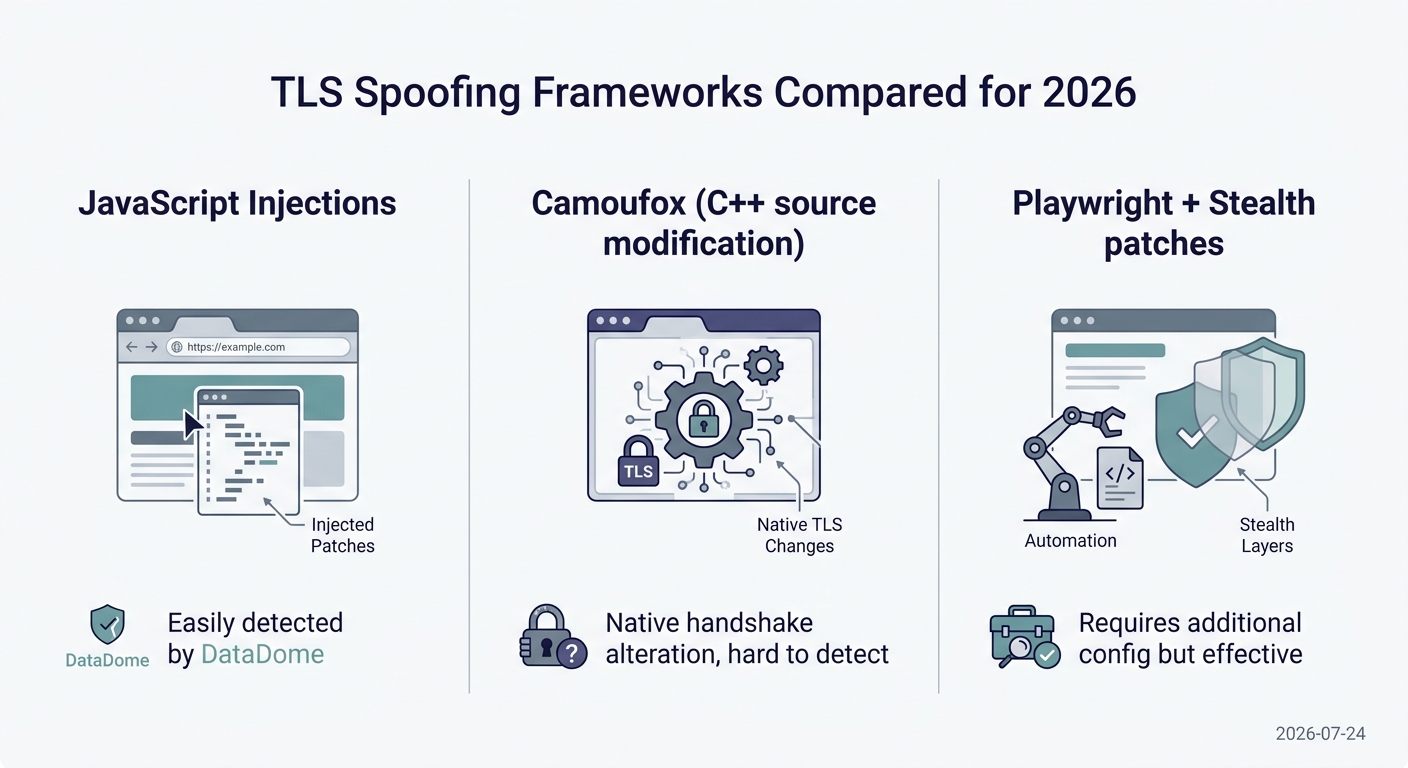
Master DataDome bypass with Playwright & Kameleo: spoof fingerprints, emulate human mouse behavior, rotate proxies, and scrape [6]. Furthermore, community consensus suggests that you should try playwright in combination with pupeteer stealth and make your script much slower [1].
# Example of Playwright Stealth configuration concept for Mexican Targets
import asyncio
from playwright.async_api import async_playwright

async def scrape_mexico_site():
    async with async_playwright() as p:
        browser = await p.chromium.launch(args=['--disable-blink-features=AutomationControlled'])
        context = await browser.new_context(
            user_agent='Mozilla/5.0 (Windows NT 10.0; Win64; x64) AppleWebKit/537.36 (KHTML, like Gecko) Chrome/124.0.0.0 Safari/537.36',
            locale='es-MX',
            timezone_id='America/Mexico_City',
            extra_http_headers={
                'Accept-Language': 'es-MX,es;q=0.9',
                'sec-ch-ua': '"Chromium";v="124", "Google Chrome";v="124", "Not-A.Brand";v="99"'
            }
        )
        page = await context.new_page()
        # Apply stealth scripts and JA3 spoofing integration here
        await page.goto('https://example.mx')
Properly aligning your JA3 fingerprinting with your device fingerprinting helps reduce the likelihood of triggering a CAPTCHA and supports a more stable scraping pipeline.
The Cost Economics of Dedicated Mobile Proxies Versus Managed APIs
When facing complex protections, developers are often told to use a managed web scraping API to bypass DataDome. While you can learn how to easily bypass DataDome’s anti-bot challenges with effective strategies using these tools [9], managed APIs charge per-request fees for successful bypasses. On DataDome-level targets these can reach several dollars per 1,000 requests: ScrapingBee, for example, charges 75 credits per successful DataDome request [2], roughly $3.60–$6.20 per 1,000 on its Business and Enterprise plans.
Managed Scraping API vs. Dedicated Mobile Proxies
| Option | Pros | Cons | Score |
|---|---|---|---|
| Managed Scraping API | No engineering required. Handles fingerprinting automatically. Quick setup for small-scale needs. | Several dollars per 1K successful requests on heavily protected sites. Concurrency limits can throttle speed. May cache data instead of real-time. 10M pages/month can exceed $36,000. |
4/10
|
| Dedicated Mobile Proxies (ProxyServer.tech) | From $115/month per proxy with 1 GB/day of data (2 GB/day: $219; 5 GB/day: $525). Unlimited IP rotations. Real-time data access. Dedicated SIM. Native Mexican IPs. | Requires maintaining custom Playwright/Nodriver scripts. Engineering resources needed for setup. Daily data allowance caps volume. |
9/10
|
For enterprise-scale scraping, this adds up quickly, and paying per successful request is not always scalable. For an enterprise scraping 10 million pages monthly at that rate, managed API costs can exceed $36,000.
Beyond the base per-request fees, managed APIs often hide additional costs. Some providers enforce concurrency limits that throttle your extraction speed, forcing you to purchase higher-tier plans. Furthermore, API providers may cache data, meaning you are not receiving real-time pricing or inventory updates—a critical flaw for competitive intelligence in fast-moving Mexican markets. Using a dedicated hardware endpoint eliminates these per-request costs and ensures you are hitting the target site directly for the freshest data possible.
Dedicated mobile proxies are billed per month with a data allowance rather than per request, providing a predictable-cost alternative for high-volume extraction.
| Solution Type | Cost Structure | Monthly Estimate (1M Requests) |
|---|---|---|
| Managed Scraping API | ~$3.60 – $6.20 per 1k successful requests (e.g. ScrapingBee on DataDome-level targets) | ~$3,600 – $6,200 |
| ProxyServer.tech Mobile | Monthly plan per proxy with a daily data allowance | From $115 (1 GB/day) to $525 (5 GB/day) per proxy, depending on data volume |
By choosing to buy Mexican 4G proxies, developers get a dedicated mobile proxy for scraping from $115/month (1 GB/day included). A dedicated endpoint lets developers run requests through high-trust mobile IPs without paying per-page-load premiums, within the plan’s data allowance. This economic shift may help organizations scale their data operations sustainably while maintaining high success rates.
Limitations, Alternatives, and Professional Guidance
Bypassing DataDome remains a continuous cat-and-mouse game. Even with real Mexican 4G proxies and perfect TLS spoofing, aggressive scraping speeds will trigger behavioral blocks or CAPTCHA challenges. If you lack the engineering resources to maintain custom Playwright or Nodriver scripts, expensive managed APIs handle the fingerprinting for you, though at a significantly higher cost per request. Whatever the setup, collect only publicly available data, review each site’s terms of service and robots.txt, keep request rates modest, and use an official API where one exists (Mercado Libre, for example, offers a developer API).

Even with the most sophisticated setup, aggressive concurrency will trigger blocks. DataDome monitors request velocity per IP. If you send 100 requests per second from a single mobile IP, the behavioral model will flag it as a bot, regardless of how perfect your TLS fingerprint is. A best practice is to limit concurrency to 1-2 concurrent requests per mobile IP and implement randomized delays (e.g., 2-5 seconds) between page loads. If a block does occur, pause, lower your request rate, and only then resume on a fresh mobile connection.
⚠️ Concurrency Limits: Don’t Trigger Behavioral Blocks
Even with perfect TLS spoofing and real Mexican 4G proxies, aggressive concurrency will trigger blocks. DataDome monitors request velocity per IP. Sending 100 requests/second from a single mobile IP flags the behavioral model as a bot. Best practice: limit to 1-2 concurrent requests per mobile IP and implement randomized delays of 2-5 seconds between page loads. If blocked, pause, lower your request rate and only then resume on a fresh mobile connection.
Always implement robust error handling to detect CAPTCHA responses early. DataDome typically returns a 403 Forbidden status code with a datadome cookie and a challenge page loaded from captcha-delivery.com; Akamai usually answers with a 403 “Access Denied” page. Your HTTP interceptor should constantly monitor for these signs. Upon detection, pause extraction and rotate your mobile proxy IP immediately to preserve the IP’s reputation. Bypass techniques involve mimicking legitimate traffic, which requires constant tuning as DataDome updates its models.
📡 Monitor HTTP Responses
Your HTTP interceptor should constantly monitor for 403 Forbidden status codes from DataDome.
🔍 Check for Challenge Markers
DataDome blocks usually come as a 403 with a datadome cookie and a challenge from captcha-delivery.com.
⏸️ Pause Extraction Immediately
Upon detecting the CAPTCHA header, pause all extraction activity to preserve the IP’s remaining reputation.
🔄 Rotate to Fresh Mobile IP
Retire the flagged IP and rotate to a fresh mobile proxy connection to continue scraping operations.
Frequently Asked Questions About Bypassing DataDome
How does DataDome detect web scrapers?
DataDome detects web scrapers using a multi-layered approach that analyzes IP reputation, TLS/JA3 fingerprinting, browser fingerprints, and behavioral analysis. If your request lacks the proper HTTP/2 frames or exhibits non-human navigation patterns, it is flagged and blocked before the page loads.
💡 FAQ: How DataDome Detects Scrapers
DataDome uses a multi-layered approach analyzing IP reputation, TLS/JA3 fingerprinting, browser fingerprints, and behavioral analysis. If your request lacks proper HTTP/2 frames or exhibits non-human navigation patterns, it is flagged and blocked before the page loads. No single layer is sufficient — all must be satisfied simultaneously.
Can you bypass DataDome with residential proxies?
You can bypass DataDome with residential proxies, but only if they are high-quality and geographically accurate. However, proxies whose IPs belong to datacenter or hosting ASNs, or that only geolocate to Mexico, are easily flagged by IP reputation checks, making real 4G mobile proxies a safer alternative.
Why is my scraper blocked on Mexican e-commerce sites?
Your scraper may be blocked on Mexican e-commerce sites because anti-bot systems such as DataDome (which uses customer-specific models) or Akamai Bot Manager evaluate your IP, fingerprints and behaviour. A scraping script that works on a US site can fail on a Mexican retailer if it does not match the specific localized traffic baselines and behavioral expectations of that region.
How to fix DataDome CAPTCHA slider?
To fix a DataDome CAPTCHA slider, you must avoid triggering it entirely by improving your IP trust score. Third-party CAPTCHA solvers frequently fail because DataDome flags the underlying browser fingerprint. Using a dedicated mobile proxy and a browser with a consistent TLS fingerprint can make the CAPTCHA appear far less often.
Does Playwright stealth work against DataDome in 2026?
Playwright stealth does work against DataDome in 2026, but it requires additional configuration. Stealth plugins are increasingly detected, so many teams switch to browsers that patch fingerprints natively, such as Camoufox or the Kameleo anti-detect browser, and you must drastically slow down your script execution to mimic human behavioral analysis.
What is the best proxy location for scraping Mexico?
The best proxy location for scraping Mexico is physically inside Mexico (for example Mexico City) on local carriers like Telcel, AT&T, or Movistar. Datacenter IPs, even ones geolocated to Mexico, are much more likely to trigger IP reputation filters and blocks on protected sites.
✅ FAQ: Best Proxy Location for Mexico
The best proxy location for scraping Mexico is physically inside Mexico (for example Mexico City) on local carriers like Telcel, AT&T, or Movistar. Datacenter IPs, even ones geolocated to Mexico, are much more likely to trigger IP reputation filters and blocks on protected sites.
Conclusion
Successfully bypassing DataDome on Mexican targets in 2026 requires moving beyond basic User-Agent rotation. You must satisfy all detection layers simultaneously, from spoofing JA3 TLS fingerprints to navigating per-customer ML models with human-like behavioral pacing. Most importantly, your infrastructure must match your target.

Stop burning through expensive API credits and low-quality spoofed residential IPs. ProxyServer.tech provides a dedicated Mexican mobile modem physically located in Mexico City. Powered by real Telcel and AT&T SIM cards, our hardware gives you genuine Mexican mobile IPs that hold up far better against IP reputation checks. Secure your dedicated Mexican mobile modem today and scale your scraping operations responsibly.
References
[1] How to bypass datadome in 2025?. https://www.reddit.com/r/webscraping/comments/1kjvn2p/how_to_bypass_datadome_in_2025/
[2] How to Bypass DataDome: A Complete Guide for Web …. https://www.scrapingbee.com/blog/how-to-bypass-datadome/
[3] How to Bypass Datadome Anti Scraping in 2026. https://scrapfly.io/blog/posts/how-to-bypass-datadome-anti-scraping
[4] How TLS Fingerprinting Reinforces DataDome’s Protection (DataDome). https://datadome.co/engineering/how-tls-fingerprinting-reinforces-datadomes-protection/
[5] DataDome’s Advancements in Multi-layered AI Put Businesses in Control of AI Agents (Apr 2025). https://cioinfluence.com/security/datadomes-advancements-in-multi-layered-ai-put-businesses-in-control-of-ai-agents/
[6] Guide to Bypassing DataDome in 2025. https://kameleo.io/blog/guide-to-bypassing-datadome
[7] Más del 70% del tráfico en Hot Sale 2025 provino del canal móvil (Mobile Time, AMVO data). https://mobiletime.la/noticias/10/07/2025/hot-sale-2025-canal-movil/
[8] Website using DataDome gets captcha blocked while …. https://stackoverflow.com/questions/62199222/website-using-datadome-gets-captcha-blocked-while-scraping-using-selenium-and-py
[9] How To Bypass and Scrape DataDome Protected Sites. https://www.scraperapi.com/blog/how-to-scrape-datadome-protected-websites-with-python/