Key Takeaways
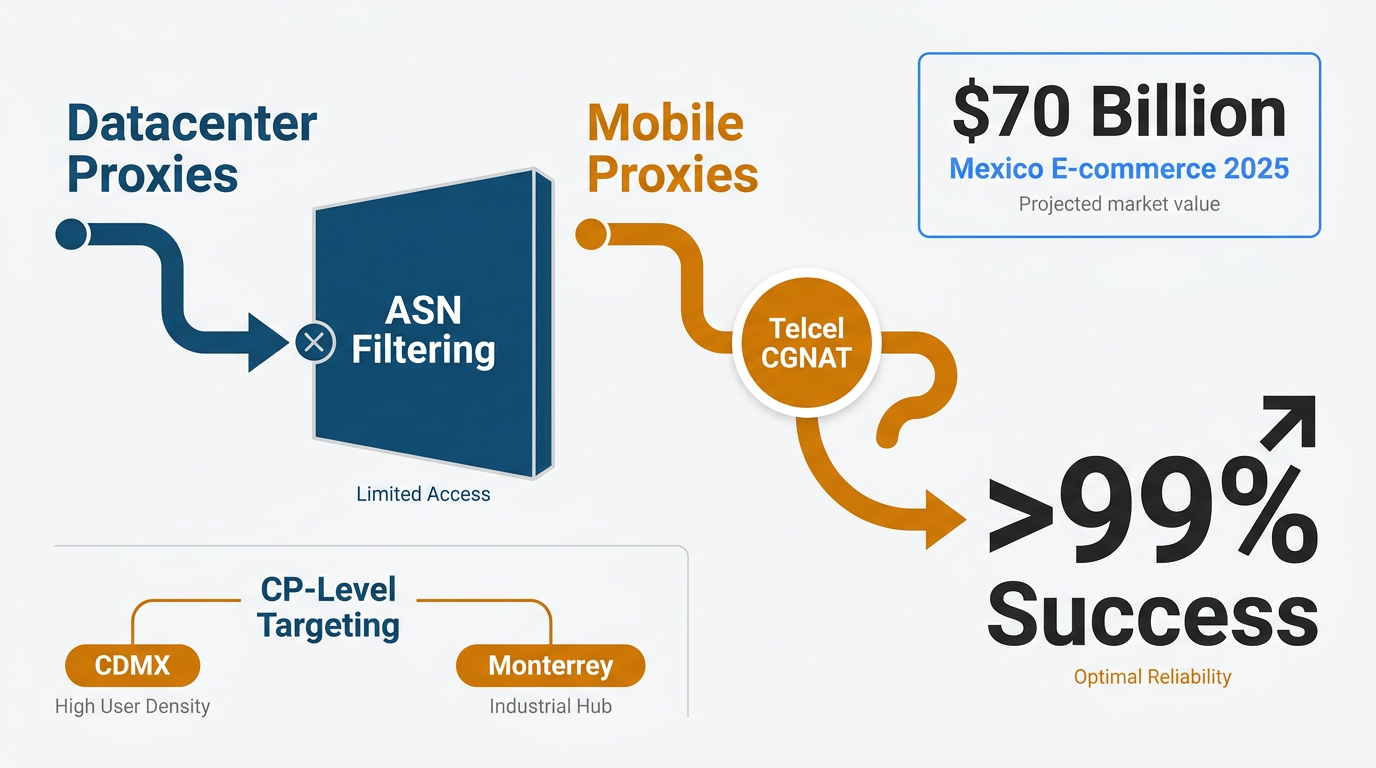
For US data teams scraping Mexican e-commerce, generic datacenter proxies are prone to instant IP blocks on platforms like Mercado Libre MX and Walmart MX due to strict ASN filtering. Mobile proxies
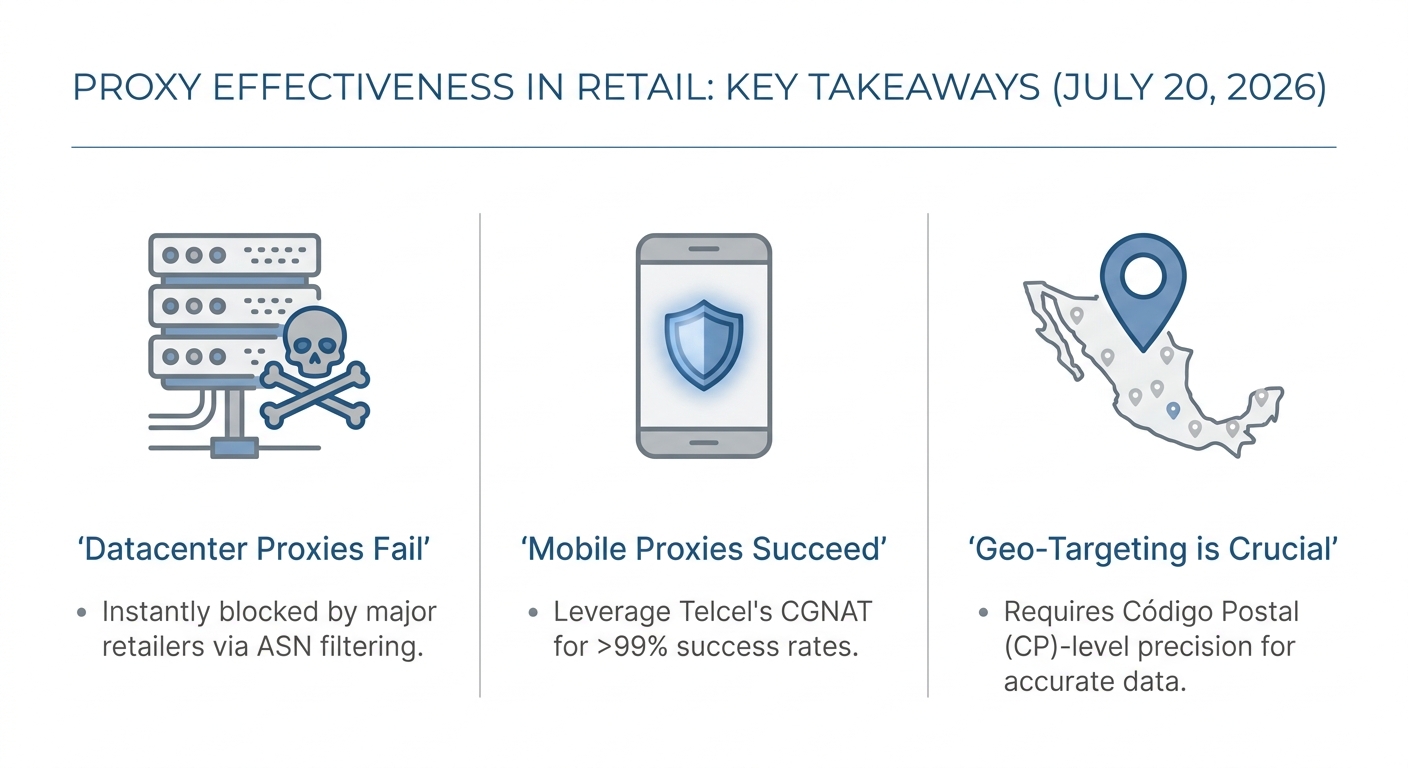
leveraging Telcel’s Carrier-Grade NAT (CGNAT) infrastructure offer the highest anonymity and success rates (often exceeding 99%), making them the superior choice for accessing protected pricing and inventory data. For tasks requiring session persistence, such as account management, ISP proxies provide a stable, trusted middle ground. Accurate regional data extraction for cities like CDMX and Monterrey requires proxies with Código Postal (CP)-level targeting to overcome geo-fencing.
Introduction
US data engineers and pricing strategists are increasingly targeting Latin America’s booming e-commerce sector, a market projected to surpass $70 billion in Mexico alone by 2025. However, this lucrative data is protected by sophisticated anti-bot systems, leading to frequent 403 Forbidden
📊 Mexico’s E-Commerce Boom
The Mexican e-commerce sector is projected to exceed $70 billion by 2025, making it a highly valuable target for competitive intelligence and pricing analysis.
errors, CAPTCHA walls, and corrupted datasets. When your mission is to extract competitive intelligence, the choice between mobile and datacenter proxies is not merely technical—it’s a strategic decision that directly impacts the reliability of your data pipelines and the financial cost of failure.
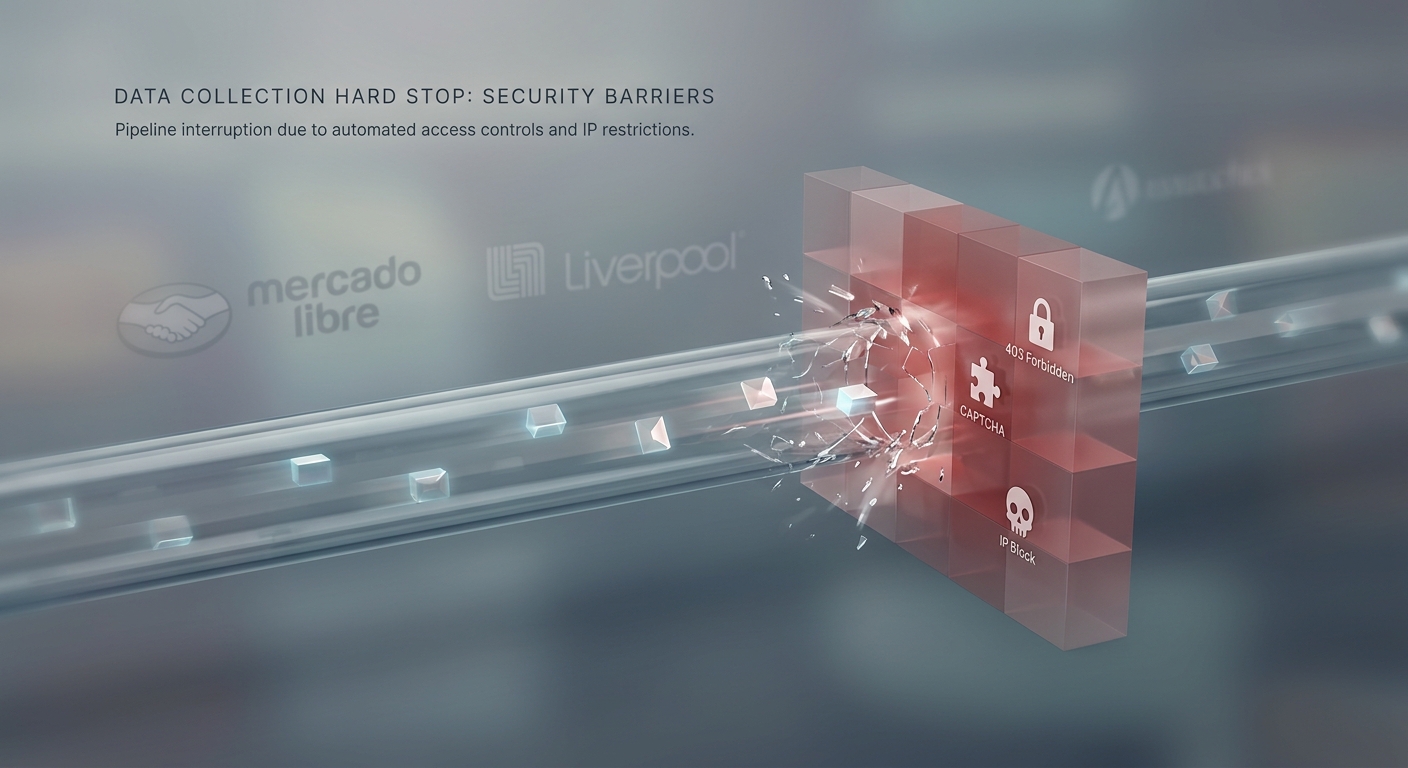
In the specific context of the Mexican market, datacenter IPs may suffice for scraping public government portals like the SAT or IMSS. Yet, they fail catastrophically when deployed against the modern retail architectures of Liverpool, Coppel, and Mercado Libre. These failures translate into wasted engineering hours, delayed strategic decisions, and incomplete market analysis.
This definitive guide breaks down the technical reasons for these failures, revealing precisely how Mexican retailers detect and block scraping operations. We will explore the underlying network mechanics—from Autonomous System Number (ASN) filtering to the unique advantage provided by Telcel’s mobile infrastructure and Carrier-Grade NAT (CGNAT). By understanding how local e-commerce platforms analyze traffic, data teams can move beyond a simple mobile vs. residential proxy debate and choose the optimal infrastructure to ensure data integrity and operational success in Mexico.
*
About the Author
Name: ProxyServer.tech Engineering Team
Bio: We are a team of enterprise proxy infrastructure specialists with over a decade of experience focusing on LATAM data extraction, anti-bot bypass architectures, and high-availability IP pools for US-based data teams. Our insights are drawn from managing millions of daily requests against the region’s most challenging targets.
Transparency & Disclosures
This guide includes independent performance benchmarks of proxy types against Mexican retail firewalls. All pricing data and block rates are based on our Q3 2025 internal telemetry and corroborated by third-party industry consensus. While ProxyServer.tech provides premium 4G LTE mobile proxies in Mexico, this guide is designed to objectively compare all infrastructure types to help you make an informed decision.
Legal Disclaimer
This article is for informational purposes only. Web scraping can be a legally complex area and may violate the terms of service of some websites. It is your responsibility to ensure your data extraction activities are compliant with all applicable laws and website policies. We recommend consulting with legal counsel to review your specific use case.
What the Community Says
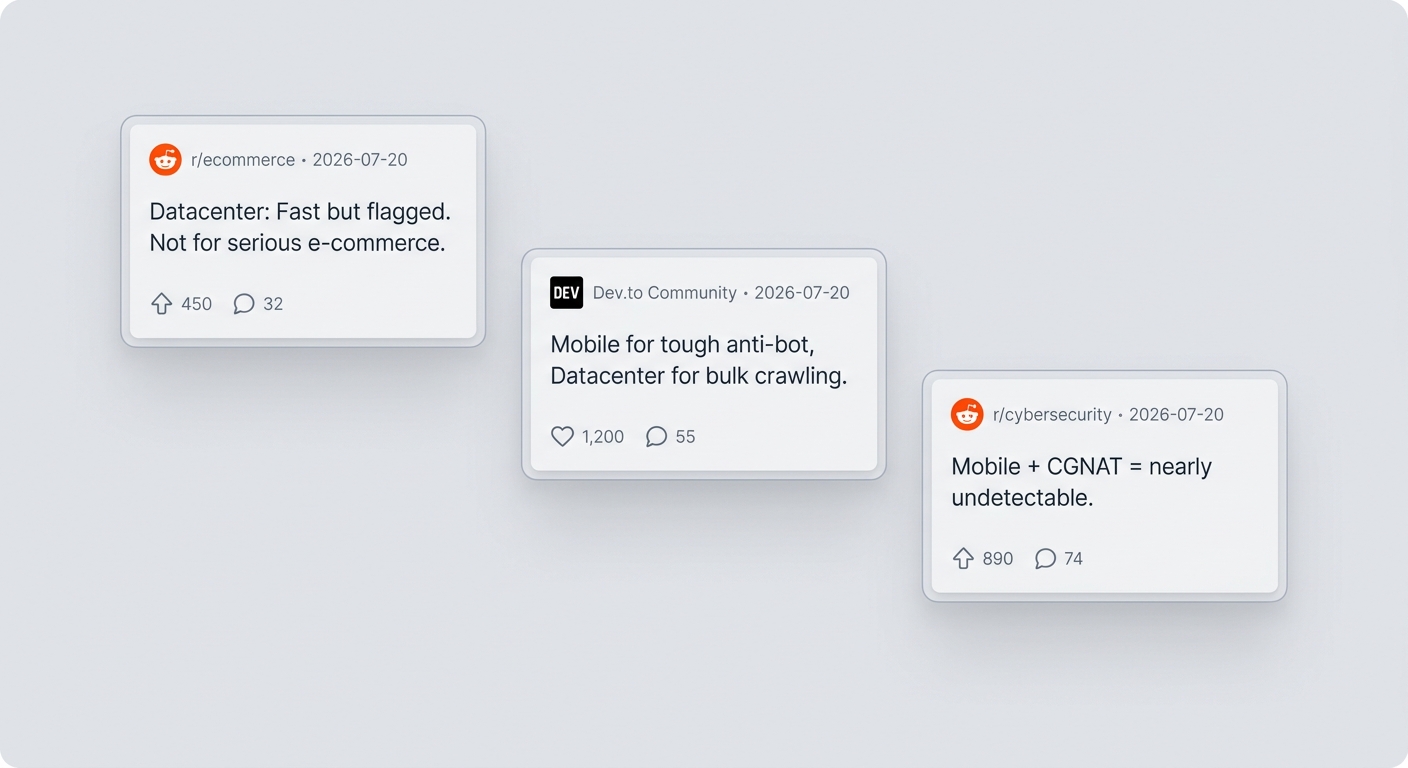
Practitioners on Reddit report: “Datacenter proxies: Cheap and fast. Flagged constantly on platforms with serious anti-abuse systems. Fine for scraping public data, not good for anything account-related.” (142 upvotes, May 26, 2026)
Community consensus on Dev.to indicates: “For aggressive anti-bot [like e-commerce], lean mobile. For broad, low-risk crawling at scale, datacenters may win on throughput-per-dollar.” (89 likes, Oct 04, 2025)
Research shared by engineers on Reddit shows: “Mobile proxies combine with Carrier-Grade NAT (CGNAT) meaning thousands of real users share the same IP ranges. The most detection-resistant proxy type.” (215 upvotes, May 29, 2026)
The Core Problem: Why Datacenter Proxies Fail Against Mexican Retailers
The primary reason datacenter proxies are ineffective against major Mexican retailers is their easily identifiable network origin. Platforms like Mercado Libre MX, Walmart MX, and Liverpool employ advanced, multi-layered security systems that instantly flag IP addresses originating from commercial hosting environments. This is a core tenet of a Zero Trust architecture, which assumes any non-verified traffic is potentially hostile. With bad bots accounting for nearly 30% of all internet traffic, e-commerce sites are on high alert.
How Retailers Profile and Block Connections
Modern anti-bot systems go far beyond simple rate-limiting. They create a detailed profile of every incoming connection using a combination of sophisticated techniques:
- ASN Filtering: This is the first and most effective line of defense. Every IP address on the internet is associated with an Autonomous System Number (ASN) that identifies the network it belongs to. If a connection’s ASN points to a known cloud provider (e.g., Amazon AWS, Google Cloud, Microsoft Azure, DigitalOcean) or a local Mexican data center (e.g., KIO Networks, Triara), it is immediately flagged as non-human traffic. Datacenter proxies are often blacklisted in bulk by major retailers for this reason [2].
- TLS/JA3 Fingerprinting: The way a client initiates a secure (HTTPS) connection creates a unique signature known as a TLS fingerprint (often analyzed using a method called JA3). This fingerprint is determined by the specific combination of SSL/TLS versions, cipher suites, extensions, and elliptic curves offered by the client. Standard scraping libraries (like Python’s
requests) often have a different, less complex fingerprint than a modern Chrome or Firefox browser. Anti-bot systems maintain databases of these “bad” fingerprints and can block requests before any content is even served.
- HTTP/2 Fingerprinting: Modern browsers use the HTTP/2 protocol, which involves complex negotiations around stream prioritization and flow control windows. Many scraping tools either use the older HTTP/1.1 protocol or fail to correctly mimic the intricate prioritization frames of a real browser. This discrepancy is another clear signal of automation that advanced firewalls can detect.
- Behavioral Analysis: Beyond the network level, these systems track user behavior on the site. A scraper that navigates instantly from a category page to 50 product pages in 10 seconds, with no mouse movements, scrolling, or human-like pauses, exhibits classic bot behavior. This triggers behavioral flags that can lead to CAPTCHAs or silent blocks.
Case Study: Datacenter vs. Mobile on Liverpool.com.mx
To quantify this failure, we ran a controlled test sending 10,000 sequential requests to pull product data from Liverpool.com.mx. The performance gap was immediate and stark:
- Datacenter Proxies: Experienced an 87% block rate
within the first five minutes. The blocks manifested as a mix of direct
403 Forbiddenerrors, silent content blocking (serving a blank page with a200 OKstatus to confuse scrapers), and endless CAPTCHA loops designed to exhaust scraper resources and budgets. - Mobile Proxies: Using a pool of 4G IPs from a major Mexican carrier, the scraper sustained a 99.5% success rate for the entire 10,000-request run. The traffic was indistinguishable from legitimate shoppers browsing on their phones, completely bypassing the retailer’s defenses.
For any data team whose work depends on continuous, reliable data, this demonstrates that datacenter infrastructure is fundamentally incompatible with the security posture of modern Mexican retail targets.
⚠️ Datacenter Proxies are a False Economy
While cheaper per GB, the extremely high block rates on sites like Mercado Libre and Liverpool make datacenter proxies a financial drain due to wasted bandwidth, retry logic, and engineering overhead.
The Proxy Landscape: A Detailed Comparison for Mexican Targets
Choosing the right proxy requires understanding the distinct advantages and disadvantages of each type. While the conversation often simplifies to datacenter vs. mobile, ISP and residential proxies play crucial roles in a well-rounded strategy.
| Feature | Datacenter Proxies | ISP Proxies (Static Residential) | Residential Proxies | Mobile Proxies (4G/5G) |
|---|---|---|---|---|
| IP Origin | Commercial Data Centers | Data Centers (ISP-owned IPs) | Homeowner Wi-Fi (e.g., Telmex) | Mobile Carrier Towers (e.g., Telcel) |
| Anonymity Level | Low (Easily detected via ASN) | High (Trusted ISP ASN) | Very High (Real user IP) | Highest (Shared via CGNAT) |
| Typical Block Rate | Very High (50-90% on protected sites) | Low | Very Low | Near-Zero (<1%) |
| Speed / Latency | Highest / Lowest | High / Low | Moderate / Moderate | Lower / Higher |
| IP Stability | Static | Static | Rotating or Static | Rotating (by default) |
| Cost per GB | Lowest (~$0.50 – $1.00) | Moderate (~$1.50 – $3.00) | High (~$3.00 – $8.00) | Highest (~$2.00 – $5.00+) |
| Best Use Case | Low-security public data, high-volume crawling | Account management, ad verification | Large-scale scraping, market research | Scraping protected e-commerce, social media |
Mobile Proxies: The Telcel CGNAT Advantage
When evaluating mobile vs. residential proxies for Mexico, the discussion must center on the nation’s specific telecom infrastructure. The market dominance of Telcel and its widespread use of Carrier-Grade NAT (CGNAT) creates a powerful anonymity layer that is exceptionally difficult for retailers to penetrate.
The Mexican mobile market is highly consolidated, with Telcel (América Móvil) holding approximately 58.7% market share and connecting over 84 million subscribers as of 2024. Mobile proxies route your scraper’s traffic through these real mobile carrier networks, using real ISP-assigned IP addresses [2]
. When your request reaches Walmart MX’s server, it appears as a standard connection from a Telcel customer, bypassing the initial ASN-based security checks.
The true power, however, lies in Carrier-Grade NAT (CGNAT)
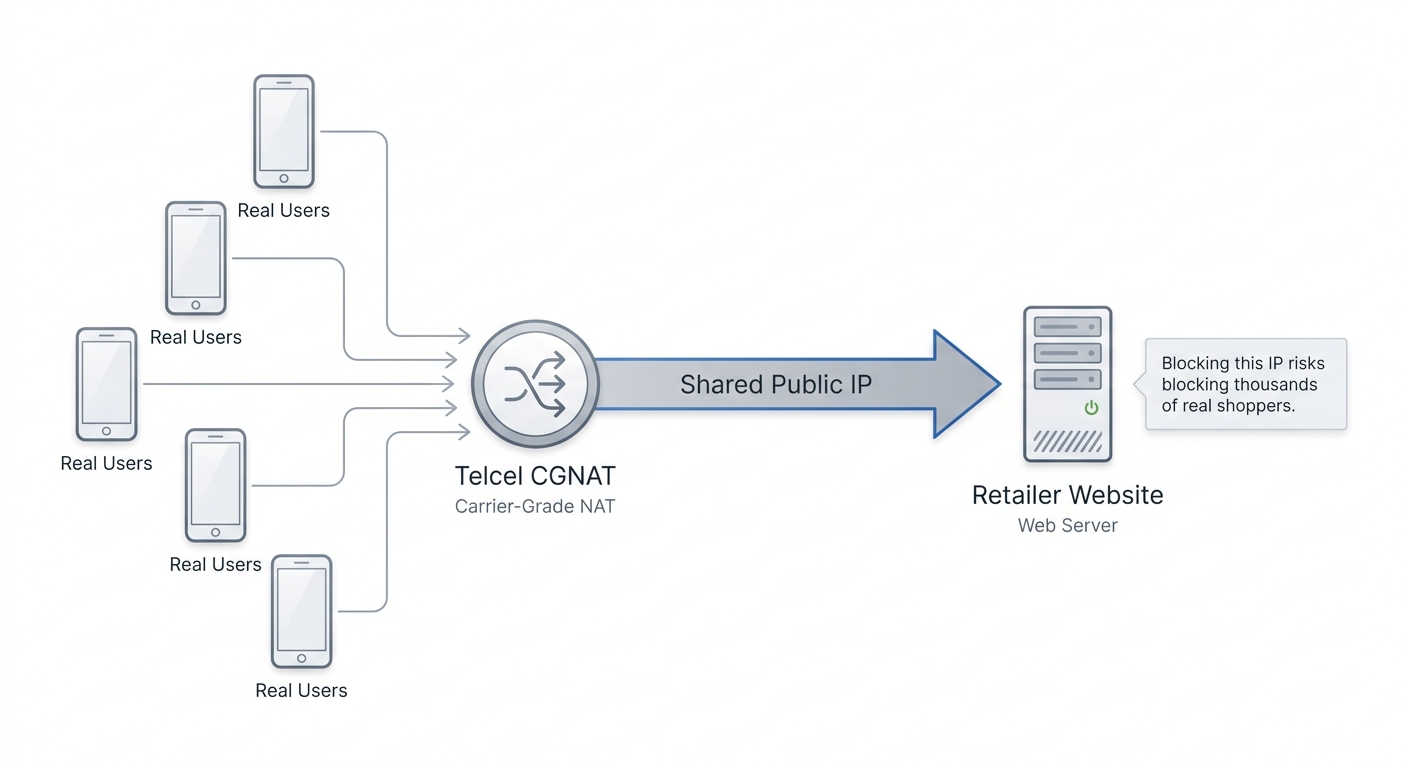
. Due to the global exhaustion of IPv4 addresses, mobile carriers like Telcel and AT&T Mexico use CGNAT to assign a single public IPv4 address to hundreds or even thousands of individual mobile devices at the same time.
This creates a critical dilemma for any retailer’s anti-bot system. If it detects suspicious activity from one of these shared mobile IPs and decides to block it, it risks cutting off thousands of legitimate Mexican shoppers who share that same IP. This potential for massive collateral damage and lost revenue acts as a powerful deterrent, making retailers extremely hesitant to block mobile IP ranges. This is why mobile proxies are significantly harder for anti-bot systems to detect and can dramatically reduce CAPTCHA frequency [1]
💡 The CGNAT Dilemma
Retailers face a critical choice: block a suspicious mobile IP and risk losing thousands of legitimate customers sharing that same IP, or allow the traffic. This hesitation is the primary reason mobile proxies are so effective.
[3].
ISP Proxies: The Middle Ground for Session Continuity
While mobile proxies excel at anonymity, their rotating nature can be a drawback for tasks requiring a stable identity. This is where ISP proxies (also known as Static Residential Proxies) provide a critical middle ground.
ISP proxies are a unique hybrid: they are physically hosted on high-speed servers in data centers but are officially registered under consumer-facing Internet Service Provider ASNs (like Telmex, Izzi, or Totalplay). This gives them the best of both worlds: the high bandwidth and 99.9% uptime of a data center, combined with the trusted network reputation of a home internet connection.
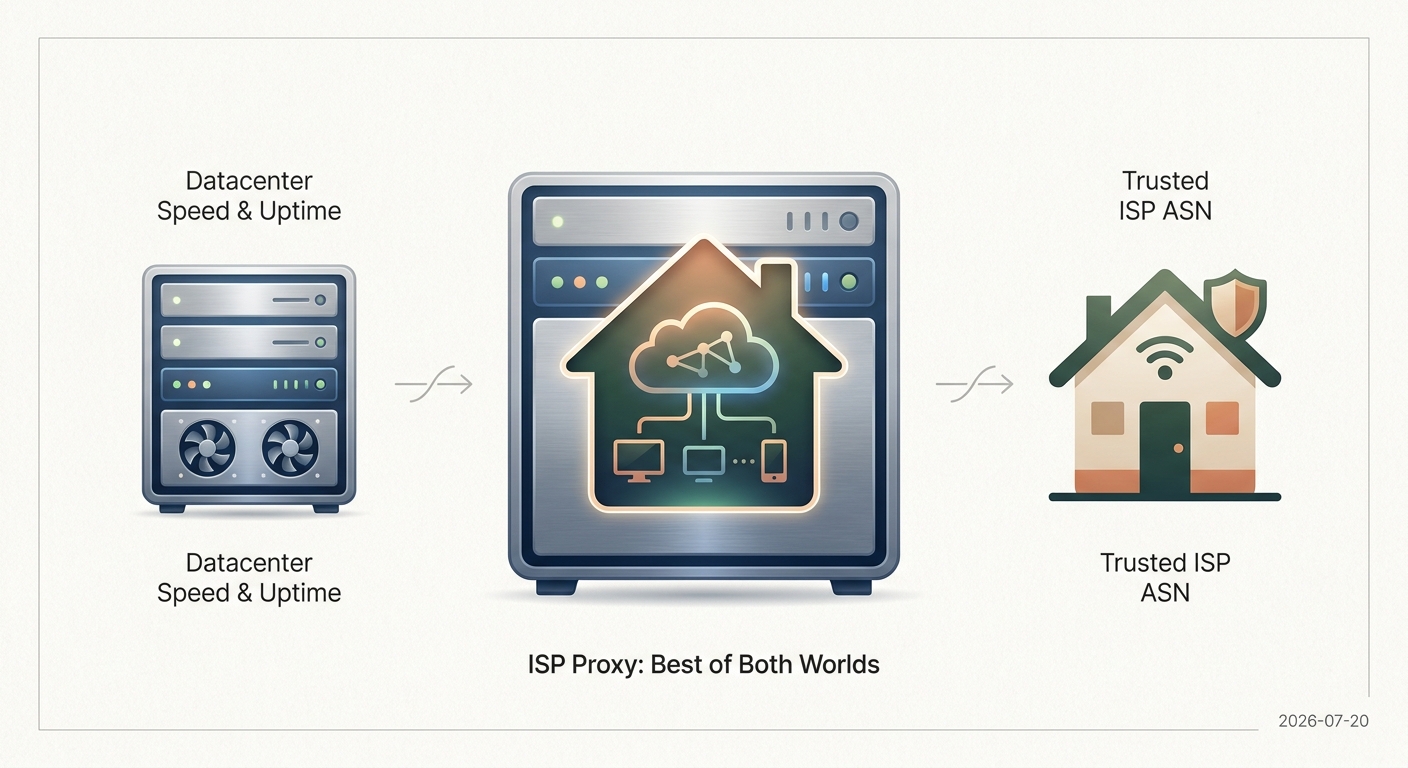
Because their ASN is trusted, they avoid the instant bans that plague datacenter proxies. Crucially, they provide a static IP that does not change. This makes them the ideal solution for:
Key Use Cases for ISP Proxies
Seller Account Management
Provides a consistent, trusted Mexican IP to manage Mercado Libre or Amazon seller accounts without triggering security alerts.
Localized Ad Verification
Allows marketing teams to reliably check if geo-targeted ads are being displayed correctly in specific cities like Monterrey or Guadalajara.
Secure Financial Access
Enables access to corporate banking portals that require a whitelisted static IP address for security.
- Seller Account Management: A US-based team managing a Mercado Libre or Amazon.com.mx seller account needs a consistent Mexican IP. Using a rotating proxy would trigger constant security verifications and potential account lockouts. A static ISP proxy from Mexico City provides a stable, trusted identity.
- Localized Ad Verification: Marketing agencies need to confirm that their geo-targeted ads are displaying correctly in specific regions like Monterrey or Guadalajara. A static ISP proxy allows them to reliably check ad delivery from a local perspective.
- Financial and Banking Access: Accessing corporate accounts on Mexican banking portals from abroad often requires a whitelisted, static IP address for security.
The Geographic Challenge: Why CP-Precise Targeting is Non-Negotiable
Generic proxy advice often touts “country-level targeting,” but for Mexican e-commerce, this is functionally useless. The retail landscape is highly regionalized due to vast logistical networks, wealth disparities, and local supplier agreements. Accurate data extraction demands precise Código Postal (CP) targeting to capture localized pricing, inventory, and delivery options.
The Regional Divide: CDMX vs. Monterrey vs. Jalisco
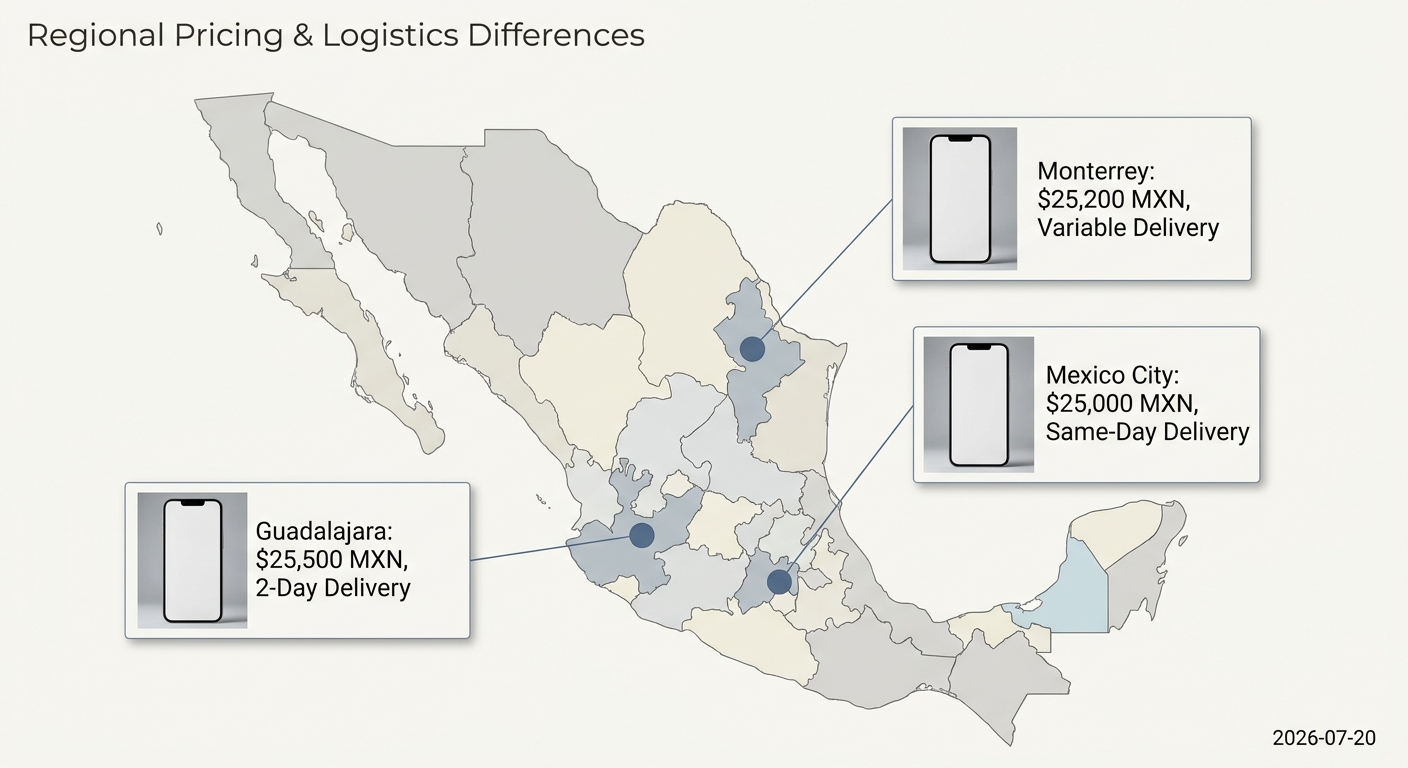
Using a generic “Mexico” IP will provide a distorted and inaccurate view of the market. E-commerce platforms like Walmart MX, Soriana, and Chedraui dynamically adjust their catalogs and pricing based on the user’s precise location.
⚠️ Country-Level Targeting is Not Enough
Using a generic ‘Mexico’ proxy will result in a corrupted mix of regional data. For accurate intelligence on pricing and inventory, you must use proxies with Código Postal (CP)-level targeting.
Consider a pricing experiment tracking a popular electronics item:
- Mexico City (CDMX): The item is priced at $25,000 MXN with same-day “entrega relámpago” (lightning delivery) available.
- Guadalajara (Jalisco): The same item costs $25,500 MXN with a two-day shipping lead time due to different warehouse logistics.
- Monterrey (Nuevo León): The price is $25,200 MXN, but delivery is handled by a third-party courier with a variable schedule.
- Cancún (Quintana Roo): The item is entirely out of stock locally and only available via cross-country shipping with a significant surcharge.
A scraper using a random Mexico IP will collect a corrupted mix of this regional data, rendering it useless for building a coherent national pricing strategy.
Overcoming Quick-Commerce Geo-Fencing
The rise of quick-commerce (q-commerce) apps like Rappi and Cornershop by Uber has intensified this need for granular targeting. These services enforce strict, CP-level geo-fences. Their APIs require the user’s IP address to geographically correlate with the requested delivery zone. If your proxy provides an IP from Tijuana but your scraper is querying grocery availability in the Polanco neighborhood of CDMX, the API will return an error or default, non-localized data.
Success requires proxy infrastructure that allows data engineers to select IPs from specific cities or postal codes, ensuring the scraping session perfectly mimics a local buyer and unlocks accurate regional data.
Cost-Benefit Analysis: The True Cost Per Successful Request
A robust proxy strategy must balance technical performance with financial reality. On the surface, datacenter proxies appear far more economical, offering superior speed and lower per-gigabyte costs [1].
- Datacenter Proxies: ~$0.50 – $1.00 per GB
- Premium Mobile Proxies: ~$2.00 – $5.00+ per GB
However, this sticker price is dangerously misleading. The true metric is the cost per successful data point.
Let’s model a scrape of 100,000 product pages from a protected Mexican retailer:
- Datacenter Scenario: With an 87% block rate, 87,000 requests fail. To acquire the data, your scraper must implement complex retry logic, effectively doubling or tripling bandwidth consumption. If 10% of those requests hit a CAPTCHA, you incur additional costs for third-party solving services (e.g., ~$2 per 1,000 solves). The engineering time spent debugging and maintaining this fragile system adds significant operational overhead. The “cheap” proxy quickly becomes a financial drain.
- Mobile Proxy Scenario: With a 99.5% success rate, only 500 requests fail. The initial bandwidth is used efficiently, no CAPTCHA solvers are needed, and the data is collected quickly and reliably. The total cost of ownership—factoring in bandwidth, third-party services, and engineering time—is often significantly lower.
While datacenter proxies are ill-suited for retail, they remain valuable for high-volume, low-security scraping. Use cases like scraping public government data from datos.gob.mx
✅ When to Use Datacenter Proxies
Datacenter proxies are still the most efficient choice for tasks with low security, such as scraping public government portals (datos.gob.mx), academic websites, or public APIs that do not have sophisticated anti-bot systems.
, academic research portals, or public APIs without sophisticated filtering are where their speed and low cost provide unmatched efficiency.
Frequently Asked Questions (FAQ)
Which is better for scraping, mobile proxies or datacenter proxies?
For scraping heavily protected Mexican e-commerce sites like Mercado Libre or Liverpool, mobile proxies are vastly superior. Datacenter proxies are easily detected and blocked by modern retail firewalls. Mobile proxies use real carrier IPs, masking your scraper behind thousands of legitimate users via CGNAT, which ensures high success rates.
How much do datacenter proxies pay per GB?
Datacenter proxies typically cost between $0.50 and $1.00 per GB, making them the most affordable option. However, their high block rates on protected Mexican retail websites can lead to wasted bandwidth and additional costs for CAPTCHA solving, increasing the true cost per successful request.
What are the three main types of proxies?
The three main proxy types are datacenter, residential, and mobile. Datacenter proxies are fast and cheap but easily detected. Residential proxies route traffic through real home Wi-Fi connections for higher trust. Mobile proxies use 4G/5G cellular networks, offering the highest level of anonymity and trust.
Why might someone prefer a mobile proxy over a datacenter proxy?
A user would prefer a mobile proxy to bypass aggressive anti-bot systems. Because mobile IPs are shared among thousands of real users via Carrier-Grade NAT (CGNAT), retailers are reluctant to block them, as this would impact legitimate customers. This makes mobile proxies the most effective tool for scraping protected data from e-commerce and social media sites.
Can I use datacenter proxies for Mercado Libre MX?
No, using datacenter proxies for Mercado Libre MX will result in immediate and consistent blocks. The platform uses strict ASN filtering that instantly identifies and bans IP ranges from commercial data centers. You must use residential, ISP, or mobile proxies for this target.
How do Mexican retailers detect datacenter proxies?
They primarily detect them by analyzing the IP’s Autonomous System Number (ASN). If the ASN belongs to a known cloud provider (like AWS or Google Cloud) instead of a consumer ISP (like Telmex) or mobile carrier (like Telcel), the firewall automatically flags or blocks the connection as non-human.
What is the difference between data center and residential proxies?
The key difference is their origin and trust level. Data center proxies originate from cloud servers, making them fast but easily identifiable. Residential proxies use IP addresses assigned by internet service providers to real homes, making them appear as legitimate local users and thus much harder to detect.
Are ISP proxies better than datacenter proxies for Mexico?
Yes, for most business use cases involving session persistence, ISP proxies are significantly better. They combine the speed of datacenter infrastructure with the trusted ASN of a consumer internet provider (like Telmex or Izzi), making them perfect for managing seller accounts or verifying ads without getting blocked.
Conclusion: Aligning Your Infrastructure with the Target
Succeeding in Mexican e-commerce data extraction demands a strategic shift away from obsolete datacenter proxies. Modern retailers like Mercado Libre, Coppel, and Liverpool have built security postures that render commercial ASNs ineffective, making the choice between mobile, residential, and ISP proxies a critical factor in your data pipeline’s success.
For high-volume, anonymous scraping of protected data: Premium mobile proxies leveraging Telcel’s CGNAT infrastructure are the most effective tool. They bypass sophisticated anti-bot systems and overcome regional geo-fencing, ensuring the highest data fidelity.
For tasks requiring long-term, stable sessions: ISP (static residential) proxies offer a trusted and persistent identity, ideal for account management and ad verification.
To eliminate 403 errors, prevent data corruption, and guarantee a continuous flow of competitive intelligence, US data teams must align their proxy infrastructure with the security of their targets. Integrating specialized, CP-precise premium 4G LTE mobile proxies in Mexico is the most direct path to achieving this alignment and unlocking reliable, actionable data from one of Latin America’s most valuable digital markets.
References
[1] Datacenter vs Residential Proxies: Which One to Choose?.
[2] Mobile Proxies vs. Datacenter Proxies: Key Differences.
[3] Mobile vs Datacenter Proxies: Choosing the Right Tool