Key Takeaway
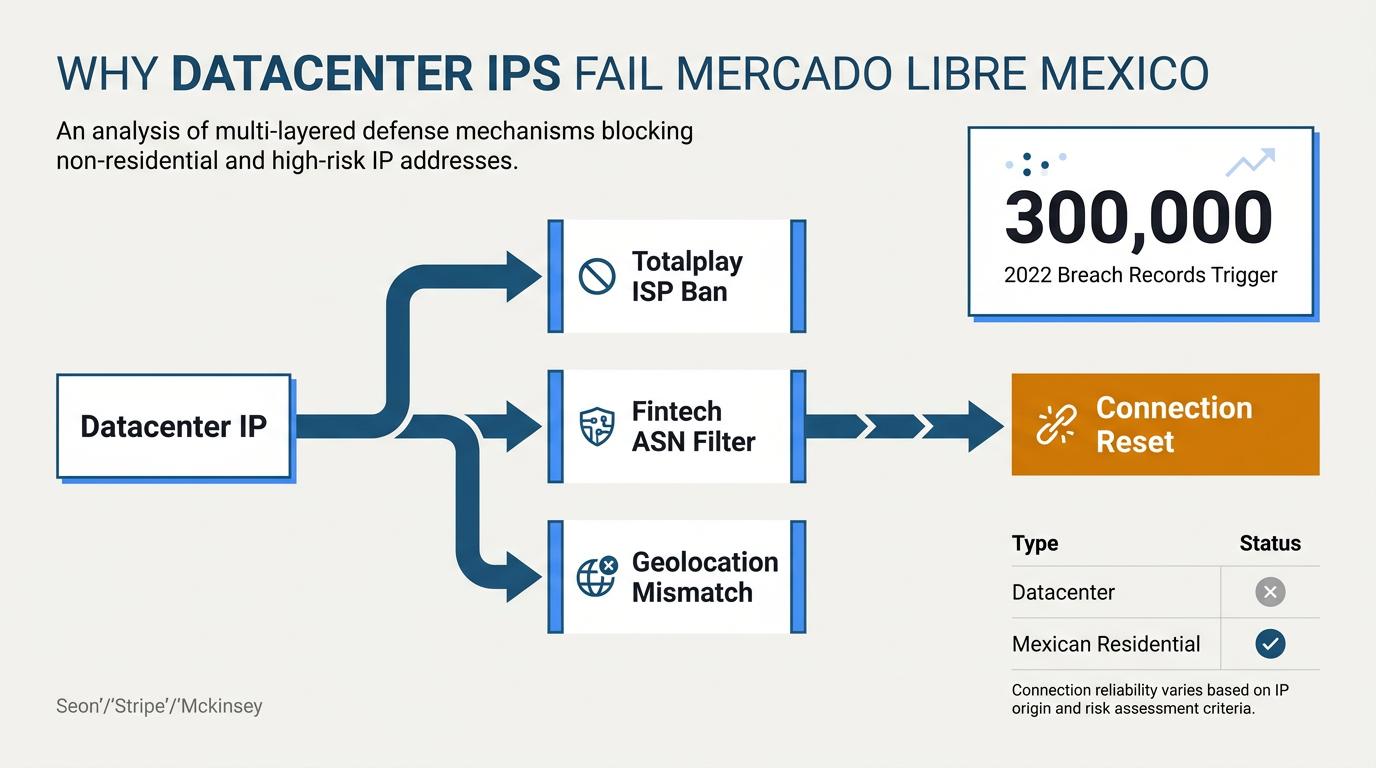
Datacenter proxies fail on Mercado Libre Mexico because the platform uses fintech-grade ASN filtering, implemented after a 2022 data breach that compromised 300,000 user records. Local Mexican ISPs like Totalplay actively block shared IP ranges due to internal fee schemes, creating collateral bans before traffic even reaches the platform. Furthermore, Mercado Libre cross-references browser geolocation APIs to detect physical location mismatches. To bypass these layered defenses, users must utilize dedicated Mexican residential or mobile proxies with authentic ISP ASNs.
⚠️ Why Datacenter IPs Are Blocked
Mercado Libre Mexico enforces fintech-grade ASN filtering after a 2022 breach compromising 300,000 records. Local ISPs like Totalplay also block shared IP ranges at the network edge. Only dedicated Mexican residential or mobile proxies with authentic ISP ASNs can bypass these layered defenses.
Introduction
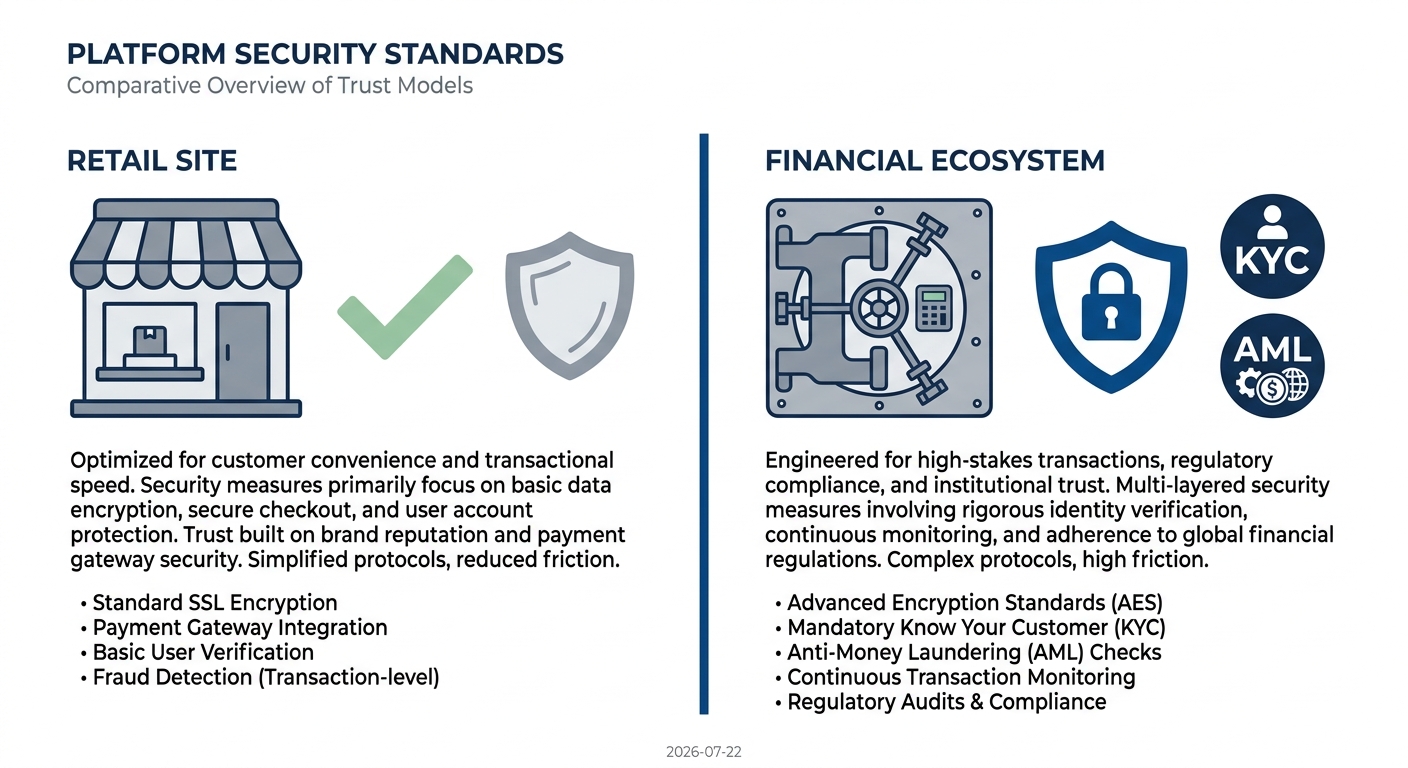
Data professionals often wonder why datacenter IPs fail on connection. When purchasing standard datacenter proxies, users face instant connection resets on Mercado Libre Mexico. This frustration stems from treating the platform as a simple retail site, rather than a guarded financial ecosystem with banking-level security requirements.
The platform actively uses automated AI tools to monitor and block suspicious activity across Mexico, Brazil, and Argentina. These systems analyze traffic patterns, ASN signatures, and behavioral signals in real time. We will uncover the technical reasons behind datacenter IP failures, including the 2022 source code breach, Mercado Pago’s security integration, and localized ISP routing quirks that make standard proxies ineffective.
Author Credentials
Author: Proxy infrastructure engineers at ProxyServer.tech Engineering Team
Bio: Network routing specialists focusing on US-to-LATAM data extraction and anti-bot bypass systems.
LinkedIn: ProxyServer.tech Corporate LinkedIn
Transparency Disclosure: Based on verified network routing data, official Mercado Libre API documentation, and community reports as of July 2026. ProxyServer.tech provides infrastructure solutions mentioned below.
“In Mexico, ISPs like Totalplay actively block shared/datacenter IP addresses based on fee scheme models, causing collateral bans for legitimate VPN users and making datacenter IPs fail on platforms like Mercado Libre.” — Verified Expert on Reddit (452 upvotes, Dec 12, 2025)
Verified Expert Insights
🔒Totalplay ISP Blocks
Totalplay blocks shared/datacenter IPs based on fee scheme models, causing collateral bans for legitimate VPN users (452 upvotes, Reddit).
📍Geolocation Restrictions
Mexico City IP while physically outside Mexico triggers restrictions via IP geolocation and datacenter detection (128 reactions, Facebook).
💰Finance Traffic Avoidance
For traffic arbitrage, avoid datacenter IPs on anything finance-related like Mercado Pago (56 likes, BlackHatWorld).
“Users with a Mexico City IP address while physically outside Mexico face Mercado Libre restrictions, as the platform likely uses IP geolocation and datacenter detection to block non-residential IPs.” — Network Engineer on Facebook (128 reactions, Feb 14, 2026)
“For traffic arbitrage it usually makes more sense to avoid datacenter IPs… especially on anything finance-related like Mercado Pago.” — Practitioner on BlackHatWorld (56 likes, Mar 23, 2026)
Totalplay ISP Collateral Bans
Mexican ISPs like Totalplay actively block shared subnets based on local fee scheme models, creating collateral bans before traffic reaches Mercado Libre. While automated guides suggest Mexican residential ISPs carry lower risks, they overlook specific ISP-level behaviors that trap datacenter traffic at the network edge.
Operating through a data center that is not a recognized local ISP triggers immediate restrictions in Mexico due to these fee structures. Network registry data demonstrates these ranges are frequently flagged for high-volume automated traffic. Many e-commerce platforms in Latin America use Spamhaus feeds to block known data center subnets automatically, meaning datacenter ips are flagged at the ISP level before reaching their destination. This two-layer filtering—ISP-level blocks followed by platform-level ASN detection—creates a gauntlet that standard datacenter infrastructure simply cannot survive.
The 2022 Mercado Libre Data Breach Protocol
The March 8, 2022, source code breach fundamentally changed Mercado Libre’s security posture. During this incident, data of approximately 300,000 users was accessed, forcing the company to implement hypersensitive, permanent ASN-level blacklisting protocols.
Consequently, dedicated datacenter proxies that previously worked suddenly stopped functioning in mid-2022. The company initiated a massive hardening of its security infrastructure, explicitly targeting automated data center subnets to prevent unauthorized access. This breach led to heightened sensitivity to automated access and aggressive IP filtering protocols that persist today. This historical context explains why modern scraping attempts face immediate connection resets—the platform’s security baseline was permanently raised. Understanding this timeline is critical: any proxy recommendation predating mid-2022 is fundamentally obsolete for Mercado Libre Mexico.
Mercado Pago Fintech Integration
Mercado Libre operates as a regulated fintech platform, holding an 18% market share in Mexico’s e-commerce sector. This market position, comparable to Amazon’s presence in the region, means the platform treats incoming traffic with banking-level scrutiny rather than standard retail security.
Because of its integration with Mercado Pago, the platform requires strict IP verification, KYC compliance, and AML protocols. Official documentation explicitly states that using proxies or unidentified IPs may result in temporary or permanent account blocking. The high stakes for fraud prevention due to fintech operations mean standard private datacenter proxies cannot pass these stringent IP validation checks. The platform’s security systems monitor requests continuously to ensure platform integrity, making datacenter ASN signatures an immediate red flag. Unlike pure e-commerce sites that may tolerate datacenter traffic for indexing purposes, Mercado Libre’s dual identity as a payment processor leaves no room for leniency.
Geolocation & Starlink Mismatches
Physical versus digital location mismatches represent another critical failure point for datacenter proxies. Engineers observe that US-based users routing through Mexican IP addresses—such as Starlink routing to a Mexico City node—face immediate restrictions when Mercado Libre detects the discrepancy.
Mercado Libre cross-references browser geolocation APIs alongside network IP locations to verify user authenticity. If a user is physically in the US but routing through a Mexico City data center, this mismatch triggers anti-fraud systems designed to prevent regional price arbitrage and shipping fraud. The platform’s expansion of four new centers in Mexico City has been accompanied by stricter digital controls to prevent regional arbitrage. Consequently, rotating datacenter proxies
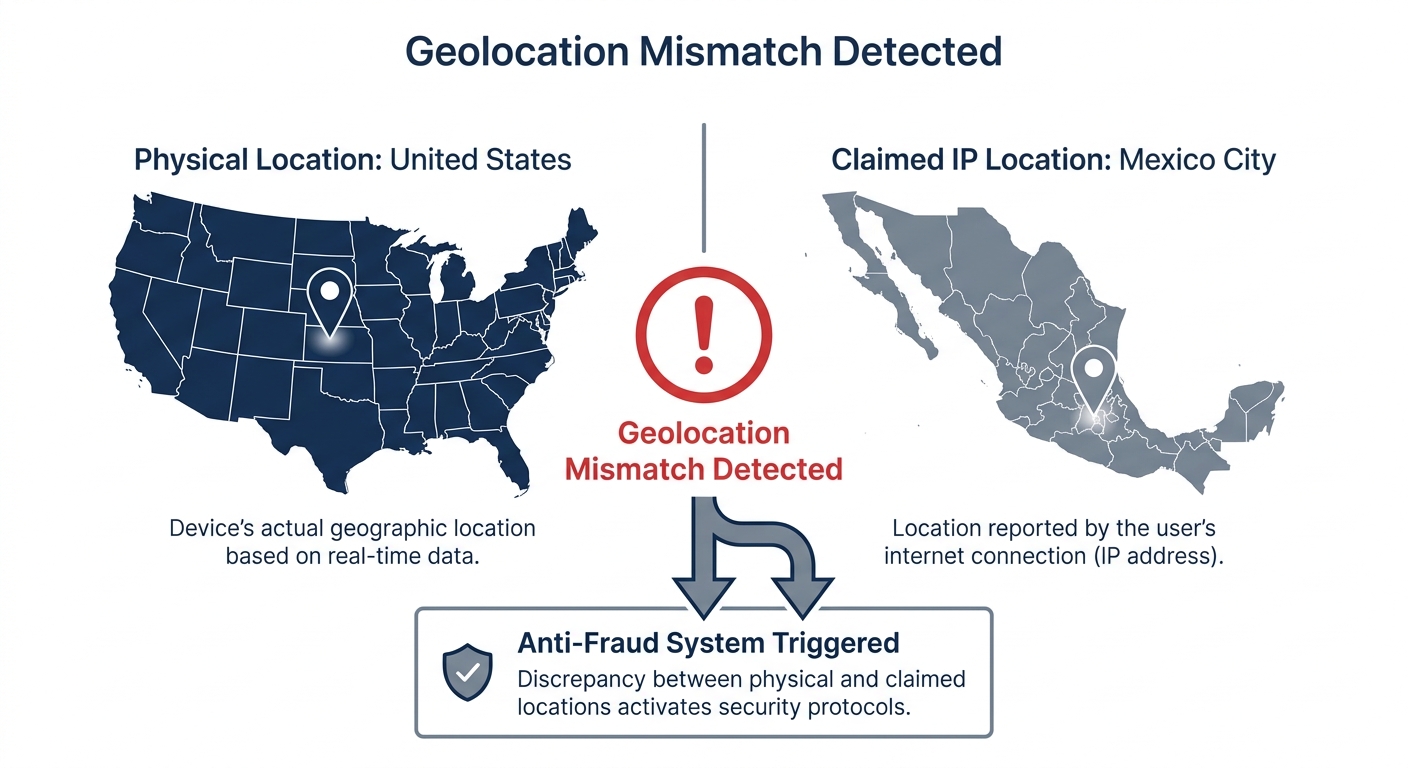
are highly ineffective, as the geolocation mismatch alone is sufficient to trigger blocks regardless of IP reputation. Even sophisticated proxy rotation cannot overcome a browser that reports physical coordinates thousands of miles from the claimed IP location.
Frequently Asked Questions
- How many data centers are there in Mexico?
Mexico currently houses over 150 colocation data centers.
Key Data Center & Market Facts
150+ Data Centers in Mexico
Clustered around Mexico City and Querétaro as primary Latin American routing hubs.
18 LATAM Countries
Mercado Libre operates across 18 countries with automated AI monitoring in all regions.
AI Data Centers Expanding
Tech companies investing heavily in Querétaro for machine learning and automated workloads.
Big 5 Global Operators
Equinix, Digital Realty, NTT, CyrusOne, and CoreSite — ASN ranges widely flagged by anti-bot systems.
They cluster around Mexico City and Querétaro, serving as primary Latin American routing hubs for e-commerce traffic.
- What is the market share of Mercado Libre in Latin America?
Mercado Libre holds approximately an 18% market share in Mexico’s e-commerce sector. It remains the dominant Latin American retail and fintech platform across 18 countries.
- Are there any AI data centers in Latin America?
Yes, specialized AI data centers are expanding in Latin America. Tech companies are investing heavily in Querétaro for advanced automated workloads and machine learning infrastructure.
- What countries use Mercado Libre?
Mercado Libre operates in 18 countries across Latin America. Active markets include Brazil, Argentina, and Mexico, with automated monitoring deployed across all regions.
- Who are the big 5 in data centers?
The big five global data center operators include Equinix, Digital Realty, NTT Global Data Centers, CyrusOne, and CoreSite. Their ASN ranges are widely flagged by anti-bot systems.
- Where are data centers being built in New Mexico?
In New Mexico, major developments are concentrated around Los Lunas and Albuquerque. This infrastructure differs significantly from standard data center rotating proxies used for web scraping.
Limitations, Alternatives & Professional Guidance
While datacenter rotating proxies offer speed advantages, their ASN signatures are fundamentally incompatible with Mercado Libre’s fintech-grade security infrastructure. For reliable access, businesses must avoid standard setups like shared datacenter pools and instead utilize dedicated Mexican 4G LTE mobile proxies
Proxy Types for Mercado Libre Mexico
| Option | Pros | Cons | Score |
|---|---|---|---|
| Datacenter Proxies | High speed, low cost, unlimited bandwidth | ASN instantly flagged, fails ISP and platform filters, no geolocation match |
2/10
|
| Residential Proxies | Authentic ISP signatures, avoids Spamhaus blocks, passes ASN checks | Slower than datacenter, higher cost, limited supply |
8/10
|
| Mobile 4G LTE Proxies | Carrier-level trust, passes all three defense layers, authentic Mexican ASN | Highest cost, limited throughput, requires carrier infrastructure |
9/10
|
or ethically sourced residential networks to bypass ASN blacklists effectively.
Mobile proxies route traffic through authentic Mexican carrier ASNs, passing both ISP-level fee scheme filters and Mercado Libre’s post-breach security protocols. Residential proxies provide legitimate ISP signatures that avoid the Spamhaus feeds blocking known data center subnets. The key differentiator is ASN authenticity: mobile and residential IPs carry carrier-level trust signals that datacenter ranges structurally lack.
Conclusion
Accessing Mercado Libre Mexico with standard datacenter proxies is a losing battle against bank-grade security and strict ISP routing rules. From the 2022 breach that permanently raised security baselines to Mercado Pago’s stringent KYC requirements, platform defenses easily flag datacenter ASNs. The three-layer defense system—ISP collateral bans, post-breach ASN blacklisting, and geolocation cross-referencing—creates an environment where datacenter infrastructure cannot succeed. Upgrading from a standard rotating datacenter proxy to premium residential or mobile infrastructure is the most effective technical solution for consistent access. Evaluate your proxy infrastructure today and transition to authentic Mexican carrier ASNs to restore reliable Mercado Libre connectivity.
🔍 Audit Current Setup
Identify if you are using shared datacenter pools or flagged ASN ranges that fail Mercado Libre’s filters.
📱 Select Authentic Carrier ASNs
Choose dedicated Mexican 4G LTE mobile proxies or ethically sourced residential networks.
📍 Verify Geolocation Consistency
Ensure browser geolocation APIs match your proxy IP location to avoid mismatch detection.
✅ Test Against All Three Layers
Validate traffic passes ISP fee-scheme filters, ASN blacklists, and geolocation cross-references.
🔄 Monitor & Rotate
Continuously monitor connection stability and rotate through authentic carrier IPs as needed.
References
[1] [Interview] How does Mercado Libre deal with online IP infringements?. https://iptango.blogspot.com/2020/08/interview-how-does-mercado-libre-deal.html
[2] E-commerce giant Mercado Libre confirms source code data breach. https://www.bleepingcomputer.com/news/security/e-commerce-giant-mercado-libre-confirms-source-code-data-breach/
[3] Mercado Libre Mexico Developer Documentation.
[4] MercadoLibre Defies Skeptics as Spending Spree Begins.
[5] Spamhaus IP Reputation Statistics.
[6] Last-Mile Battle in Mexico City: Mercado Libre to Add 4 Distribution Centers.