Key Takeaway
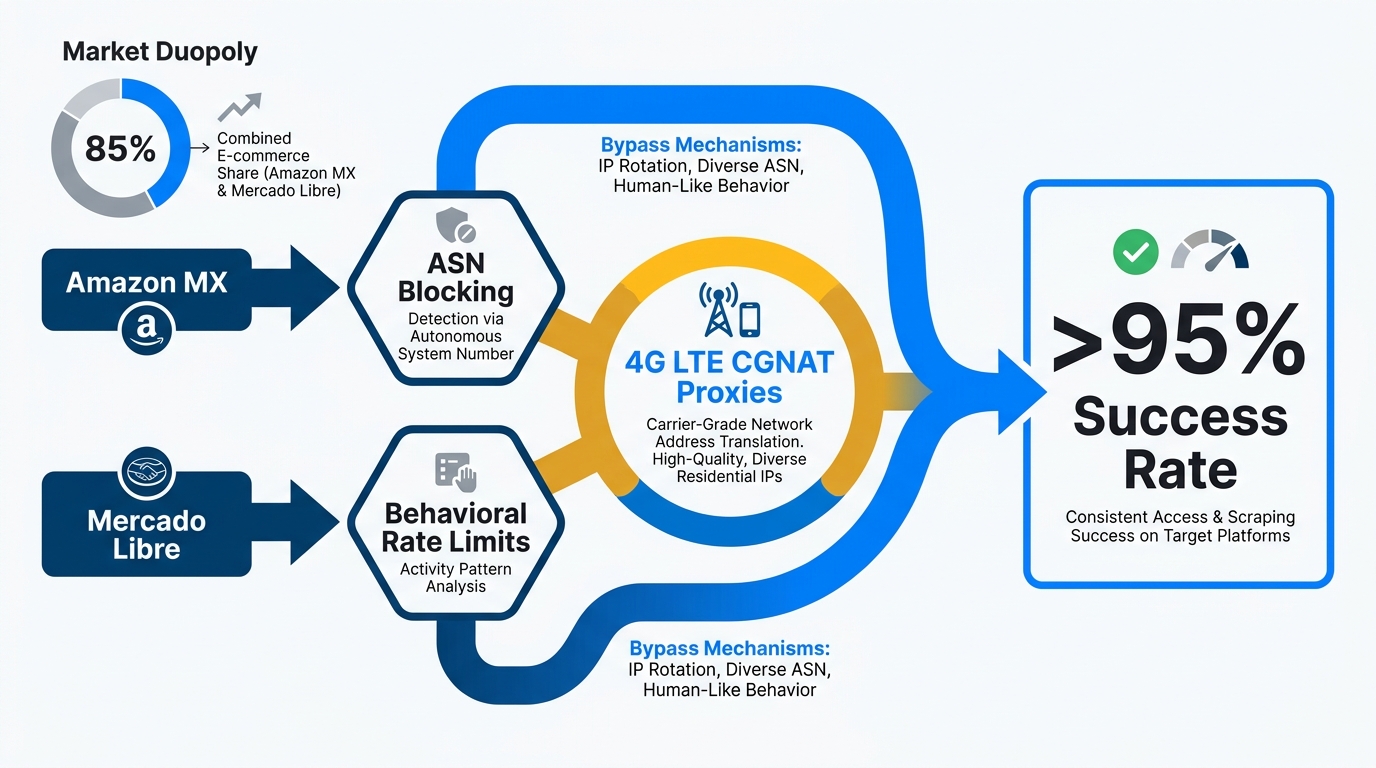
To bypass the aggressive anti-bot systems of Mexico’s e-commerce leaders, data engineers must use authentic 4G LTE Mexican mobile proxies. Amazon MX blocks IPs based on their network origin (ASN), while Mercado Libre uses behavioral rate-limiting. Only mobile proxies from carriers like Telcel and AT&T, which leverage Carrier-Grade NAT (CGNAT), provide the trust signals and rotation flexibility needed to achieve over 95% success rates for price monitoring and SERP tracking without triggering blocks.
Introduction
The Mexican e-commerce market is a duopoly, with Mercado Libre and Amazon MX commanding a combined 85% market share [1]. For enterprise data engineering teams, extracting real-time pricing, stock levels, and competitor data from these platforms is mission-critical for competitive intelligence. Yet, standard proxy infrastructure consistently fails. Datacenter and residential proxies are burning through IPs, triggering CAPTCHAs, and corrupting data pipelines because they cannot defeat the sophisticated, platform-specific bot detection used by these giants.

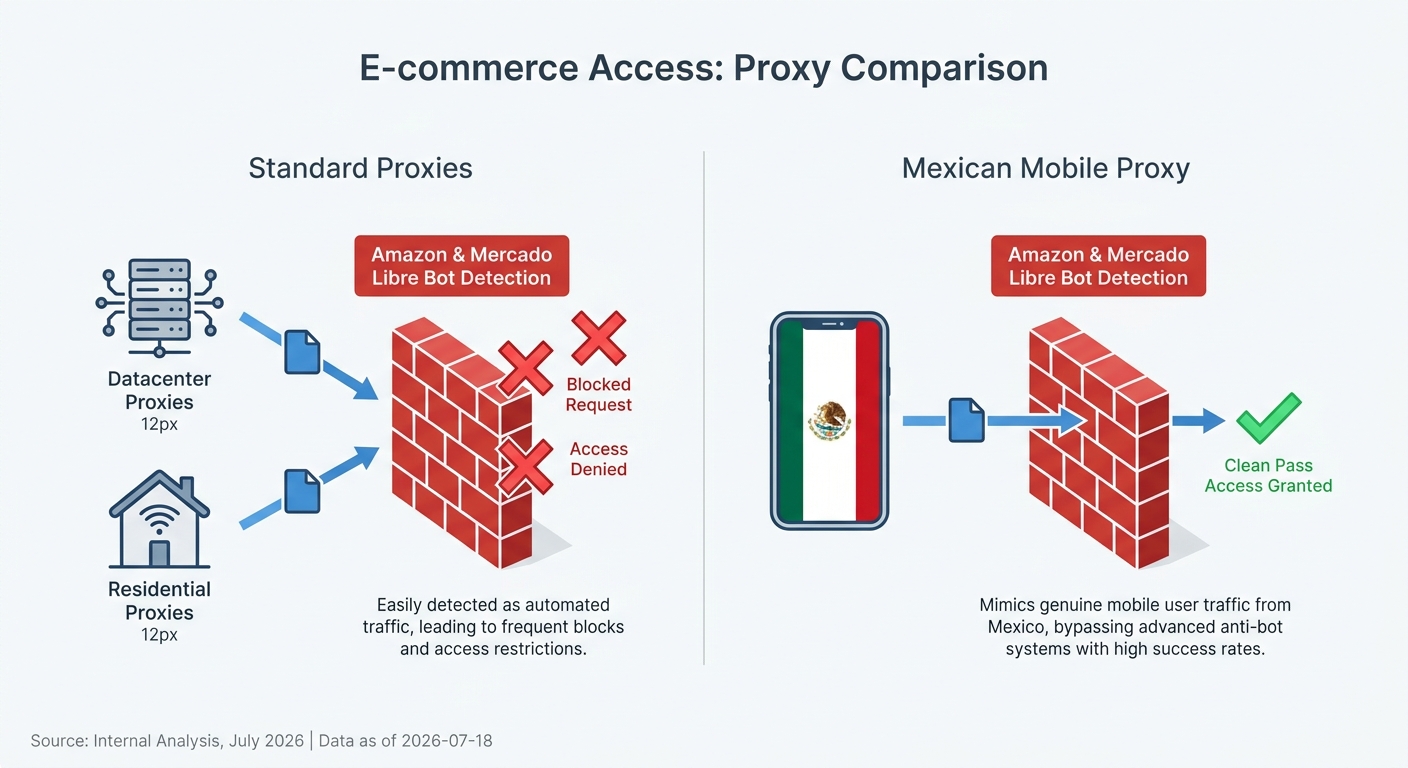
This guide provides a technical deep dive into the exact strategies needed to succeed. We will dissect the crucial differences in how Amazon and Mercado Libre detect automated traffic, explain why authentic 4G LTE mobile proxies backed by CGNAT are the definitive solution, and outline how to configure your infrastructure for high-volume, compliant web scraping in Mexico. Understanding these specific network dynamics is the key to selecting the best Mexican mobile proxies for Mercado Libre and Amazon MX and ensuring your data extraction projects deliver clean, reliable results.
Author Credentials
Author: ProxyServer.tech Engineering Team
Bio: Authored by the senior network infrastructure team at ProxyServer.tech, specializing in authentic 4G LTE mobile proxy deployment across Mexico and Spain. With over a decade of experience bypassing enterprise-grade anti-bot systems, our engineers manage physical SIM card arrays on local carriers (Telcel, AT&T) to support unblockable data extraction for global e-commerce and SEO agencies.
Expert Consensus: Scraping Mexico’s E-Commerce Duopoly
“Mercado Libre’s system is all about velocity. If you hit it with rapid-fire requests from different IPs, you’re flagged instantly. You need a single, trusted mobile IP for a 10-minute session to mimic a real shopper. Anything else gets rate-limited.” — Lead Data Engineer, Fortune 500 Retail Analytics Firm
“Amazon.com.mx doesn’t care about your session as much as your IP’s origin. Its primary defense is a massive ASN blocklist. If your IP’s ASN resolves to a hosting provider, you’re blocked before your first request even lands. Only mobile carrier ASNs get a pass.” — Senior Web Scraping Architect, UScraper Technical Blog
“We tried everything for.com.mx: premium residential, ISP proxies… all failed within hours. The only thing that provides consistent uptime is dedicated 4G proxies physically located in Mexico City. The local carrier IP is non-negotiable for reliable data.” — Head of SEO, Global Marketing Agency on Apify Forums
Amazon MX’s ASN Blocking vs. Mercado Libre’s Rate Limits
A one-size-fits-all proxy strategy is doomed to fail in Mexico. Amazon MX and Mercado Libre deploy fundamentally different defense mechanisms, requiring distinct scraping approaches.
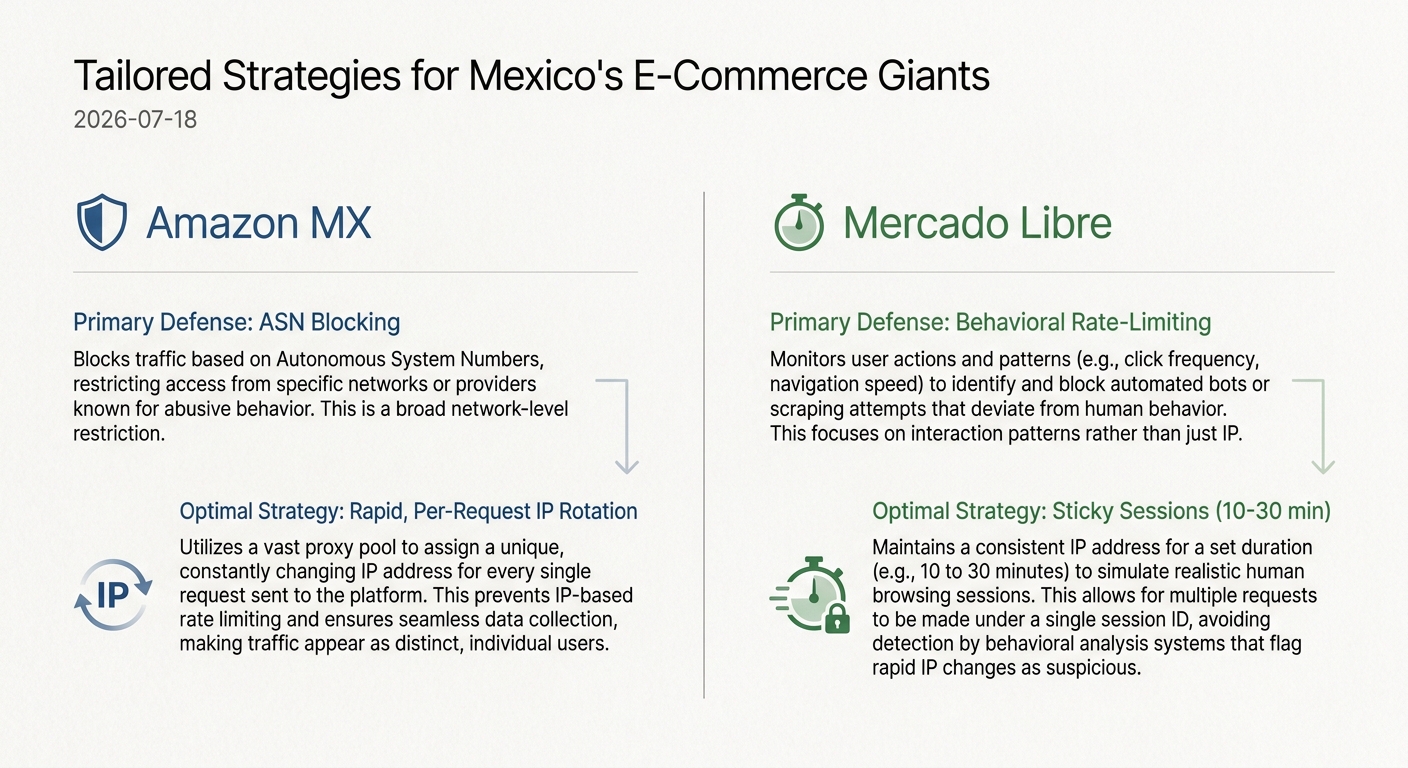
Amazon MX primarily identifies bots by analyzing the Autonomous System Number (ASN)
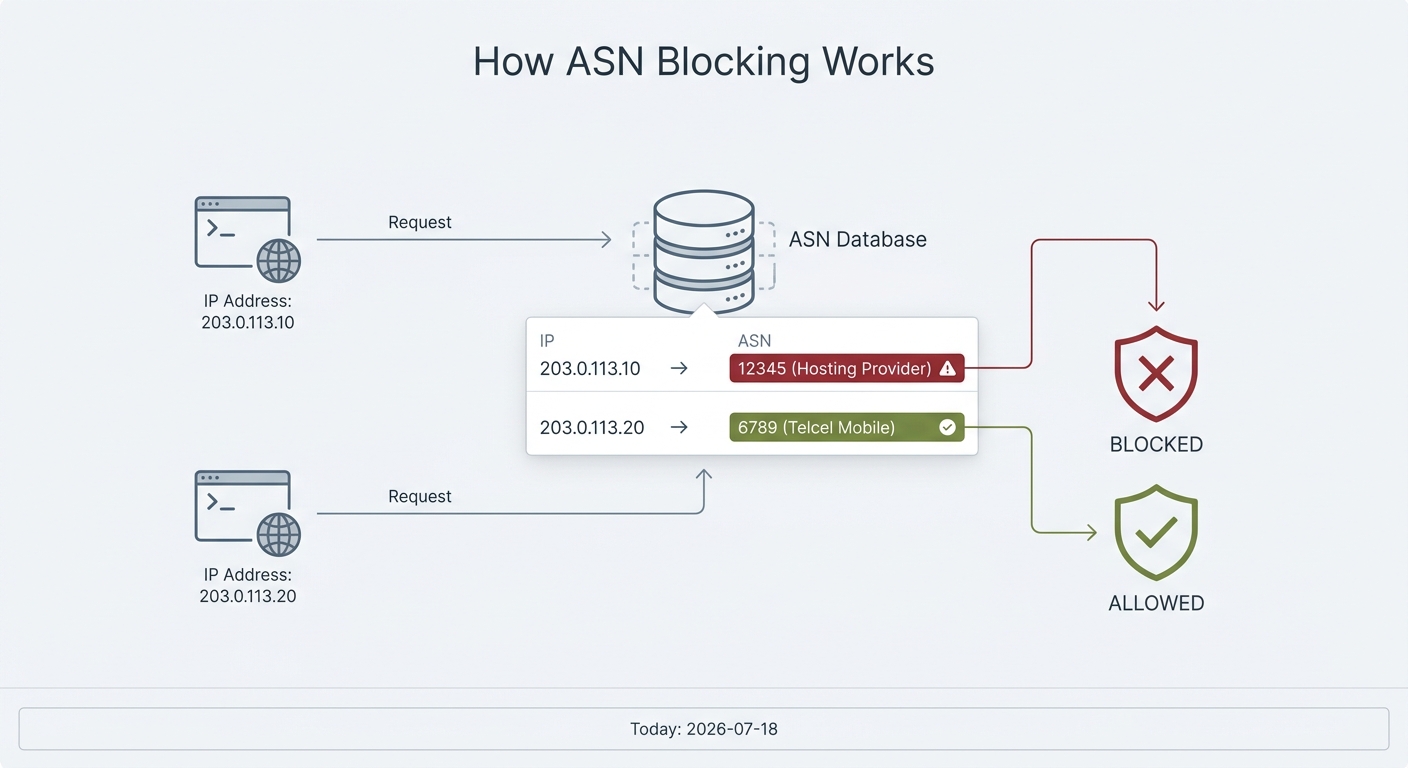
of an incoming IP address. It maintains extensive blocklists of ASNs belonging to data centers and hosting providers, instantly flagging and blocking these requests. Mercado Libre, which holds roughly 55% of the e-commerce market [9], focuses on behavioral analysis. It uses sophisticated rate-limiting algorithms that track request velocity, session duration, and navigation patterns to identify non-human activity.
This means your rotation strategy must be tailored to the target:
- For Amazon MX: Use rapid, per-request IP rotation. A single IP making numerous requests is a red flag, but rotating through a pool of trusted mobile IPs bypasses ASN filters.
- For Mercado Libre: Use “sticky” sessions lasting 10-30 minutes. Rapidly changing IPs during a single browsing session is a clear sign of automation for its behavioral engine. Maintaining the same IP for a longer duration mimics legitimate user behavior.
Residential and mobile proxies are the only types that work reliably on Amazon because its detection stack classifies IPs by ASN, and mobile carrier ASNs are inherently trusted [10]. For implementation, developers often create a custom method like get_proxy() that randomly selects a proxy from a list [8] to distribute loads for rapid-rotation tasks.
| Target Platform | Primary Defense Mechanism | Optimal Rotation Setting | Expected Success Rate |
|---|---|---|---|
| Amazon MX | ASN Classification / Geo-blocking | Rapid (Per Request / 1 min) | 85-95% (with Mobile IPs) |
| Mercado Libre | Behavioral Rate-Limiting | Sticky (10 – 30 minutes) | 85-95% (with Mobile IPs) |
Using the best Mexican mobile proxies for Mercado Libre and Amazon MX is the only way to gain the granular control needed to switch between these conflicting rotation requirements.
The CGNAT Advantage for E-Commerce Price Monitoring
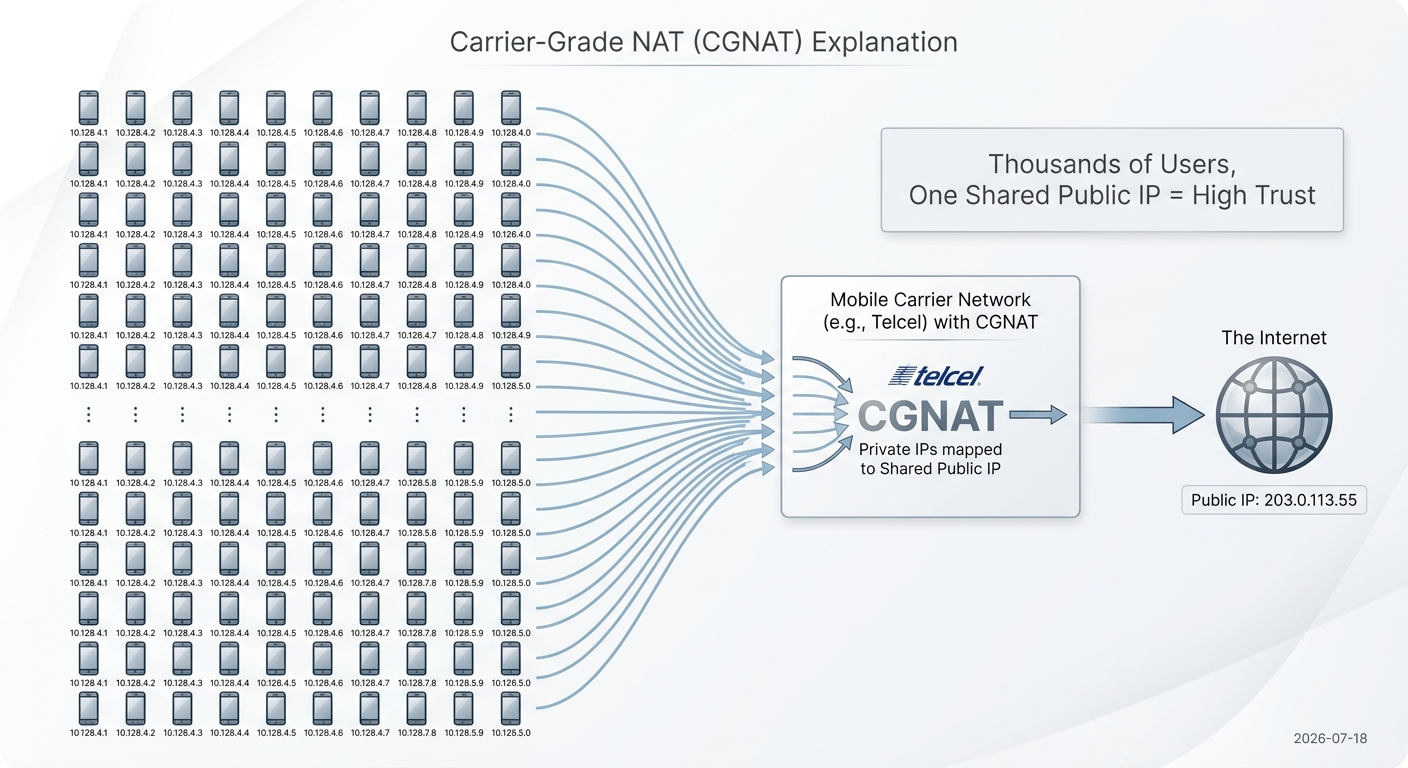
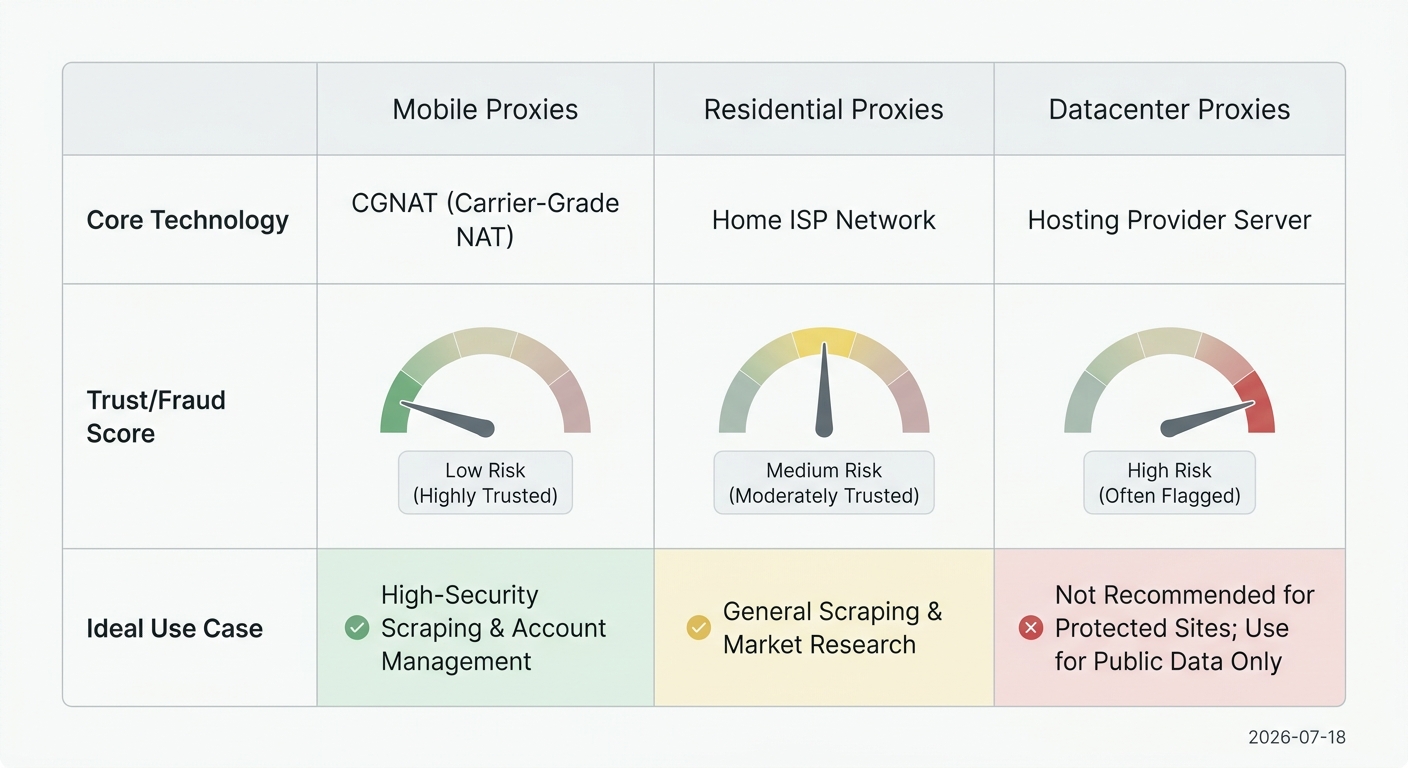
Carrier-Grade NAT (CGNAT) is the core technology that gives mobile proxies their “unblockable” status. Mobile carriers like Telcel and AT&T use CGNAT to allow thousands of legitimate mobile users to share a small pool of public IPv4 addresses. Because of this massive IP sharing, e-commerce platforms cannot block a CGNAT IP without simultaneously blocking thousands of real shoppers. This gives 4G LTE mobile proxies a virtually zero fraud score and makes them exceptionally resilient to bans [3]
.
While many sources state mobile proxies are “trusted,” they fail to explain these underlying network mechanics. Datacenter and hosting IPs are published in well-known ranges that anti-bot systems flag on sight. In contrast, 4G LTE ranges belong to consumer mobile networks, so they carry a mobile-grade reputation out of the box [2]. This infrastructure provides the highest detection resistance for mobile-targeted E-commerce [7], with mobile proxies achieving 85-95% success rates on heavily protected sites [3]
.
It’s crucial to distinguish between authentic mobile proxies from physical SIM cards and “simulated” mobile IPs, which are often just residential IPs re-flagged. True CGNAT protection and the associated trust only come from hardware managed within the carrier’s network [4].
| Proxy Type | CGNAT Protection | Fraud Score | Best For |
|---|---|---|---|
| Mobile Proxies | Yes (Massive IP Sharing) | Near Zero | High-security Price Monitoring |
| Residential Proxies | No (Single Household IP) | Low | General Web Scraping |
| ISP Proxies | No (Datacenter Hosted) | Medium | Static Account Management |
When managing multiple seller accounts, it is crucial to combine these proxies with anti-detect browsers. Experts recommend creating distinct accounts with different names, bank accounts, emails, and phone numbers, and using a dedicated proxy setup for each to avoid linking them [5].
Key Criteria for Selecting a Mexican Mobile Proxy Provider
Not all mobile proxies are created equal. To ensure success, evaluate providers based on these technical criteria:
- Carrier Diversity and Authenticity: The provider must offer IPs from top Mexican carriers like Telcel, AT&T, and Movistar. Crucially, verify that they use real 4G/5G SIM card hardware, not simulated or re-flagged residential IPs. Authentic hardware is the only way to guarantee a true mobile IP reputation.
- Granular Rotation and Session Control: Your provider must offer flexible rotation controls via an API or dashboard. You need the ability to force an IP rotation on every request for Amazon MX, while also being able to create sticky sessions of 30+ minutes for Mercado Libre.
- Geolocation Specificity: For tasks like local SERP tracking or monitoring delivery apps, you need city-level targeting. Ensure the provider offers proxies physically located in key metropolitan areas like Mexico City, Guadalajara, and Monterrey.
- Dedicated vs. Shared Resources: For enterprise-level scraping, a dedicated proxy (a device and SIM card used only by you) is non-negotiable. Shared proxies, while cheaper, risk having their IP reputation tarnished by other users, compromising your operations.
Navigating Mexico’s 2025 Data Privacy Overhaul
Following the dissolution of INAI in March 2025, Mexico overhauled its data privacy laws, requiring strict transparency and purpose-limitation for any web scraping operations collecting personal data. This makes compliance a critical component of any data extraction project in the region.
The 2025 legal overhaul requires scrapers collecting personal data to provide notice, transparency, purpose-limitation, and secure consent [6]. For e-commerce data extraction, this means focusing exclusively on publicly available information and avoiding any Personally Identifiable Information (PII). Our infrastructure supports compliance by strictly routing traffic for public data extraction (pricing, SERPs) while providing compliant IP masking.
Compliance Best Practices for Scraping in Mexico:
- Target Public Data Only: Limit scraping to product prices, stock status, and public seller information. Avoid customer reviews with names, user profiles, or other PII.
- Set a Clear User-Agent: Identify your bot with a descriptive User-Agent string (e.g.,
MyCompany-Price-Monitor/1.0). This demonstrates transparency and allows site administrators to contact you. - Respect
robots.txt: While not legally binding, respecting a site’srobots.txtfile is a best practice that signals good faith. - Maintain a Low Request Rate: Even with unblockable IPs, scraping too aggressively can degrade site performance. Mimic human browsing speed to minimize your footprint.
Beyond E-Commerce: Scraping Local SERPs & Delivery Apps
The value of Mexican mobile proxies extends far beyond Amazon and Mercado Libre. They are essential for SERP tracking and monitoring local delivery apps (like Rappi, Uber Eats, and DiDi Food), which are a cornerstone of Mexico’s digital economy. The online food delivery market in Mexico alone is projected to grow to over $7 billion by 2028.
SEO agencies need authentic local IPs from cities like Mexico City or Guadalajara to accurately track rankings for high-value commercial queries like restaurante mexicano cerca de mi or mejores tacos en Polanco
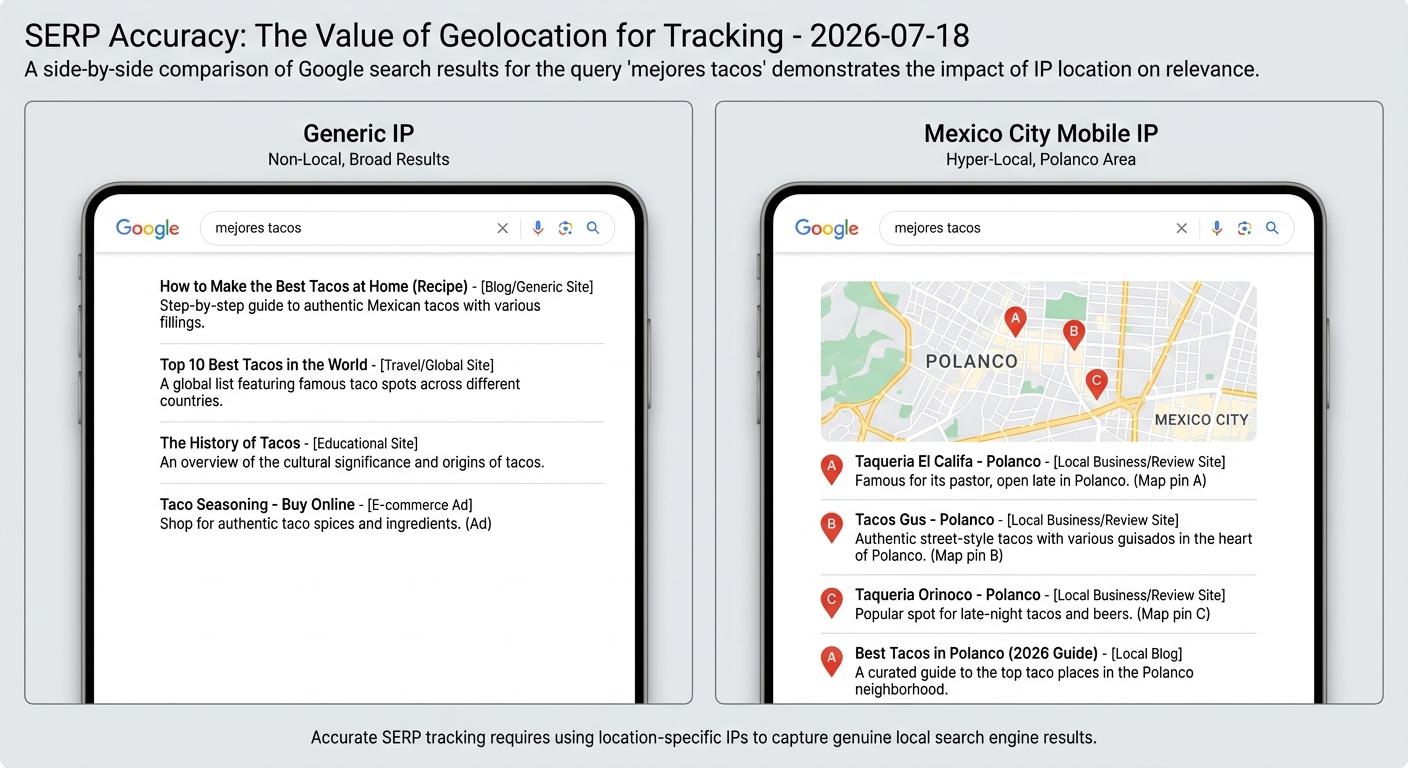
. A mobile IP provides the precise geographic context needed for accurate SERP intelligence, bypassing Google’s geo-fencing and rate limits. Similarly, businesses use mobile proxies to scrape delivery apps for competitive data like menu pricing, delivery fees, active promotions, and restaurant visibility rankings within the app—data that is impossible to access without a local, trusted mobile IP.
Frequently Asked Questions
Who is Amazon’s competitor in Mexico?
Mercado Libre is Amazon’s primary competitor in Mexico. Holding approximately 55% of the e-commerce market share [9], Mercado Libre outpaces Amazon’s 30% share, making it the dominant platform for online retail and a critical target for price monitoring.
What is the Mexican equivalent to Amazon?
Mercado Libre serves as the Mexican equivalent to Amazon. Founded in Argentina but dominating the Latin American market, it offers a similar ecosystem of e-commerce, fulfillment (Mercado Envíos), and digital payments (Mercado Pago).
Is MercadoLibre bigger than Amazon in Mexico?
Yes, Mercado Libre is significantly bigger than Amazon in Mexico. Recent data indicates Mercado Libre controls roughly 55% of the retail market share [9], compared to Amazon’s estimated 30%, driven by its deep integration with local payment methods and consumer habits.
What is the Mexican version of Amazon?
While Amazon operates its own localized site (Amazon.com.mx), Mercado Libre is widely considered the homegrown Latin American version of Amazon. Both platforms form a duopoly that controls 85% of the Mexican e-commerce landscape [1].
Limitations, Alternatives & Professional Guidance
While 4G LTE mobile proxies offer the highest success rates (85-95%) [3], they are a premium solution. For low-security targets or basic scraping, rotating residential IPs may suffice. However, for continuous, high-volume extraction from Mercado Libre and Amazon MX, using cheaper datacenter IPs will almost certainly lead to CAPTCHAs and prolonged bans.
For maximum reliability, professional data teams must pair mobile proxies with anti-detect browsers. These browsers spoof a device’s digital fingerprint—including WebGL, canvas, fonts, and browser headers—making each connection appear as a unique, legitimate user. This combination is the industry standard for managing multiple accounts and performing large-scale, undetected scraping.
Conclusion
Navigating Mexico’s e-commerce duopoly isn’t a matter of finding a proxy; it’s about deploying a precise, adaptable strategy. Amazon MX’s ASN filtering demands rapid IP rotation, while Mercado Libre’s behavioral analysis requires sticky sessions. Only authentic 4G LTE Mexican mobile proxies provide the granular control to master both challenges. By leveraging real mobile IPs from carriers like Telcel and AT&T, backed by CGNAT technology, data engineers can achieve the unblockable access needed for accurate price monitoring and SERP tracking.
As bot detection evolves, the line between a real user and a bot will blur further, making authentic mobile carrier IPs the only sustainable infrastructure for mission-critical data. Whether targeting national pricing trends or localized search queries in Guadalajara, real mobile IPs from physical SIM cards represent the most robust and reliable approach for data extraction in 2026.
Call to Action: Ready to scale your data extraction? Explore ProxyServer.tech’s premium Mexican mobile proxy plans and secure your dedicated Telcel or AT&T connection today.
References
[1] CCIA’s Comments on the Mexican COFECE’s Final Report on E-Commerce Retail Market Competition
[2] 4G Proxies — Real 4G LTE Mobile IPs from Carriers | PROXIES.SX
[3] Best Proxies for Web Scraping in 2026 | PROXIES.SX
[4] CGNAT & Mobile Proxies: Trust Scores Explained
[5] How to Run Multiple Amazon Seller Accounts Safely in 2026
[6] Mexico: Artificial Intelligence – Country Comparative Guides
[7] E-commerce Proxies: Price & Competitor Data – Databay
[8] GitHub – luminati-io/Proxy-with-python-requests