Key Takeaway: A 5G mobile proxy routes internet requests through a real mobile device or modem on a 5G carrier network. It can deliver higher bandwidth and lower latency than 4G LTE, but 5G does not automatically improve anonymity or trust. Both generations typically sit behind carrier-grade NAT, so their IPs share the same carrier-origin reputation. For scraping, social media management, and ad verification, a reliable real-SIM 4G proxy is often the better buy. 5G earns its premium only on bandwidth-intensive work.
Why 5G Speed Does Not Automatically Make a Better Proxy
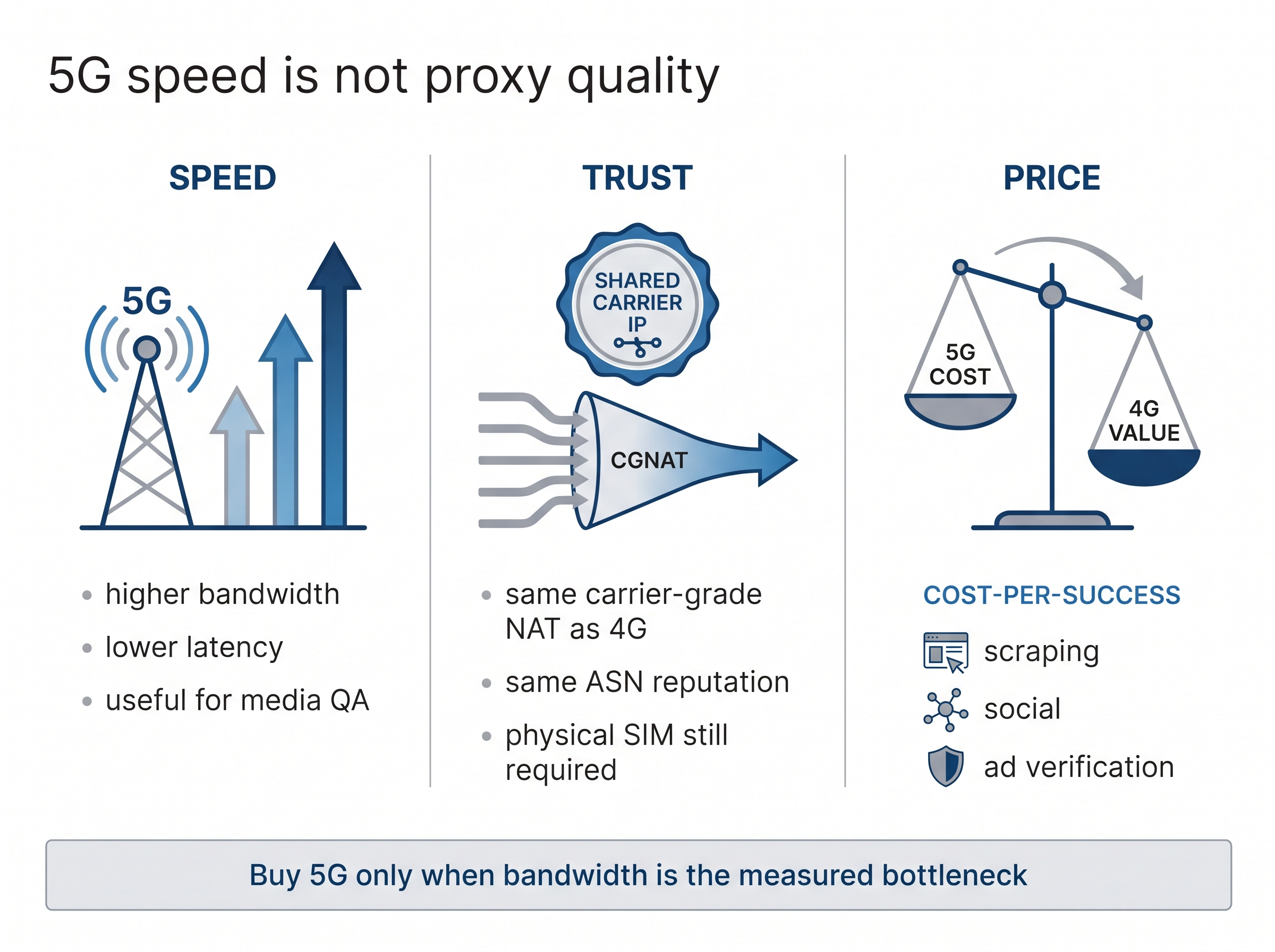
Infographic comparing 5G proxy speed, shared carrier trust, and price, showing that 5G does not automatically improve anonymity.
A 5G mobile proxy sends traffic through a physical SIM on a carrier’s 5G network. Websites see a carrier IP instead of a datacenter address or a virtualized residential identity. The term “5G” describes only the radio link.
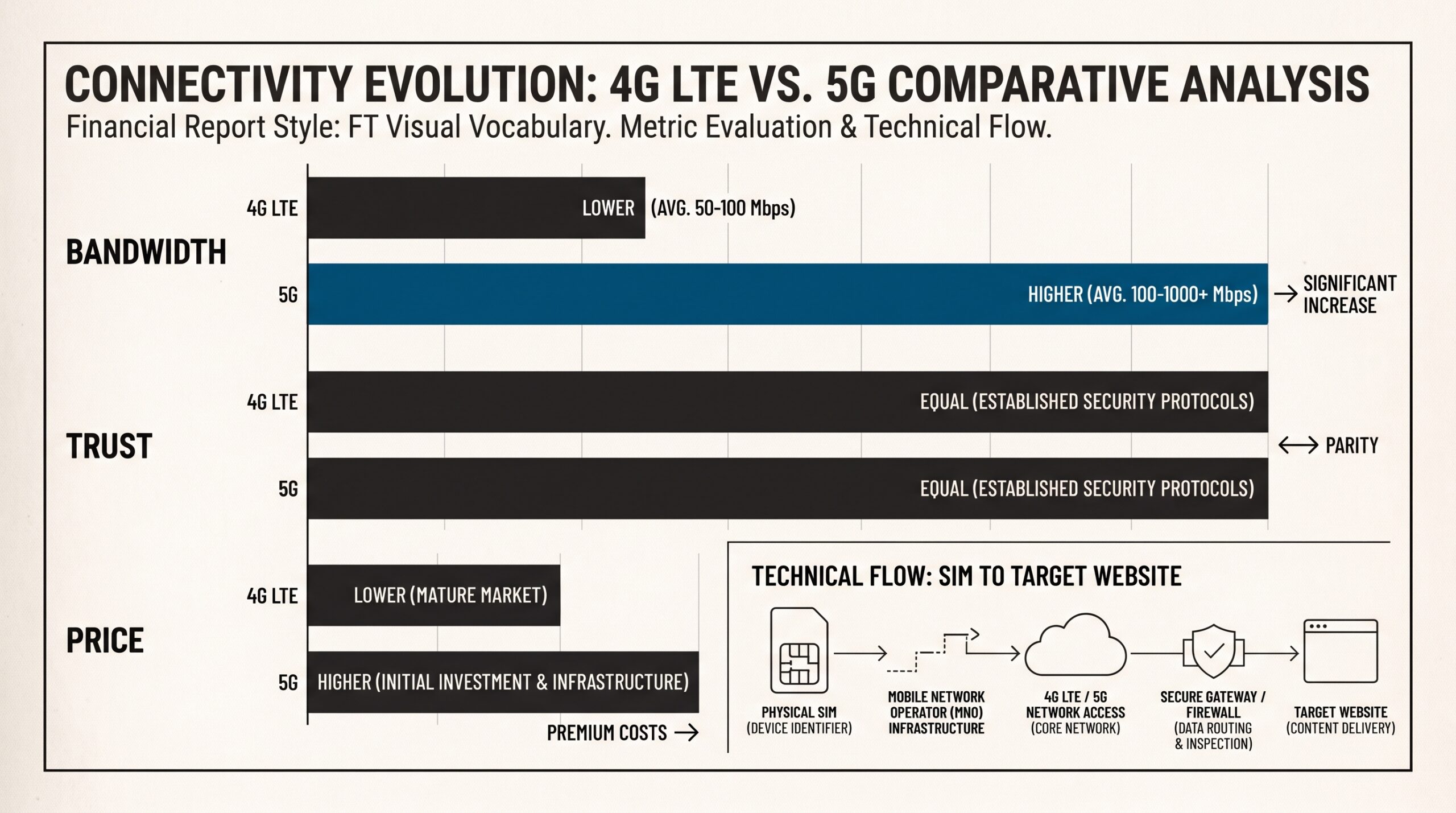
Network generation affects speed. Trust and reliability depend on other factors: CGNAT, carrier reputation, SIM authenticity, IP rotation, and infrastructure quality. Buyers who confuse speed with trust overpay for the wrong product.
This guide is for US and European teams that need Mexican or Spanish mobile identities. Typical jobs include:
Latin American ad verification
Mercado Libre and Amazon Mexico price monitoring
Spanish-market app and website QA
Social account management
Localized SERP testing
For these tasks, location and carrier identity usually matter more than theoretical bandwidth.
The guide covers five topics:
How 5G proxies work
Measured performance compared with advertised claims
Why 4G still covers most workflows
How CGNAT shapes blocking
When Mexican and Spanish identities are the strategic choice
How 5G Mobile Proxies Route Requests Through Carrier Networks
A mobile proxy has four parts:
A physical SIM
A smartphone or cellular modem
A live carrier connection
Proxy software that exposes the link over HTTP, HTTPS, or SOCKS5
A hide.me guide puts it this way: mobile proxies “can route Internet traffic through real mobile devices using 3G, 4G, and 5G cellular connections.”
This separates mobile proxies from several other options:
Datacenter proxies
Cloud-hosted IPs
Emulated mobile fingerprints
Residential proxies that never touch carrier infrastructure
“5G” names the radio-access connection. It tells you little about the provider’s wider architecture.
The request path
Your scraper, browser, or automation tool sends a request to the proxy endpoint.
The proxy server forwards it to the physical modem.
The modem connects to a nearby cell tower.
The carrier routes the traffic through its mobile core.
CGNAT maps the subscriber’s private address to a shared public carrier IP.
The destination website receives the request from that carrier-associated IP.
The response returns through the carrier network and modem to your client.
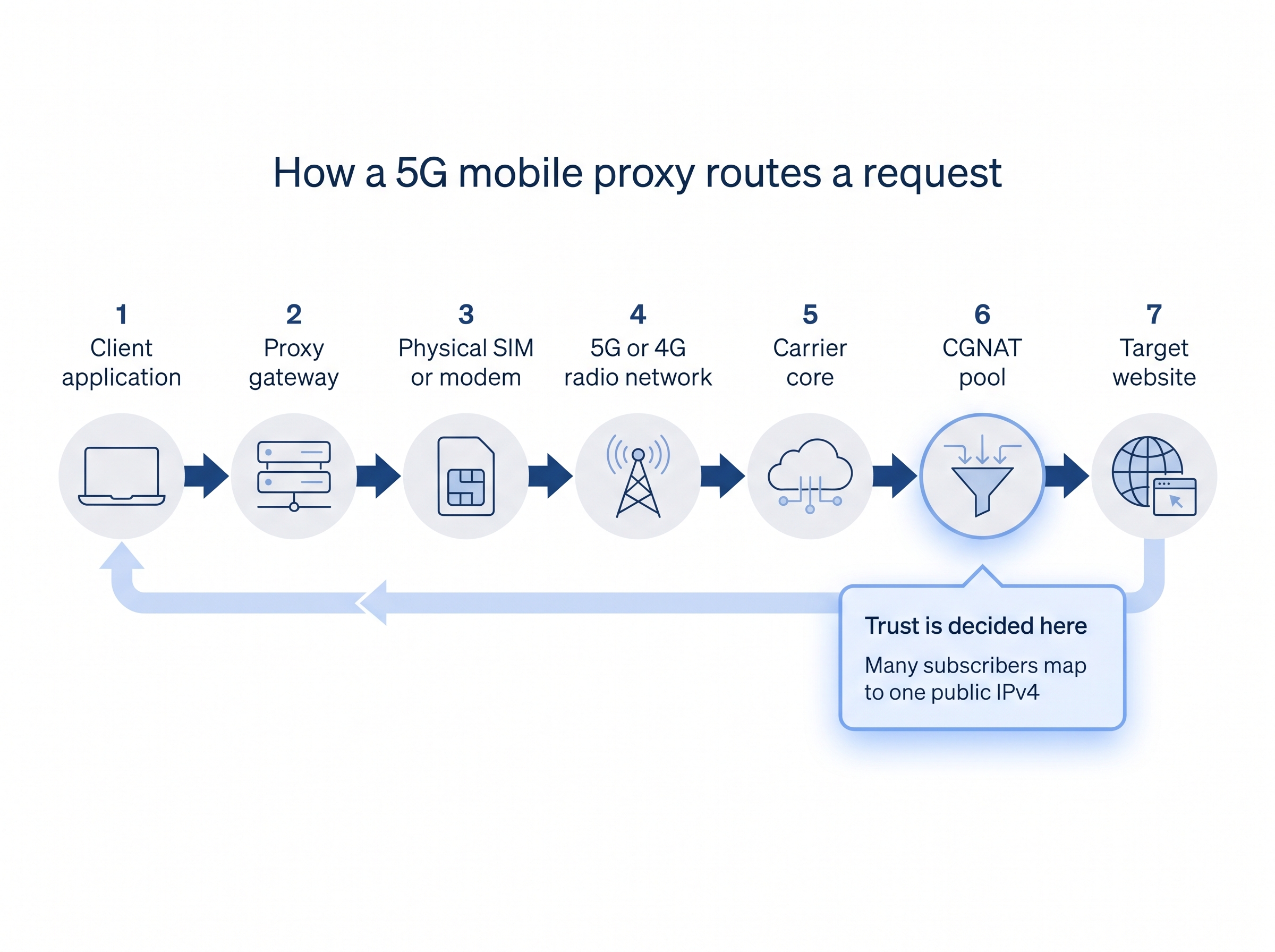
Client application → Proxy gateway → Physical SIM/modem → 5G or 4G radio network → Carrier core → CGNAT pool → Target website
Seven-stage diagram of a mobile proxy request traveling from a client through a SIM, radio network, carrier core, and CGNAT to a website.
Step 5 is where trust is decided. Carrier-grade NAT lets operators assign private addresses that middleboxes translate into shared public IPv4 addresses [1].
What 5G changes, and what it leaves alone
5G may improve throughput, latency, concurrent transfers, and media loading.
5G does not change any of the following:
Whether the IP belongs to a real carrier
Whether the provider uses physical SIMs
The target site’s rate limits
The legality of your traffic
Responsible scraping and account management remain your job.
3GPP designs 5G to work alongside 4G LTE. As a result, many connections switch between generations during a session. 3GPP’s 5G system overview describes this backward compatibility.
Advertised maximum speeds and usable proxy throughput are different things.
⚠️ Peak 5G speed is not usable proxy throughput
Marketing download rates describe the radio link under favorable conditions, not what your scraper will complete. Target throttling, CAPTCHAs, concurrency caps, browser rendering, and rotation delays usually set the ceiling long before megabits per second do.
Real-World 5G Performance: Measured Speed, Latency, and Network Maturity
Marketing claims say 5G is simply faster. Measurements show a more qualified picture.
Treat the latency figures as study measurements, not guarantees. The ACM paper by Azuaje and colleagues reports a 12 ms average uplink end-to-end latency and a 21 ms 95th percentile [6]. No proxy is guaranteed to match these numbers. The Opensignal KT score measures user experience, not proxy success [9].
NSA versus SA
There are two types of 5G deployment:
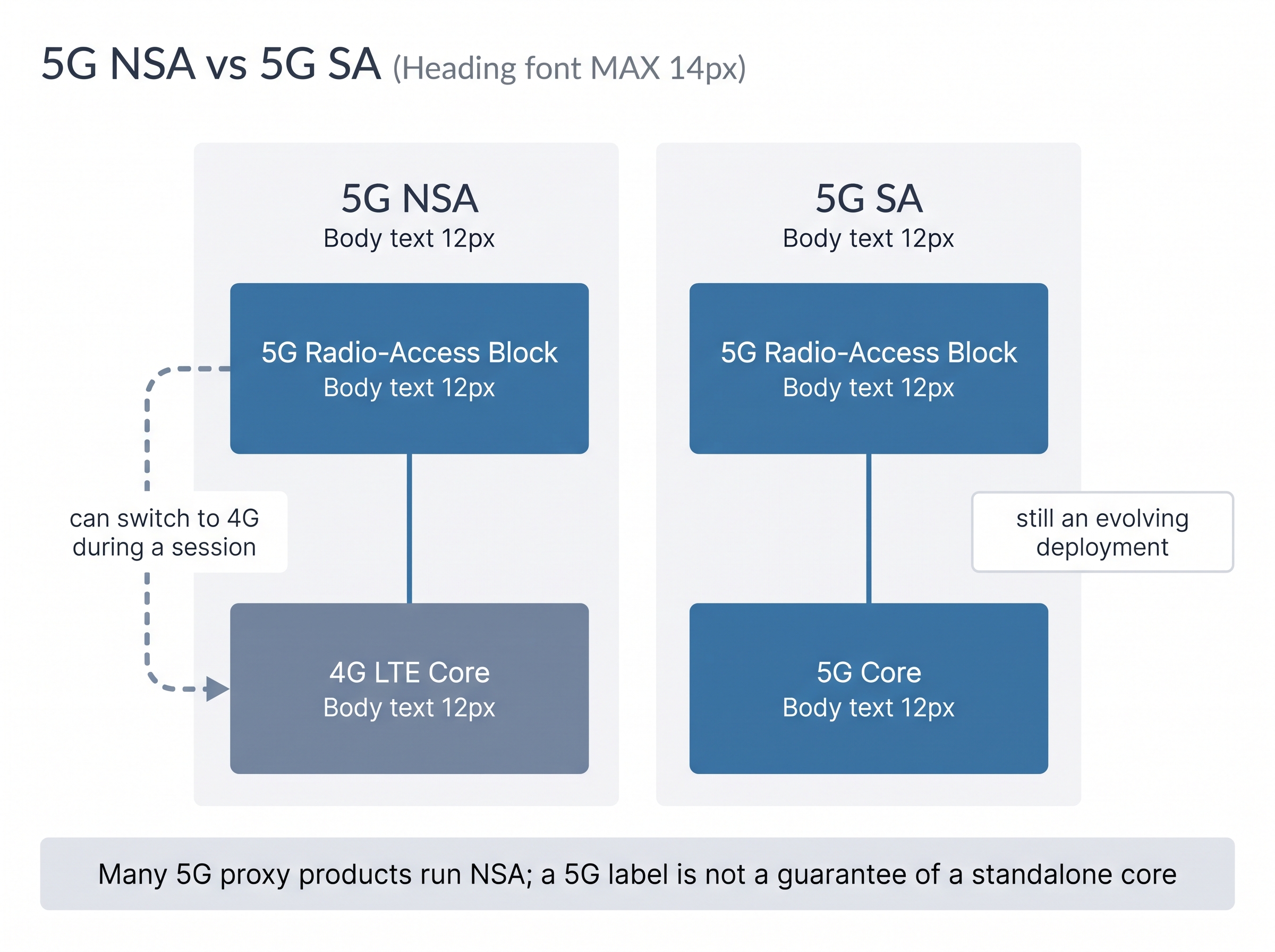
Side-by-side architecture graphic of 5G non-standalone using a 4G core versus 5G standalone using a 5G core.
5G NSA (non-standalone) uses 5G radio access supported by a 4G core.
5G SA (standalone) pairs 5G radio with a 5G core.
Many “5G proxy” products still run on NSA. Others switch between 4G and 5G as signal strength changes. A 5G label does not prove that a session stays connected to a standalone core.
GSMA Intelligence benchmarked 46 markets. It found a widening gap in advanced capabilities such as SA, 5G-Advanced, and uplink performance [4]. Network maturity is uneven across countries.
Which workloads can use the speed
Some bandwidth-heavy jobs may benefit from 5G:
Streaming-service QA
Video-ad verification
Large asset downloads
Mobile app performance testing
Media scraping, where the target permits it
Most other work is not limited by bandwidth. SERP checks, price monitoring, social account management, ad rendering checks, and text scraping rarely use the full capacity of a mobile link.
Other limits usually slow you down first:
Target-site throttling
Concurrency caps
CAPTCHAs
Browser rendering
Rotation delays
A 273 Mbps connection does nothing for a 4 KB JSON response when the server limits how often you can request it.
Validate before you buy
Test any endpoint yourself before you commit. Measure these factors:
Download and upload throughput
Median and 95th-percentile latency
DNS resolution time
Connection success rate
IP rotation consistency
Target-site response time
Carrier and ASN identity
Session stability over long tasks
High bandwidth only helps when your workload can use it. Base your purchase on that.
4G Versus 5G Mobile Proxies: Selecting the Right Network for the Workload
Many buyers treat 5G as an automatic upgrade. That approach ignores cost.
Scraping, social media, ad verification, SERP checks
Media QA, streaming, large transfers, latency-critical apps
Match the network to the real bottleneck
A Proxies.sx comparison reaches a similar conclusion. It finds that 4G is the better choice for most use cases, with speeds of 10–50 Mbps and the same trust scores as 5G [10]. Proxies.sx is a vendor, so read this as industry opinion.
Why 4G can be the smarter purchase
Network speed is rarely what limits a proxy request. These factors usually limit it instead:
Website rate limits
CAPTCHA systems
Browser execution
Per-session concurrency
Target response times
Extraction logic
If the target returns small HTML or JSON files, moving from 20 Mbps to 100 Mbps may not increase the number of completed requests.
A stable 4G link on real SIM infrastructure can also beat an overloaded or poorly placed 5G endpoint. ScrapingBee’s provider comparison found that some fast providers refused connections to a noticeable number of sites. Check connection restrictions as carefully as you check speed.
Invoicing, including CFDI for eligible Mexican operations
4G and 5G share the same trust profile because of CGNAT.
CGNAT, Carrier Reputation, and Why Mobile IPs Are Difficult to Block Broadly
Calling mobile proxies “more anonymous” explains nothing. The underlying mechanism does.
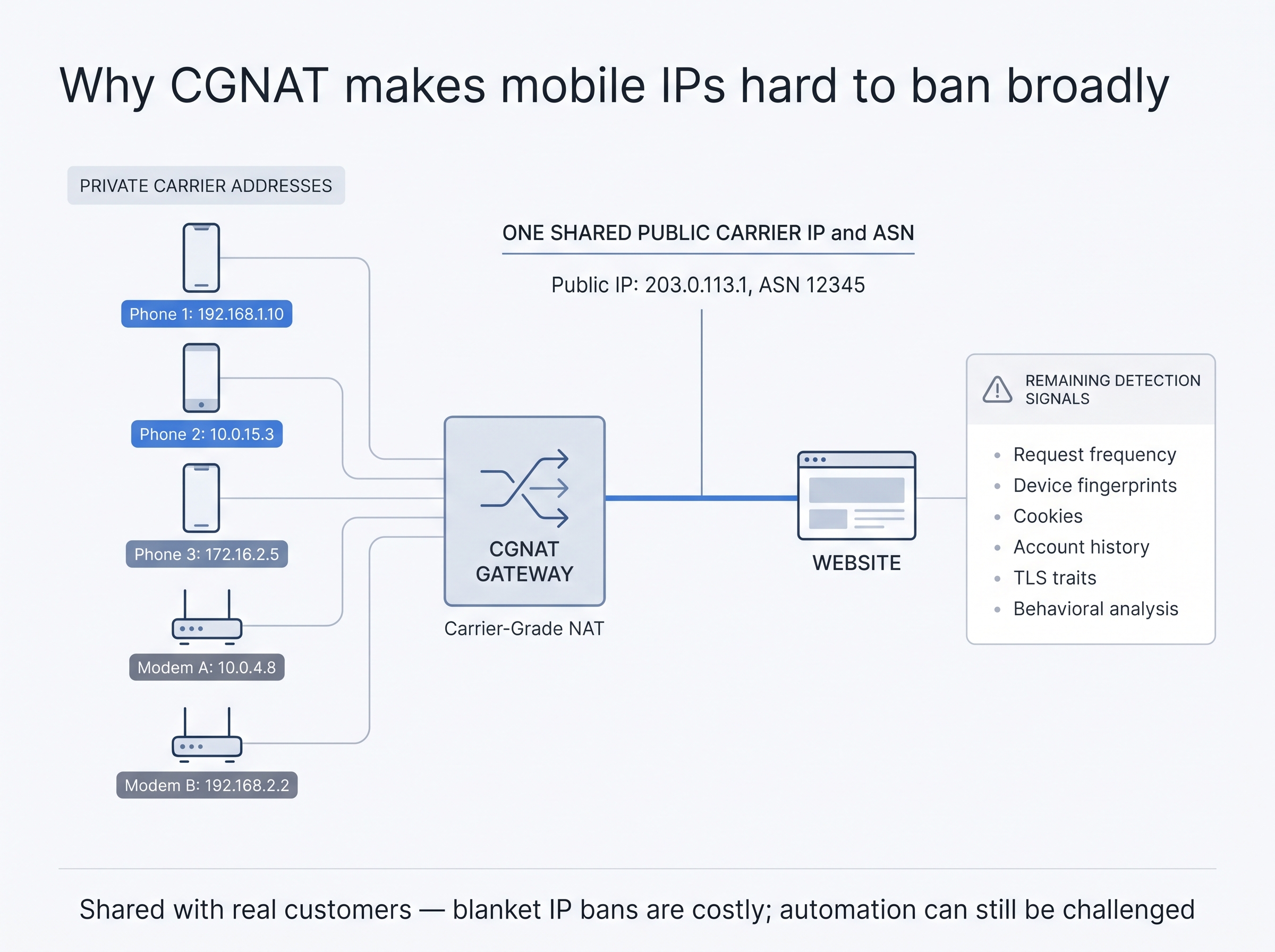
Inside a carrier network, mobile subscribers usually receive private addresses. The carrier translates many subscriber connections into a smaller pool of public IPv4 addresses. As a result, one public IP may serve many legitimate customers at the same time [1]. The destination site sees the carrier’s public IP and ASN, never the subscriber’s private address.
Device or modem → Private carrier address → Mobile core → CGNAT gateway → Shared public carrier IP → Website
Why shared IPs carry weight
Diagram of many mobile devices sharing one public carrier IP through CGNAT, with other automation-detection signals listed.
A carrier ASN is linked to ordinary phones and mobile apps. Blocking one of its IPs can lock out real customers. This makes blanket bans less attractive than blocking a known datacenter range.
MobileProxies.org’s CGNAT analysis argues that AT&T, Verizon, and T-Mobile addresses send stronger legitimacy signals than hosting-provider IPs. Treat this as practitioner analysis, not an industry standard.
Websites still use many other signals to detect automation:
Request frequency
Browser and device fingerprints
Cookies
Account history
TLS characteristics
Behavioral patterns
Repeated automation signatures
A clean IP combined with a robotic fingerprint will still be challenged.
Treat trust scores with care
⚠️ Vendor trust scores are not a standard metric
Figures such as 85–99 for mobile IPs or a 98% scraping success rate come from providers and are not industry-wide measurements. A carrier IP can still be challenged. Rotation quality, SIM authenticity, and request behavior decide outcomes more than a published score.
MobileProxyNow publishes trust scores of 85–99 for mobile IPs and 10–30 for datacenter IPs. It also claims a 98% scraping success rate. These figures come from a provider and need independent validation.
Keep three points in mind:
“Trust score” is not a standardized measurement.
A carrier IP can still be blocked or challenged.
CGNAT makes the network origin look more plausible. It does not hide abusive automation.
Rotation strategy and SIM quality still decide results.
Responsible use
At ProxyServer.tech, we present CGNAT as a reliability and authenticity advantage. It is not a way to defeat security controls. Follow these rules:
Website terms of service
Applicable privacy and data-protection laws
Rate limits
Robots directives, where relevant
Platform automation rules
Mexican and Spanish Mobile Identities for Cross-Border Business Operations
Most guidance assumes US carrier proxies. Teams testing Mexican or Spanish experiences need something different.
Why location and carrier identity matter
A US business may need to check several things in Mexico or Spain:
Whether a Mexican ad reaches a Mexican mobile user
How Mercado Libre Mexico shows prices and inventory
US availability does not predict Mexican conditions
Spain and Mexico testing
Validate by carrier, city, endpoint
Country-level labels are not enough
Coverage is not proxy inventory. About 30% Latin America 5G and 25% mid-band 5G versus 79% North American penetration show why a 4G LTE Mexican identity can be the more authentic baseline.
Coverage statistics do not measure proxy availability, and Ericsson does not claim they do. They do show something useful: a provider that offers only 5G endpoints may not match what most users in a given Mexican market experience. A real 4G LTE connection can be more representative.
Three use cases
LATAM ad verification. Check creative delivery, redirects, language, currency, and regional targeting. Use a Mexican or Spanish carrier identity, not just a datacenter IP with a country code.
Mexican e-commerce monitoring. Check availability, marketplace pricing, shipping estimates, and promotions. Keep request rates controlled. Log the timestamp, location, carrier, and session type for each check.
Spanish-market app QA. Test mobile-only flows, login behavior, downloads, localization, and performance. Compare 4G with 5G only when the test measures the network experience itself.
Qualifying a provider
Ask each provider about these points:
Physical SIM infrastructure
Country and carrier details
4G and 5G availability for each endpoint
Sticky and rotating session options
IP replacement rules
Uptime SLA
Concurrency limits
Acceptable-use and anti-fraud policies
Billing, including CFDI-compliant invoicing for Mexican companies
CFDI-compliant invoicing for qualifying Mexican business operations
Our approach is practical and 4G-first. We do not claim 5G is always better.
Choose a proxy based on your workload, carrier authenticity, geography, and measured success rate. The generation number matters less than these factors.
Frequently Asked Questions
What is a 5G mobile proxy?
A 5G mobile proxy routes your traffic through a real SIM-connected device or modem on a 5G carrier network. The target site sees a mobile carrier IP rather than a datacenter address. Speed, location, carrier reputation, rotation behavior, and provider infrastructure all affect how well it performs in practice.
Is a 5G mobile proxy better than a 4G proxy?
Not automatically. 5G can offer higher bandwidth and lower latency. However, both generations may use the same CGNAT architecture, so they have similar network-origin trust [10]. For scraping, social media, and ad verification, a stable 4G proxy is often enough.
How much does a 5G mobile proxy cost?
Pricing depends on location, bandwidth, session type, rotation, concurrency, and infrastructure. Don’t compare price per gigabyte alone. Also consider:
Cost per successful request
Uptime
Available carriers
Minimum commitment
Support
Whether the provider issues the business documents you need
Are 5G mobile proxies detectable?
No proxy is completely undetectable. Mobile IPs can look more legitimate because they belong to carrier networks and are shared with ordinary subscribers. Sites can still detect automation through request behavior, fingerprints, cookies, account patterns, TLS characteristics, and unusual traffic volume.
What is CGNAT and why does it matter for proxies?
CGNAT lets a carrier share public IPv4 addresses among many subscribers[1]. A mobile proxy may therefore use an IP that legitimate users also use. This can help reputation. It does not prevent behavioral detection, account challenges, or blocking.
Can I get a 5G mobile proxy with a Mexican or Spanish IP?
Availability depends on the provider’s physical SIM and modem infrastructure. Ask the provider three questions:
Does the endpoint truly connect to a Mexican or Spanish carrier?
Does it support 4G as well as 5G?
Can sessions rotate or stay sticky to suit your workflow?
What is the difference between rotating and dedicated mobile proxies?
A rotating proxy changes the exit IP on a schedule or trigger. A dedicated or sticky session keeps one endpoint for longer. Rotation suits independent requests. Sticky sessions suit logins, shopping carts, dashboards, and multi-step application tests.
How fast are 5G mobile proxies in real-world tests?
Performance varies by carrier, spectrum, signal, congestion, device, and architecture. Opensignal measured Orange’s 5G downloads at 273.4 Mbps in France [8]. Even so, target rate limits and connection restrictions can still cap proxy throughput.
Do mobile proxies work for web scraping at scale?
They can, if your workflow respects target rules and keeps concurrency under control. Results depend on rotation quality, carrier diversity, session management, request pacing, parsing efficiency, and the target’s defenses. Test a representative sample before you commit to large collection runs.
Are mobile proxies legal to use in the United States?
Using a proxy is not automatically illegal, but your purpose and conduct matter. Review applicable laws, contracts, privacy obligations, platform terms, and anti-fraud rules. Do not use proxies for credential theft, unauthorized access, abusive automation, bypassing security controls, or collecting data without a lawful basis. This article is not legal advice. Consult a qualified attorney for your situation.
How do I set up a mobile proxy on a phone or scraper?
Enter the provider’s hostname, port, username, and password in your scraper, browser, operating system, or automation tool. Before sending production traffic, verify the exit IP, country, ASN, DNS behavior, timeouts, and rotation rules. Use separate credentials and rate limits for each project.
Why do mobile proxies often have higher trust than datacenter proxies?
Mobile IPs belong to telecom carriers and may be shared with legitimate subscribers. Blocking them broadly causes more disruption than blocking a known hosting range. Trust is still not guaranteed. Sites also evaluate behavior, fingerprints, account history, and request patterns.
Limitations, Alternatives, and Professional Guidance
Speed and trust figures vary by provider, carrier, city, device, spectrum, congestion, and measurement method. Third-party trust scores are not standardized industry metrics. The 98% scraping-success claim comes from a provider, so test it yourself.
Other proxy types may suit your needs better:
When another proxy type is the better fit
Option
Pros
Cons
4G mobile (real SIM)
Carrier identity plus CGNAT reputation at a lower cost than 5G for scraping, social, and verification.
Typical 10–50 Mbps will not help media-heavy QA or large transfers.
Residential
Useful for household-network tests when you do not need a mobile carrier identity.
Does not present a true cellular origin or SIM-backed carrier ASN.
Datacenter
Low cost and high volume when the target accepts hosting-range IPs.
Weaker origin reputation; easier to blanket-block than a carrier pool.
4G mobile proxies provide cost-efficient, authentic mobile access.
Residential proxies work for household-network testing when you don’t need a carrier identity.
Datacenter proxies handle permitted high-volume, low-cost tasks where IP reputation is acceptable.
Get professional legal review before any regulated, sensitive, or large-scale data collection. Use proxies only for authorized testing, research, verification, and automation.
Choose the Proxy Network That Matches the Test
A 5G mobile proxy combines a real mobile identity with a newer radio network. 5G can deliver higher throughput and lower latency. However, theoretical speed does not lead to proxy success when rate limits, fingerprints, and session design control the pace. 4G and 5G proxies share the same CGNAT-based carrier reputation, so trust depends on the SIM, the carrier, and the provider’s infrastructure.
Follow these steps:
Default to stable 4G for scraping, social media, and verification work. It delivers the better return.
Choose 5G only when bandwidth or latency is the measured bottleneck, such as media QA, streaming checks, or large transfers.
For Mexico and Spain, verify the carrier and city first. The generation label matters less.
Run a short trial on your own targets before you commit. Record success rate, median and 95th-percentile latency, and cost per successful request.
When you are ready to put a mobile proxy to work, ProxyServer.tech’s mobile proxy setup guide explains how to configure one step by step.